Growing Corn
Grow Corn in Circles Instead of Rows
Key links: The No Till Farm • Microbial Fertilizers • Cover Crops • Alfalfa Cover Crop • Sustainable Agriculture • Circular Agriculture • Biodiversity Hub • Pollinators • To Bee or Not To Bee • Climate Stress Resilience Calculator • Food Security Calculator.
| Factor | Conventional Rows | Spiral / Crop Circle Layout |
|---|---|---|
| Planting geometry | Linear rows | Spiral / circular density |
| Pollination | Block planting needed | Enhanced by geometry |
| Water delivery | Broadcast irrigation common | Targeted root-zone |
| Weed pressure | Higher | Lower potential with mulch/fabric |
| Soil compaction | Machinery traffic | Reduced via no-till beds and pathways |
Corn yield and sweetness depend heavily on pollination timing, consistent moisture, and planting geometry. Block and spiral layouts can improve wind pollination compared to long single rows.
Corn is one of the most widely grown crops in the world, used for food, feed, fuel, and fresh eating. Sweet corn, grain corn, and silage corn all respond strongly to planting density, water availability, soil fertility, and pollination timing. Small management changes can create large differences in ear fill, sweetness, and final yield.
Conventional row-based corn systems are well suited to mechanization and large-scale production, but management practices vary widely. Where fields rely on intensive tillage, exposed soil, broadcast inputs, or inefficient irrigation, they can experience greater erosion, runoff, water loss, and disruption of soil biology.
Regenerative and precision systems address these challenges through reduced soil disturbance, cover crops, targeted irrigation, improved plant population management, and more precise nutrient delivery.
This guide explores conventional row corn, Crop Circle spiral planting, no-till systems, companion planting, and water-smart irrigation strategies to help growers produce healthier, sweeter corn with fewer inputs.
In regions with high insect pressure, farmers often add a pest management program – sometimes using chemical pesticides, sometimes biological controls, and sometimes a combination. When these inputs are used heavily year after year, they can damage soil biology, contaminate water, and reduce on-farm biodiversity.
Mechanized agriculture has undeniably increased the scale of corn production. GPS guidance, precision planters, and yield monitors allow growers to plant, fertilize, and harvest thousands of acres with fewer labor hours than ever before. Farmers can grow more types of corn – from field corn and silage to sweet corn and specialty varieties – using the same row-based equipment. But this convenience comes with a cost: soil erosion, nutrient runoff, and loss of native habitat that once supported wildlife and beneficial insects. That’s why sustainable agriculture practices are becoming essential for growing corn in a hotter, drier, more variable climate.
These limitations have led Crop Circle Farms to rethink how we plant and irrigate corn – replacing straight lines with spirals and circles that conserve water, reduce weeds, and grow better-tasting sweet corn with less input.
Deep dive: The No Till Farm — a practical guide to no-till design for regenerative systems.
Forecast plant population, ear count, harvest windows, and sales channels for your garden or farm.
Explore growing guides for corn, beans, squash, and weed management, including planting, spacing, companion cropping, soil protection, and sustainable production strategies.
Explore corn varieties, plant development, spacing, pollination, growing requirements, harvest timing, and production strategies.
Explore Corn Plants →Learn about bush and climbing beans, planting methods, soil fertility, companion cropping, harvest timing, and productive growing systems.
Explore Bean Plants →Explore summer and winter squash, spacing, vines, pollination, companion planting, growing conditions, and harvest strategies.
Explore Squash Plants →Explore common agricultural weeds, weed competition, prevention, ground covers, reduced-tillage strategies, and sustainable weed management.
Explore Weeds & Weed Control →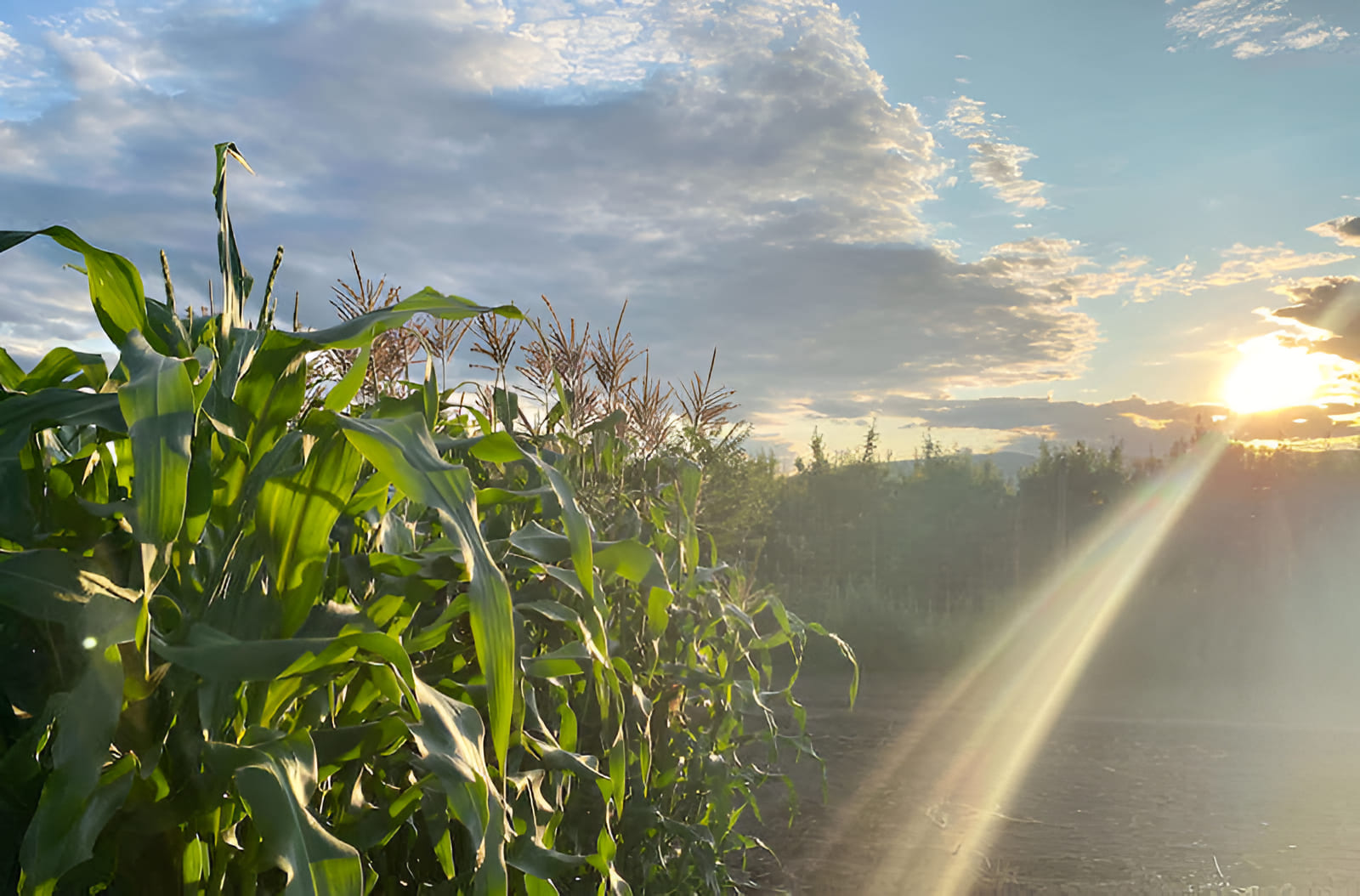
A new corn cultivation technique developed by Crop Circle Farms improves crop quality, production, and time to harvest. Instead of long straight rows, we plant corn in spiraled crop circles that follow the natural arc of the sun and maximize light penetration into the canopy. For open-field, short season production, a double row of corn is grown in a large, acre-scale spiral, irrigated from the center by a mast-mounted water gun. For urban agriculture, half-acre double spirals offer high-yield corn production on a small footprint that fits campuses, parks, and community farms.
These “corn circles” are part of our broader sustainable agriculture toolkit – using geometry, ground covers, and water-smart irrigation to grow more food with fewer inputs and less environmental impact.
No-till agriculture is a core principle behind Crop Circle corn systems. Instead of repeatedly plowing and disking the field, we plant directly into minimally disturbed soil, often over a terminated cover crop or permanent ground cover. Seed is placed into a narrow slit or band, leaving the rest of the soil protected by residue and mulch.
There are several advantages to no-till corn farming, especially when combined with crop circles:
When combined with Crop Circle ground covers and precise irrigation, no-till corn systems become a robust, low-impact production method suited to smallholder farms, urban farms, and commercial-scale plantings alike.
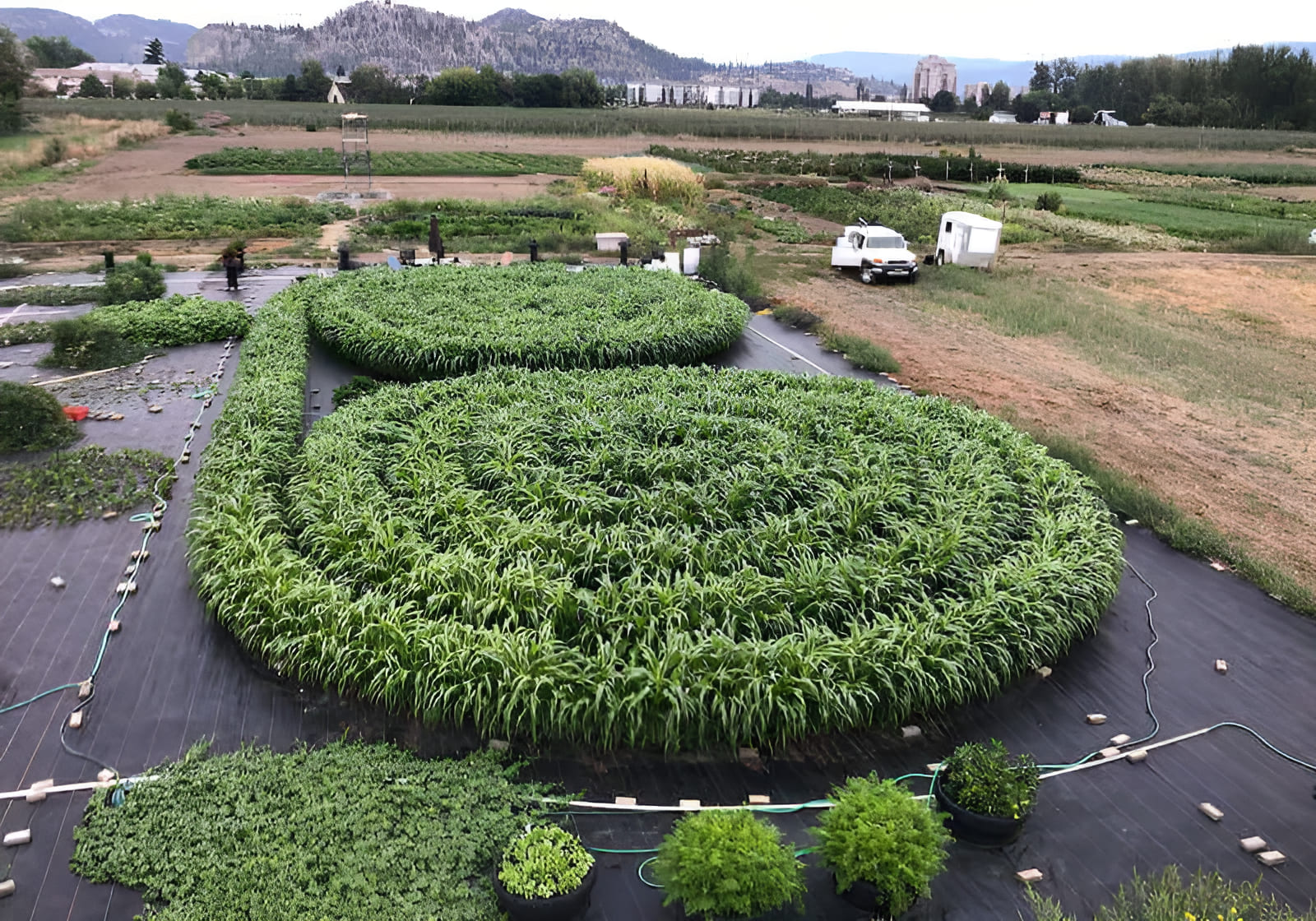
Crop Circle corn ground covers are essential for weed prevention, water savings, and soil protection. Once the land area is lightly tilled or prepared, amended, and leveled, a durable ground cover – typically a woven fabric or biodegradable film – is rolled out over the soil and pinned in place to prevent wind lift. This instantly blocks light, suppressing weed germination across the entire corn acre.
A single spiraled ribbon is cut through the ground cover, exposing a 6-inch-wide spiral of soil. The exposed planting band is seeded along its full length with approximately 15,000 corn seeds. Crop Circle Farms field testing and production modeling indicate that, under favorable growing conditions and good management, this configuration can produce approximately 40,000 cobs from a Crop Circle Corn Acre. Because only the spiral planting band remains exposed, irrigation and fertility can be concentrated directly within the active root zone rather than being applied across unplanted row middles and weed-producing areas.
For a double spiral, the ground cover is laid out over a rectangular half acre. Two spiraled ribbons are cut, exposing a co-joined double spiral of soil, each 6 inches wide. The soil is seeded along the length of both ribbons with approximately 6,000 seeds, with modeled production of up to 15,000 cobs from a Crop Circle Corn Half Acre under favorable growing conditions and good management. This configuration is designed for urban agriculture plots, school farms, and demonstration sites where high production per square foot is a priority.
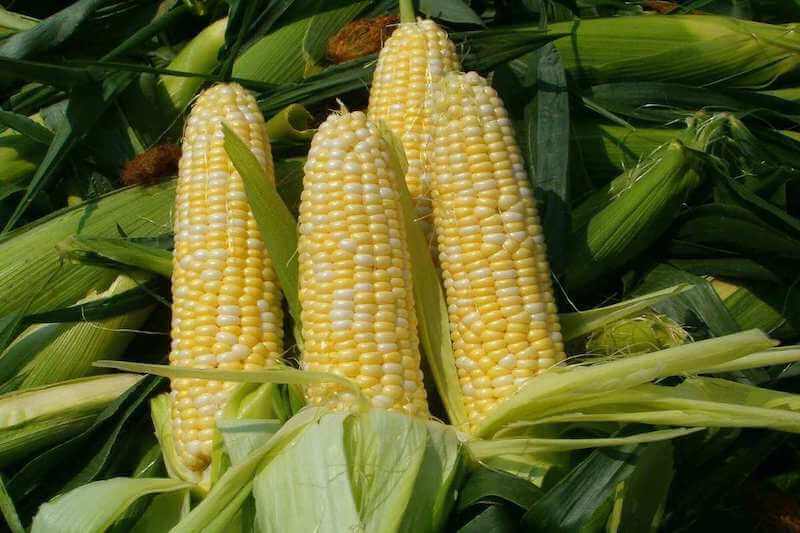
Spiraling corn creates a living vertical wall that’s perfect for companion planting. Pole beans – a classic partner for corn – can be planted along the spiral, climbing the stalks and using the corn as a natural trellis. Planting a bean seed with every second corn seed creates a bumper crop of climbing beans that adds both income and protein to the same footprint.
In Crop Circle designs, a Fibonacci-inspired spiral can provide an effective configuration for growing corn because each loop expands as it moves outward from the center. The increasing spacing between outer loops can improve light penetration and provide additional growing space for companion crops.
This creates a modern version of the ancient “Three Sisters” planting system, developed by Indigenous peoples of North and Central America – corn, beans, and squash working together in a mutually supportive polyculture.
The Three Sisters method is an agricultural technique used by many Indigenous cultures. It involves planting corn, beans, and squash together so that each crop supports the others:
Traditionally, farmers began by forming a mound of soil, about a foot high, in a sunny spot. The mounds were spaced several feet apart to give squash room to sprawl. Corn was planted in the center of the mound and, as it grew, provided a strong pole for climbing beans. The beans, in turn, form nitrogen-fixing root nodules through their association with soil bacteria. This contributes nitrogen to the overall cropping system, particularly as bean roots and plant residues decompose.
Squash was planted around the base of the mound. Its broad leaves shaded the soil, keeping it cool and moist, while the prickly vines discouraged animals from raiding the planting. Together, the three crops created a balanced, self-mulching ecosystem that recycled nutrients, reduced weeds, and provided a diversified harvest of grain, protein, and storage crops.
Crop Circle corn spirals update this ancient wisdom with modern design – combining companion planting, no-till ground covers, and water-smart irrigation into a single system. The result is sweeter corn, healthier soil, more biodiversity, and a highly productive model that fits everything from backyard micro-farms to large-scale sustainable agriculture projects.
Crop Circle Farms designs resource-efficient agricultural systems tailored to site conditions, crops, water availability, production goals, and market needs. Services can include farm layout, irrigation planning, crop selection, production modeling, soil and fertility strategy, and integration of Crop Circle growing systems.
Contact Us to discuss a farm design for your property.
Through nonprofit and community partnerships, Crop Circle farming systems can support sustainable food production, smallholder agriculture, food security, education, and climate-resilience projects in communities around the world. Project scale and outcomes depend on crops, climate, infrastructure, water availability, management, and local conditions. Contact Growing To Give to explore smallholder farm clusters, school farm hubs, and community Crop Circle projects.
For backyard and market gardens, aim for 8–10 inch in-row spacing with 30–36 inch rows, which is roughly 14,000–18,000 plants per acre equivalent. Plant in blocks at least four rows wide to ensure good pollination and ear fill.
Corn’s peak water demand occurs from tasseling through milk stage. Maintain consistent soil moisture using drip lines or tape and avoid drought stress at silking, which can cause poor kernel set. Mulch and groundcovers help reduce evaporation and stabilize soil temperatures.
Start with balanced pre-plant nutrients and plenty of organic matter, then focus nitrogen during rapid growth (V6–tassel) using split applications or fertigation. Monitor EC and pH for your water and soil, and avoid excessive nitrogen which can cause lodging, lush but weak growth, and delayed maturity.
Plant corn in square or rectangular blocks instead of single long rows to increase pollen contact with silks. Keep soil moisture steady during silking, and avoid mixing different sweetness types (su, se, sh2) in the same block so flavor, maturity, and kernel texture remain consistent.
Use an integrated pest management (IPM) approach: scout regularly, track local moth flights where possible, target silk protection windows, and use physical barriers or oil applications on small plantings. Encourage beneficial insects, rotate plantings, and only use selective controls when economic thresholds are reached.
Sweet corn is ready at the milk stage: silks are brown and dry, kernels are plump, and a pierced kernel exudes milky juice. For best flavor and sweetness, pick in the cool of the morning and chill promptly to slow the natural sugar-to-starch conversion.