Rooftop Agriculture
High In The Sky Farms & Gardens
Key links: Crop-Smart Irrigation • Root Tube Gardens • Climate Stress Resilience Calculator • Food Security Calculator. • Vertical Produce Delivery System
Rooftop agriculture transforms unused building roofs into productive food-growing spaces within cities. Using lightweight planters, modular farm panels, and water-efficient irrigation systems, crops can be grown safely and productively above homes, schools, hospitals, and commercial buildings.
Rooftop farms can deliver premium, ultra-local produce while reducing resource use—when structural loads, wind exposure, waterproofing, and irrigation are engineered correctly. The snapshot below highlights the performance outcomes we design for.
Unlike ground-level urban farms, rooftop agriculture must account for structural load limits, wind exposure, drainage, and access. When properly designed, rooftop growing systems can produce meaningful quantities of fresh vegetables, herbs, and fruits while reducing building heat, managing stormwater, and shortening the distance food travels from farm to table.
This page explores how rooftop agriculture works, the benefits it offers cities and building owners, and the systems used to create high-yield, wind-safe rooftop farms and gardens.
Urban residents increasingly want to know where their food comes from, how it was grown, and who grew it. They want food that is fresh, nutrient-dense, and grown close to home. They are often willing to pay a little more for the confidence that their food supports local jobs, strengthens the neighborhood economy, and protects precious resources like soil and water.
In many cities around the world, it is no longer just about quality – it is about reliable availability. Local farmland was paved over decades ago, and many cities now rely on long-distance imports for almost everything they eat. A disruption in trucking, shipping, or fuel prices can ripple through the entire food supply.
Growing food on the roofs of buildings is one of the fastest ways to bring food production back inside the city limits. Rooftop agriculture can:
There is a huge, largely untapped food-growing opportunity high above everyone’s heads. With most accessible ground-level land already developed, the next frontier is the roofscape – the enormous area of flat and lightly sloped roofs that blanket modern cities.
Crop Circle Farms proposes a transformative approach to rooftop agriculture: colonizing city roofscapes with high-in-the-sky farms and gardens to create a building-by-building supply chain of nutritious, fresh produce for cities around the world.
Patented and trademarked in more than 40 countries, rooftop Crop Circle Farms® are productive food-propagation systems that can be installed on suitable rooftops, school buildings, hospitals, commercial centers, and mixed-use developments. They integrate Crop Circle layouts, water-smart irrigation, and modular farm panels to unlock the full productive capacity of a roof without overloading the structure.
| Factor | Ground-Level Urban Farm | Rooftop Agriculture |
|---|---|---|
| Land cost | Often high | Uses existing roof area |
| Wind exposure | Moderate | High (requires design) |
| Structural review | Rarely needed | Required (load + waterproofing) |
| Stormwater impact | Limited | Can reduce runoff |
| Heat island mitigation | Moderate | High (roof cooling effect) |
| Visibility + engagement | Local | High (amenity + brand value) |
For resilient planning, pair rooftop design with Crop-Smart Irrigation and evaluate risk scenarios using the Climate Stress Resilience Calculator.

Farming on rooftops began in Europe more than half a century ago and has since spread worldwide as new roof-adaptable plant-growing systems and technologies emerged. In the 1950s, early adopters referred to the concept as “farm above the attic,” when simple roof access decks were partly used for gardens and container-grown vegetables.
A rooftop garden, sometimes called a green roof or rooftop farm, is an elevated garden constructed on the roof of a building. It is a form of urban agriculture that involves growing vegetables, herbs, flowers, fruits, and pollinator plants directly on the roof rather than in a ground-level garden.
Rooftop gardens are installed for multiple reasons. They add highly valued green space, soften hard city skylines, and reconnect people with nature. They also improve building performance by adding insulation and reducing heat absorption, which helps mitigate the urban heat island effect. These green roofs support biodiversity by creating habitat for birds, insects, and beneficial pollinators.
Perhaps most importantly, rooftop gardens provide fresh, locally grown produce, making them a practical, visible example of sustainable, climate-resilient food production in cities.
Because most roofs have no soil, growing media must be brought up. Small quantities can travel by elevator, while larger volumes are lifted by crane on pallets or in bulk bags. Older roofs usually cannot support much additional live load beyond snow and rain, so strategically placed containers are the safest option. These are often located above structural beams or near load-bearing walls.
In tropical climates, soil weight must not exceed typical rainwater load by more than about 10%, and wind exposure becomes a key design factor. Containers can be spaced adjacent to perimeter parapet walls or tied into railings to reduce wind risk. A wide range of garden containers can be used for rooftop agriculture:
Newer buildings are often engineered to support the additional live load of a low-bed rooftop farm. In these cases, most of the roof can be covered with a soil profile 8–12 inches deep, supported by a liner and drainage mat that protect the waterproof membrane. A framed perimeter holds the soil, while integrated piping drains excess water.
Up high in the sky, there are virtually no deer or rabbits to raid the beds, and many weed seeds never make it to the roof. The result is a clean, productive growing environment where beds can be tilled, amended, and fertilized each season for continuous cropping.
Raised beds are garden beds built above grade using boards, metal, stone, or composite materials. For rooftop agriculture, the choice of material and size must consider weight, durability, and build complexity:
Much like solar arrays built from modular solar panels, rooftop farm panels are designed to interlock and share a common irrigation supply. Any rectangular array can be constructed, ideally placed over supporting roof beams and load-bearing walls.
Each farm panel can arrive soil-complete, pre-fertilized, and pre-planted or seeded. Legs elevate the panel above the roof membrane, allowing air circulation beneath to protect the roof and stimulate root growth. Specialized round panels are used together with Crop Circle irrigators to create Crop Circle Farms that grow vining fruits and vegetables in spirals across the roofscape.
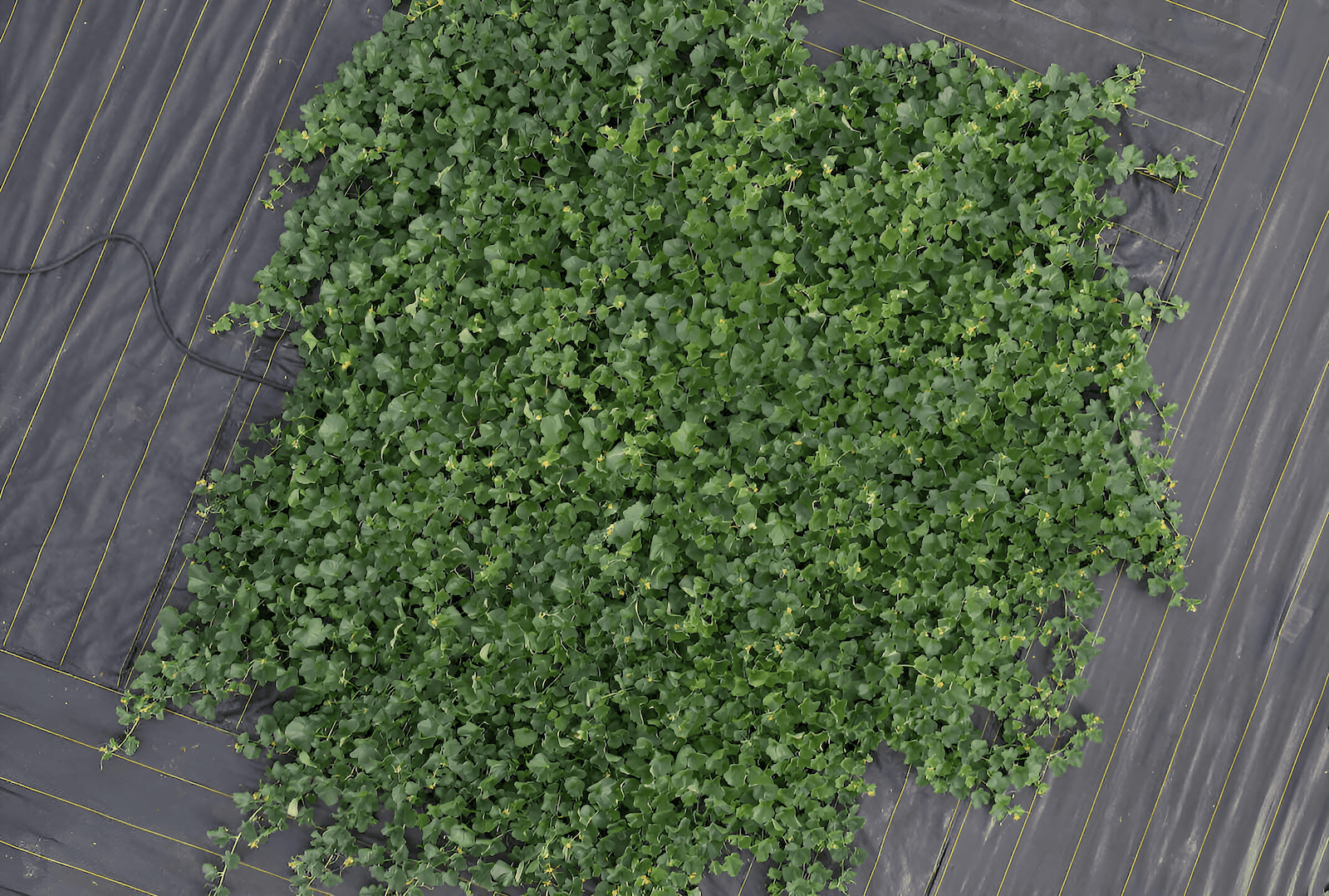
Crop Circle Farms® were specifically engineered for rooftops. Their lightweight, modular, small-footprint design makes them ideal for both new and existing roofs that meet structural requirements. A dedicated dumbwaiter or service elevator can connect the rooftop to the parking lot or lobby, creating a “rooftop-to-market” pathway for fresh produce.
A rooftop Crop Circle Farm is perfect for vining crops such as pumpkin, cucumber, watermelon, cantaloupe, squash, and honeydew. Vines can be trained to spread across the panels, distributing crop weight evenly over the roof surface while staying protected from wind by parapet walls and windbreaks.
Rooftop farms use rooftop agriculture systems to “pollinate” high-in-the-sky city roofscapes with productive, climate-smart agriculture. Building by building, they create a decentralized, resilient supply chain of nutritious, fresh produce for millions of people living in cities around the world.
Ready to transform your rooftop into a high-yield, sustainable farm? Let Crop Circle Farms design and build a custom, low-impact, and water-efficient farm tailored to your site and market. From yield modeling and farm layout to irrigation design and crop selection, we help you double your income and cut your costs in half. Contact Us to explore a Crop Circle Farm design for your property.
Help us expand our mission to revolutionize agriculture globally. We are seeking partners to implement Crop Circle Farms in food-insecure communities, island nations, and water-stressed regions. Together, we can build scalable food production systems that save water, reduce costs, and feed thousands of people year after year. Contact Growing To Give to support an initiative or program.
Have questions about rooftop agriculture and green roof farms with Crop Circle Farms? These answers cover structure, wind, irrigation, crops, permitting, and how to get a proposal for your building.
Every project starts with a structural look at load limits, roof membrane type, drainage paths, and access points. Our modular planters, farm panels, and media blends are sized so that saturated weights stay within allowable limits while still giving crops enough root volume to be productive. Where needed, we coordinate with your engineer or facilities team.
Rooftops can be windy, so we design for it. We use wind baffles, tie-downs, perimeter ballast, and crop selection that matches your rooftop microclimate. Irrigation lines are secured and protected from UV, and optional shade sails or wind screens can reduce heat and wind stress on sensitive crops and people using the space.
Most sites use automated drip irrigation or low-pressure fertigation that delivers precise water and nutrients right to the root zone. These systems can achieve up to 90% water savings and as much as an 85% reduction in fertilizer use compared with traditional beds on the same footprint. Timers and sensors keep daily tasks simple for your team.
Leafy greens, herbs, peppers, cherry tomatoes, strawberries, vining cucurbits, and pollinator strips all do very well in rooftop Crop Circle farms. We select varietals based on sun and wind exposure, harvest cadence, and who you’re feeding—tenants, restaurants, school meal programs, or a neighborhood CSA.
Yes. We can supply drawings and specifications for HOA boards, city planning, and insurers, including structural assumptions, fire code clearances, egress paths, guardrail requirements, and safe access plans. Our goal is to make approvals as straightforward as possible for building owners and property managers.
The first step is to share your address, roof type, photos, approximate square footage, and intended uses via our contact page . We review your information and follow up with a preliminary scope, budget ranges, and timeline options for a custom rooftop agriculture design.