Pollinators
The Birds and the Bees
Pollinators are among the most important allies in both agriculture and natural ecosystems. Species such as native bees, honey bees, butterflies, moths, birds, flies, and beetles help flowering plants reproduce by transferring pollen from one bloom to another. This process supports the development of many of the fruits, vegetables, nuts, and seeds that form the foundation of global food production.
Without healthy pollinator populations, yields for many crops—including berries, tree fruits, vegetables, and oilseeds—can decline dramatically. Pollinators also sustain wild plant communities, which in turn provide habitat, soil stability, and biodiversity across landscapes.
Successful pollinator ecosystems depend on several key conditions: continuous flowering plants throughout the growing season, access to clean water, undisturbed nesting areas, and responsible pest management practices. Unfortunately, habitat loss, pesticide exposure, disease, and climate stress have caused many pollinator populations to decline worldwide.
This guide explores how pollination works, which crops depend most heavily on pollinators, and how farms and gardens can create pollinator-friendly landscapes through habitat plantings, nesting areas, and bee-safe integrated pest management strategies.
Pollination is the process by which pollen is transferred from the male parts of a flower (anthers) to the female parts (stigma), allowing fertilization to occur and seeds or fruit to develop. While some plants rely on wind or self-pollination, many crops depend on animals such as bees, birds, butterflies, and other insects to move pollen between flowers.
• Approximately one out of every three bites of food people eat depends on pollinators.
• Bees are the most efficient pollinators, but birds, bats, butterflies, beetles, and flies
also contribute to pollination in many ecosystems.
• Planting a diversity of flowering plants that bloom from early spring through late fall
helps provide continuous food sources that support pollinator populations year-round.
Feel free to share this pollinators infographic on your website or blog. Please include a link back to this page as the source.
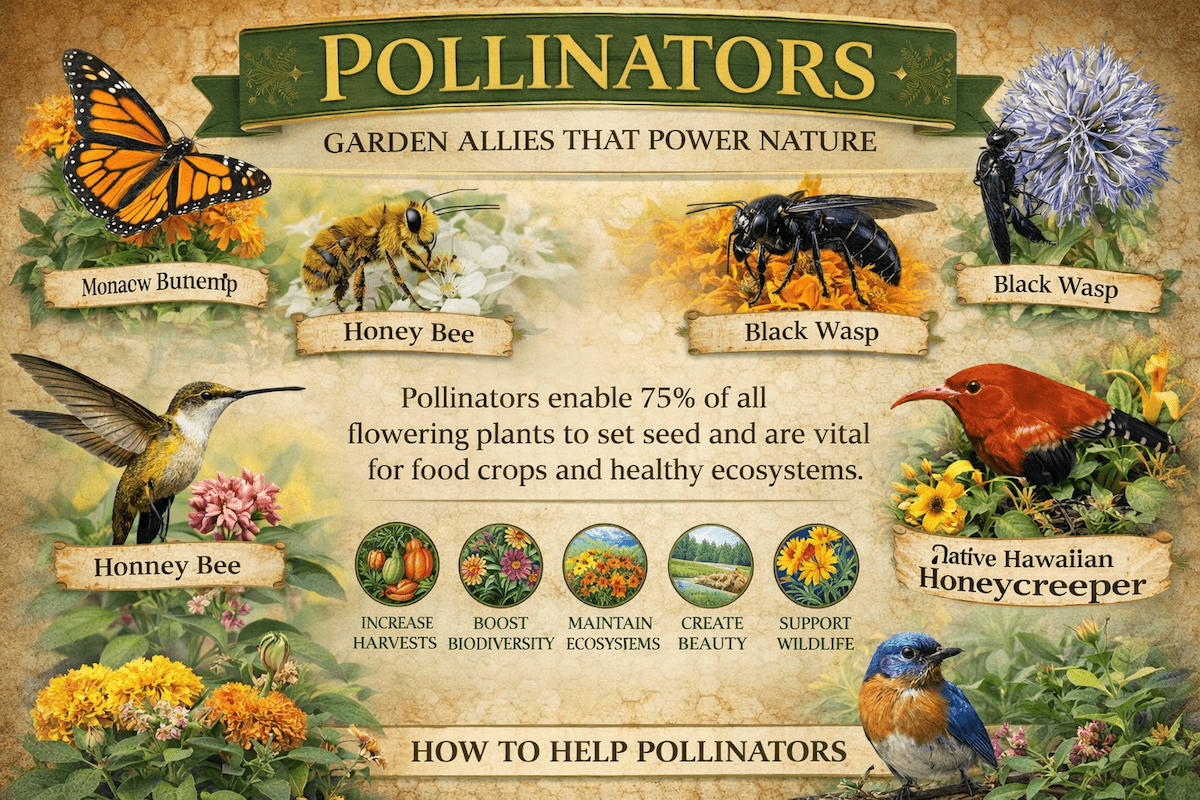
Pollinators are animals that transfer pollen from the male reproductive organs of a flower to the female reproductive organs, allowing fertilization to occur. This process leads to the formation of seeds and fruit, which are essential for the continuation of plant species and for the production of many crops that humans rely on for food. Healthy pollinator populations are also a key component of smart regenerative agriculture, where biodiversity, soil health, and ecosystem balance work together to support productive and resilient food systems.
Insects such as bees, butterflies, and moths are among the most important pollinators, but birds such as hummingbirds also play a significant role. Pollinators are attracted to flowers by their color, fragrance, and nectar, which they feed on while also transferring pollen from flower to flower. Garden systems that intentionally include flowering species and companion plants help create habitats that attract and support these important pollinators.
Pollination occurs in many ways, depending on the plant species and the pollinator involved. For example, bees are efficient pollinators of many fruit trees, including apple, cherry, and peach trees. These trees depend on bees to transfer pollen between their flowers, ensuring that fruit develops and yields remain high in orchards and gardens.
Butterflies and moths are important pollinators for many wildflowers and garden plants, such as milkweed, lavender, and coneflowers. They are attracted to the bright colors and fragrances of these plants and play a critical role in their reproduction. In diversified growing systems such as small-scale gardens or modular growing systems like Farm-in-a-Box, planting a variety of flowering crops helps sustain pollinator activity throughout the growing season.
Hummingbirds are important pollinators for many species of flowering plants, including trumpet vine, salvia, and bee balm. Their long, narrow beaks are adapted for feeding on nectar deep inside the flowers, and their movements between flowers help transfer pollen. By supporting birds, insects, and beneficial wildlife, farmers and gardeners help maintain the natural ecological relationships that allow plants to reproduce and thrive.
Planting flowers that attract pollinators is one of the most effective ways to support healthy gardens, farms, and ecosystems. Pollinators such as bees, butterflies, hummingbirds, moths, and beneficial insects rely on flowering plants for nectar and pollen. In return, these pollinators help fertilize crops and wild plants, enabling them to produce seeds and fruit that sustain both wildlife and human food systems.
A well-designed pollinator garden begins with selecting a diverse mix of flowering plants. Gardeners interested in growing flowers can create thriving habitats by choosing varieties that bloom at different times throughout the growing season. This ensures pollinators have access to nectar and pollen from early spring through late autumn.
Many pollinator gardens include classic flowering plants such as sunflowers, which provide abundant pollen and nectar for bees while also producing seeds that feed birds and wildlife. Cover crops like crimson clover are also excellent for pollinators, offering rich nectar sources while simultaneously improving soil health and supporting regenerative garden systems.
Pollinator gardens are also connected to broader agricultural concepts such as circular agriculture, where plants, soil biology, insects, and wildlife work together to create balanced and resilient ecosystems. Even planting timing strategies such as cosmic planting can influence flowering cycles and pollinator activity by aligning planting schedules with natural seasonal rhythms.
Many flowering plants are excellent for attracting pollinators. Some of the most beneficial flowers for pollinator-friendly gardens include:
Different pollinators are attracted to different flower shapes, colors, and nectar sources. Choosing a variety of plants helps support a wide range of pollinator species.
By growing flowers that attract pollinators, gardeners and farmers help support biodiversity while improving crop production. Pollinator-friendly landscapes produce healthier plants, higher yields, and vibrant ecosystems filled with beneficial wildlife.
Use these tools to estimate production, spacing, and harvest efficiency for gardens and small growing systems.
Estimate harvest potential per crop, container, raised bed, or planting unit. This tool helps gardeners and farmers forecast production, adjust plant spacing, and understand how planting density influences total yield.
Plan garden rows, plant spacing, and total harvest for beds, containers, or small growing areas. This tool helps gardeners estimate crop production and design efficient planting layouts.
Tip: Proper pruning and mildew-resistant varieties can improve fruit quality and usable yield.
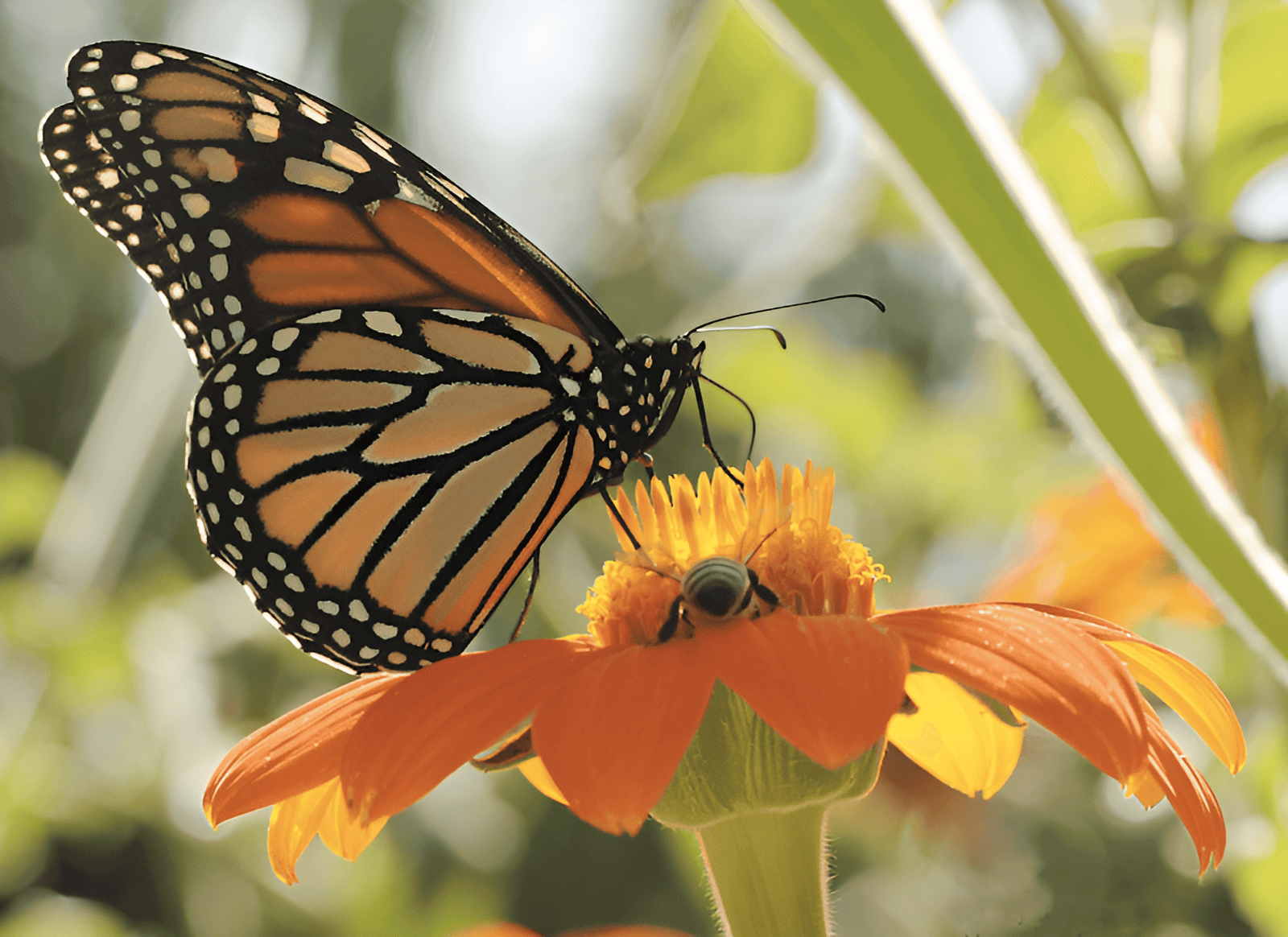
Many fruits, vegetables, and nuts depend entirely on pollinators to produce fruit. For example, almonds, apples, avocados, blueberries, cherries, cranberries, peaches, pears, plums, and strawberries are all dependent on bees for pollination.
Many vegetables also require pollinators, including cucumbers, melons, squash, and tomatoes. Without pollinators, these plants would not produce fruit and would fail to provide the food that humans rely on for sustenance.
Pollinators are essential for the maintenance of healthy ecosystems and the promotion of biodiversity. They play a critical role in the reproduction of many plant species, including those that are not used for food, and are therefore essential for the survival of many animal species that rely on these plants for habitat and food.
Pollinators also play a critical role in the production of crops that are used for biofuels and other industrial purposes, making them an essential component of the global economy.
The critical importance of pollinators for agriculture cannot be overstated. Without pollinators, many plant species, including those that provide essential food sources for humans, would not be able to reproduce, leading to widespread food shortages and environmental degradation. It is therefore essential that we take steps to protect and conserve pollinator populations and their habitats, to ensure the continued health of ecosystems and the sustainability of human food systems.
Industrial agriculture is heavily reliant on the pollination services provided by bees and other pollinators because of declining bee populations in nature. Without bees, the production of many crops would be severely impacted, leading to food shortages and economic losses. This is where the commercial pollinating industry comes in, providing industrial pollinators to farmers who need to ensure the successful pollination of their crops.
Farmers across the globe rely on bees to pollinate their crops, but many factors have led to a decline in the number of bees and other pollinators. Pesticides, habitat loss, disease, and climate change have all contributed to this decline, making it increasingly difficult for farmers to rely on natural pollination services. This is where industrial pollinators come in, providing a reliable and efficient method of pollination that farmers can depend on.
Mobile bee pollination operations are a key component of the commercial pollinating industry, providing bees and other pollinators to farmers who need them. These operations typically involve the transport and “renting” of hives containing bees to farms where they are needed for pollination. The bees are then released into the fields, where they will begin to pollinate the crops.
Mobile bee pollination operations are particularly important for crops that are heavily reliant on pollination services, such as almonds, apples, cherries, and blueberries. In the case of almonds, for example, each acre of almond orchard requires a minimum of two hives of bees to ensure successful pollination.
Mobile bee pollination operations are typically carried out by professional beekeepers who specialize in providing pollination services to farmers. These beekeepers will have a fleet of trucks and trailers equipped to transport hives of bees safely and efficiently. Billions of bees are transported across the country spring and fall.
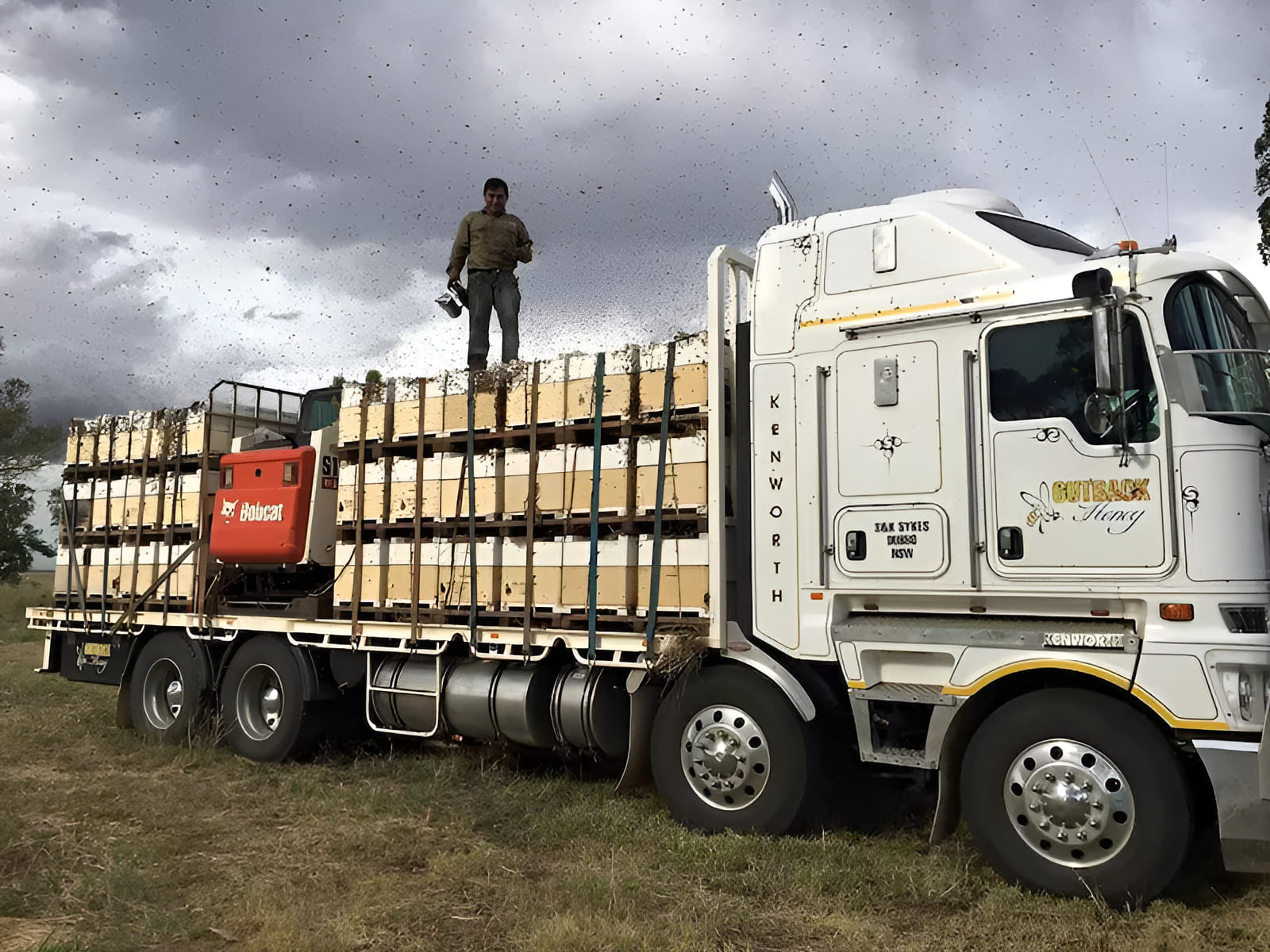
Industrial pollinators are used to pollinate a wide variety of crops, including fruits, vegetables, nuts, and seeds.
Many of these crops are grown in regions where there are not enough natural pollinators to ensure successful pollination. For example, almond orchards in California are heavily reliant on industrial pollination services due to a lack of natural pollinators in the region.
The commercial pollinating industry plays a critical role in ensuring the success of agriculture by providing industrial pollinators to farmers who need them. Mobile bee pollination operations are a key component of this industry, providing a reliable and efficient method of pollination that farmers can depend on.
Turn your 1 acre into a high-yield, profitable farm.
Crop Circle Farms specializes in designing and building fully engineered, low-impact farm systems that use 90% less water, 85% less fertilizer, and deliver two to three times the yield of traditional farming.
Whether you have a vacant lot, an empty field, a resort, school, island community, or small family farm, we’ll build it from the ground up for you. Our team handles everything from farm layout and installation to irrigation, root systems, training, and first planting.
Contact Us to explore a custom Crop Circle Farm design for your property.
Help us expand our mission to revolutionize agriculture globally. We are seeking partners to implement Crop Circle Farms to feed people in need. Together, we can build scalable food production systems that save water, reduce costs, and feed thousands of people. Contact Growing To Give
Pollinators are animals that transfer pollen between flowers, helping flowering plants complete fertilization and produce seeds or fruit. Important pollinators include native bees, honey bees, butterflies, moths, hummingbirds, flies and beetles.
Pollinators support the production of many fruits, vegetables, nuts and seeds by helping flowers develop into harvestable crops. Healthy pollinator populations can therefore contribute to crop production while also supporting biodiversity and wild plant communities.
Pollination occurs when pollen moves from the male reproductive part of a flower to the female reproductive part. Animals such as bees, butterflies, moths and hummingbirds can move pollen as they travel between flowers while feeding on nectar or pollen.
Pollinator-friendly plants include lavender, sunflowers, bee balm, coneflowers, milkweed, salvia, zinnias and cosmos. Planting a mixture of flowering species can help provide nectar and pollen for different pollinators throughout the growing season.
A pollinator-friendly garden can include clusters of flowering plants, native species where appropriate, shallow water sources, flowering herbs and vegetables, and some plants that are allowed to flower naturally. Providing flowers across the growing season gives pollinators a more continuous source of nectar and pollen.
Bees commonly visit blue, purple and yellow flowers, while butterflies are attracted to many brightly colored blooms. Hummingbirds often visit tubular red or orange flowers, and moths may visit pale or white flowers that open or remain fragrant at night.
Crops that benefit substantially from animal pollination include apples, almonds, cherries, blueberries, cranberries, cucumbers, melons and squash. The amount of pollinator dependence varies by crop and, in some cases, by variety.
Many tomato varieties are self-fertile, so they do not depend on bees in the same way as crops such as almonds or squash. Bee activity can still improve pollination and fruit set in some growing conditions, particularly because bumblebees and other species can buzz-pollinate tomato flowers.
Commercial bee pollination is the practice of providing managed bee colonies to farms during crop flowering. Professional beekeepers may transport hives to orchards and fields so growers have additional pollinator activity when crops require it.
Farms and gardens can support pollinators by maintaining flowering plants through as much of the growing season as possible, providing water and suitable habitat, preserving nesting areas where practical, and using responsible pest-management practices that reduce unnecessary exposure of beneficial insects to pesticides.