Urban Agriculture
Growing More Food in Cities
Explore related Crop Circle Farms guides and planning tools covering rooftop food production, sustainable agriculture, local food systems, and community food-security impact.
Explore rooftop gardens and farms, including structural planning, growing systems, irrigation, drainage, crop selection, and productive use of urban roof space.
Learn how soil health, efficient water use, biodiversity, nutrient management, and resilient growing practices can support more sustainable food-production systems.
Explore how local food production connects farms, restaurants, markets, institutions, and communities while shortening the distance between growers and consumers.
Model food production, servings, people reached, and potential community impact for urban farms, gardens, and food-access initiatives.
Together, these resources connect urban food production with sustainable farming, local food systems, rooftop growing, and measurable food-security impact.
Key links: Crop-Smart Irrigation • Sustainable Agriculture • Rooftop Agriculture • Circular Agriculture • Root Tube Gardens • Climate Stress Resilience Calculator • Food Security Calculator.
Urban agriculture can deliver reliable local food production at high efficiency when irrigation, fertility, and layout are engineered for constrained space. Below is a practical snapshot of the outcomes we design for in city farms, rooftops, and community food hubs.
Urban agriculture focuses on growing food efficiently within cities, suburbs, and densely populated areas. It includes backyard gardens, rooftop farms, community growing spaces, market gardens, and small commercial operations designed to produce fresh food close to where people live.
This page explores practical urban agriculture strategies — including space-efficient growing systems, water-smart irrigation, soil building, and yield planning — that help individuals, communities, and cities produce more food using fewer resources. Whether you are planning a home garden, a community project, or a small urban farm, the goal is the same: maximize food production per square foot while minimizing water, fertilizer, and labor inputs.
Throughout this guide, you’ll find examples of proven urban growing systems and tools that support smarter planning and long-term sustainability.
Urban agriculture refers to growing, processing, and distributing food within or around a city or town. Well-designed urban farms and community gardens can supply fresh, locally sourced produce, cut food miles, lower transportation costs, and strengthen citywide food security. At the same time, city farming faces real constraints that can limit productivity, profitability, and long-term sustainability.
Understanding these challenges is the first step to designing smarter, more efficient urban agriculture systems that make the most of small spaces and scarce resources.
Addressing these challenges requires collaboration between urban farmers, local governments, impact investors, and community organizations. Together they can create resilient local food systems that deliver fresh produce, green jobs, and climate-smart infrastructure to the neighborhoods that need them most.
With the right support, training, and adoption of small-space food production technologies, city farms can significantly supplement traditional rural agriculture and improve food security in dense urban areas. They are not meant to replace rural fields, but to create a diversified, resilient mix of production close to the people who eat the food.
Urban farming makes use of vacant or underutilized land that is not suitable for development, turning it into productive green space. When equipped with water-efficient drip irrigation, raised beds, and high-density Crop Circle layouts, urban farms can be twice as productive per square foot as conventional rural fields while conserving precious inputs like soil, fertilizer, and water. Growing food where people live also reduces transportation, packaging, and cooling costs.
Well-planned community gardens and rooftop farms increase access to fresh, healthy, locally grown produce and help reduce food deserts in low-income neighborhoods. They also create shaded, living landscapes that cool cities, soak up stormwater, and improve mental health and social connection.
According to United Nations estimates, more than half of the world’s population now lives in cities, and urban farms and gardens already produce a significant share of global vegetables and herbs. That contribution could double if just 5% of the world’s urban farms adopted Crop Circle Farming practices designed for high-yield, low-water urban agriculture.
| Factor | Conventional City Garden | Crop Circle Urban Farm |
|---|---|---|
| Layout | Linear rows | Space-efficient circular/spiral |
| Water delivery | Hand watering / overhead | Drip + smart irrigation |
| Yield per sq ft | Moderate | High |
| Soil health strategy | Often static | Soil-first regenerative |
| Impact reporting | Limited | Metrics-ready (food security, resilience) |
Use the Food Security Calculator to model people reached and the Climate Stress Resilience Calculator to plan adaptation.
There are challenges unique to urban agriculture that rarely appear in rural settings. Space and production efficiency are at the top of the list. Hydroponic agriculture, vertical farms, and indoor grow rooms can produce food in very small spaces, but they are capital-intensive to build and expensive to operate. Until economies of scale kick in, most hydroponic operations in cities focus on high-value crops such as microgreens, winter tomatoes, and culinary herbs marketed to restaurants and affluent neighborhoods.
Hydroponic systems are poorly suited to staple root crops like potatoes, carrots, and cassava, which are important everyday foods in many cities worldwide. With rising fertilizer prices, volatile energy costs, and ongoing supply-chain disruptions, many indoor farms are struggling to remain profitable. This opens the door for low-cost, resource-efficient, high-production systems like Crop Circle Farms , which use soil-based growing methods, smart irrigation, and spiral layouts to maximize yield in small city spaces.
Reducing “food miles” by growing produce locally lowers transit-related costs and the carbon emissions associated with transport, packaging, and long-distance cooling. However, when food is grown indoors under lights with heating and cooling powered by fossil fuels, those savings can quickly disappear.
Research from agricultural engineers such as Louis Albright at Cornell University shows that fully closed, artificially lit systems are energy intensive and, in many climates, difficult to power using solar or wind alone. For example, growing a pound of lettuce under lights can generate many pounds of carbon dioxide at the local power plant. By contrast, growing that lettuce outdoors in a Crop Circle Farm with drip irrigation and good soil management can cut emissions dramatically while improving soil health.
Other ways urban farms can reduce their carbon footprint include:
Sustainability experts increasingly agree that climate-resilient urban agriculture has the potential to reduce emissions, promote carbon sequestration, and demonstrate more sustainable ways of growing food in cities.
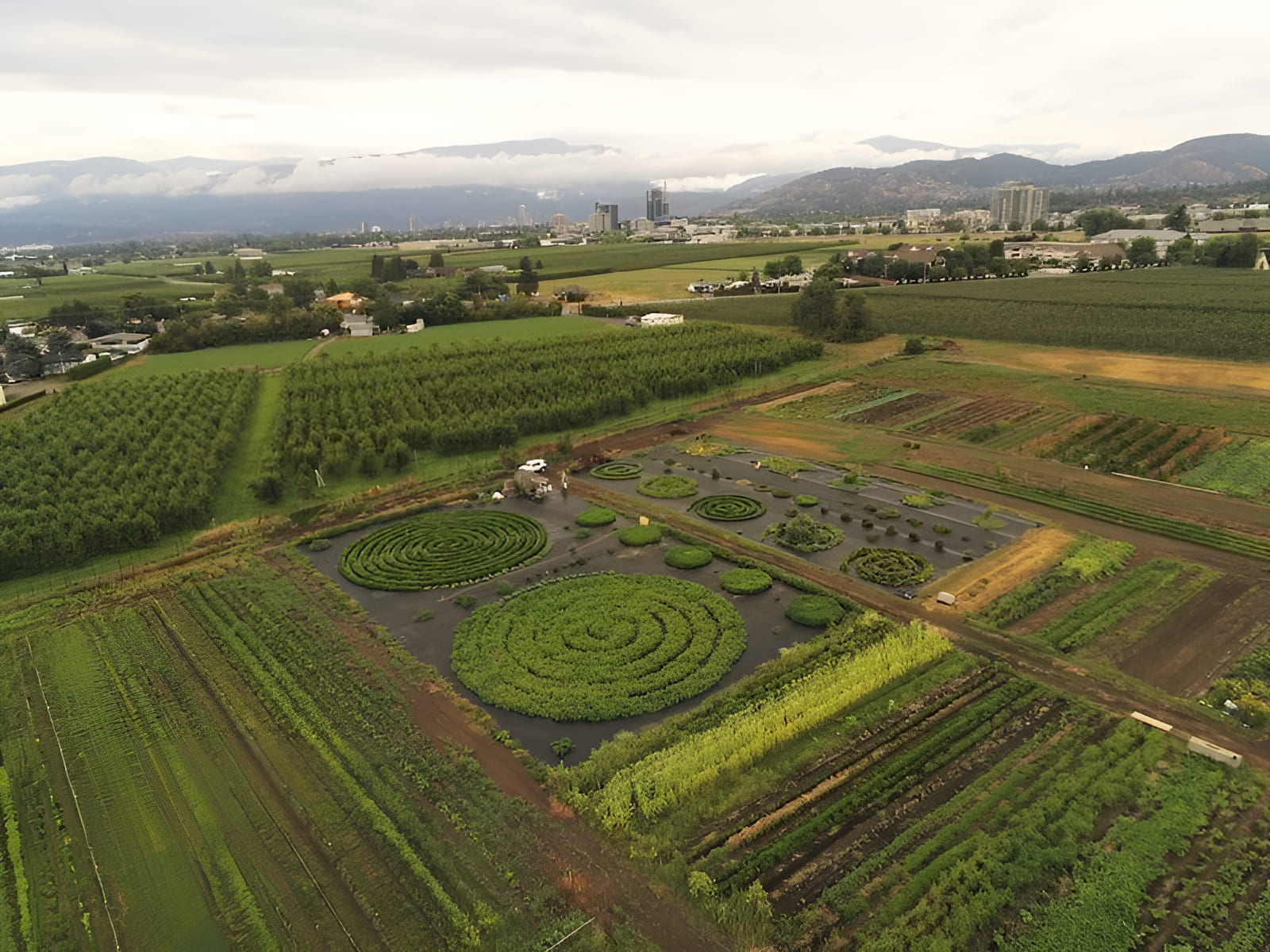
City land is a premium resource measured in square feet rather than acres. Small city spaces — rooftops, courtyards, schoolyards, and vacant lots — are not suitable for conventional open-field farming or tractor-based equipment. The high capital costs of hydroponic and vertical-farming operations are prohibitive for many community groups. The most practical way to grow produce at a profit in these spaces is to use Crop Circle Farming systems designed from the ground up for high-yield urban agriculture.
Today, roughly 75 percent of the world’s food comes from a small number of major crop species. In North America, huge monoculture fields produce these staples using large amounts of fuel, fertilizer, herbicides, and pesticides. While these systems generate high yields per worker, they are also among the largest sources of chemical pollution and greenhouse-gas emissions worldwide.
A Crop Circle Farm market garden offers a different model. By intensively planting diverse crops in spiral beds and using drip irrigation, mulching, and regenerative soil practices, these systems can:
Crop Circle Farms are soil-regenerative and biodiverse. They support beneficial insects, soil microbes, and pollinators while building long-term fertility instead of mining it.
Soil regenerative agriculture focuses on improving soil health and fertility while reducing negative environmental impacts. For urban farmers, these practices are a powerful way to increase yields and resilience in small spaces.
Overall, soil regenerative agriculture supports truly sustainable farming by promoting long-term soil health, reducing negative environmental impacts, and improving the productivity and profitability of Crop Circle Urban Farms. Urban agriculture could surpass the per-square-foot production of many rural operations and potentially double the share of global food grown in cities if just a small percentage of the world’s urban farms adopted Crop Circle technologies.
Ready to transform your land into a high-yield, sustainable urban farm? Let Crop Circle Farms design and build a custom, low-impact, and water-efficient farm tailored to your site and market. From yield modeling and farm layout to irrigation design and crop selection, we help you double your income and cut your costs in half. Contact Us to explore a Crop Circle Farm design for your property.
Help us expand our mission to revolutionize agriculture globally. We are seeking partners to implement Crop Circle Farms in food-insecure communities, island nations, and water-stressed regions. Together, we can build scalable food production systems that save water, reduce costs, and feed thousands of people year after year. Contact Growing To Give to support an initiative or program.
These frequently asked questions cover urban farming, rooftop gardens, small-space food production, irrigation, soil health, crop selection, community food systems, and planning an urban agriculture project.
Urban agriculture is the production of food within cities, towns, and densely populated communities. It can include backyard gardens, community gardens, school gardens, rooftop farms, container growing, market gardens, greenhouse production, and other forms of small-space food production.
Urban agriculture is generally intended to complement rural farming by producing fresh food closer to where people live while making productive use of available urban land and infrastructure.
Urban food production can use raised beds, containers, rooftop planters, community gardens, market gardens, greenhouses, hydroponic systems, vertical growing structures, and space-efficient soil-based growing systems.
Crop Circle Farms focuses on site-responsive designs that can combine circular or spiral growing layouts, managed soil, targeted irrigation, containers, and other techniques appropriate for the available space and project goals.
Yes, but paved and rooftop sites require additional planning. Rooftop projects should consider structural load capacity, wind, drainage, waterproofing, access, irrigation, growing-media weight, and local building requirements.
Parking lots and other paved spaces may use containers, raised growing systems, or modular installations where direct planting into the underlying ground is not practical.
Crop selection depends on climate, growing season, sunlight, available space, water, soil or growing media, and the purpose of the project. Leafy greens, herbs, tomatoes, peppers, beans, strawberries, cucumbers, and other frequently harvested crops can work well in many urban settings.
The best crop plan should also consider household use, school meals, food-bank distribution, farmers-market sales, restaurant demand, or other intended markets.
Urban farms can improve water efficiency with drip irrigation, targeted watering, mulching, soil-moisture monitoring, appropriate planting density, irrigation scheduling, and systems that deliver water close to plant root zones.
Actual water use varies by crop, climate, soil or growing media, irrigation design, water quality, planting density, and management.
Urban soil should be evaluated before food production begins, particularly on former industrial, commercial, roadside, or previously developed properties. Potential concerns can include heavy metals, petroleum residues, and other contaminants.
Depending on site conditions, growers may use soil testing, raised beds, imported clean soil or growing media, containers, physical barriers, or other approaches that reduce crop contact with unsuitable native soil.
Neither approach is best for every project. Hydroponic and controlled-environment systems can provide high production density and precise environmental control, but they may require significant equipment, energy, technical expertise, and capital.
Soil-based systems can be simpler and may integrate compost, biological soil management, outdoor growing, and a broader range of crops. The appropriate approach depends on the site, climate, crop mix, budget, operating capacity, and project objectives.
Maintenance depends on farm size, crop selection, irrigation, season, climate, pest pressure, and the level of automation. Common tasks include irrigation checks, planting, pruning, harvesting, weed management, pest scouting, soil or fertility management, cleaning, and crop rotation.
Thoughtful layouts and automated irrigation can reduce routine labor, but every productive farm still requires regular management.
Yes. Urban farms and community gardens can increase the local availability of fresh produce, particularly when food is distributed through schools, food banks, community organizations, neighborhood markets, or direct-to-consumer programs.
The scale of the impact depends on production, crop selection, distribution methods, participation, season length, and the size of the population being served.
Yes. Urban farms can potentially reuse leaves, plant residues, suitable food scraps, and other organic materials through managed composting systems. Finished compost can return organic matter and nutrients to appropriate growing areas.
These practices can form part of a broader circular agriculture strategy in which useful materials are recovered and reused rather than treated only as waste.
Start with available space, sunlight, water access, soil condition, drainage, climate, zoning, building requirements, crop selection, irrigation, labor, storage, site security, accessibility, and expected operating costs.
Commercial and community projects should also consider markets or distribution partners, food-safety requirements, funding, volunteer or workforce capacity, expected production, and how the farm will be managed over time.
Begin by gathering information about the site, including its address, approximate growing area, photographs, sunlight, water availability, existing surfaces or soils, and the goals of the project.
Contact Crop Circle Farms to discuss an urban agriculture feasibility assessment, growing-system design, irrigation strategy, crop plan, or broader project concept.