
The No-Till Farm
Building healthier soil and climate resilient farms
No-till agriculture is a powerful soil-building practice that helps farmers and gardeners grow healthier crops while protecting the long-term productivity of the land. Instead of plowing or turning the soil each season, no-till systems leave the soil structure intact and maintain a protective layer of crop residue or living cover on the surface.
This approach supports the natural biology of the soil, allowing beneficial microbes, fungi, and earthworms to thrive. As soil structure improves, water infiltration increases, erosion declines, and plant roots are able to grow deeper and stronger. Over time, these changes lead to healthier plants, improved yields, and farming systems that are more resilient to drought and extreme weather.
Today, no-till agriculture is widely recognized as a cornerstone of regenerative and sustainable farming. By protecting topsoil, improving soil fertility, and reducing the need for intensive mechanical disturbance, no-till practices help farmers produce food while restoring the health of the land for future generations.
No-till agriculture is a farming practice in which crops are planted directly into undisturbed soil without traditional plowing or tilling. Crop residues remain on the soil surface, protecting the soil from erosion, conserving moisture, improving soil structure, and supporting microbial life that contributes to long-term soil fertility.
No-till agriculture is one of the most important soil-building practices in modern regenerative farming. By minimizing soil disturbance and maintaining protective crop residue on the soil surface, no-till systems help farmers reduce erosion, improve soil structure, increase water infiltration, and support beneficial soil life. The infographic below highlights several of the key benefits that make no-till an essential strategy for sustainable agriculture and long-term soil health.
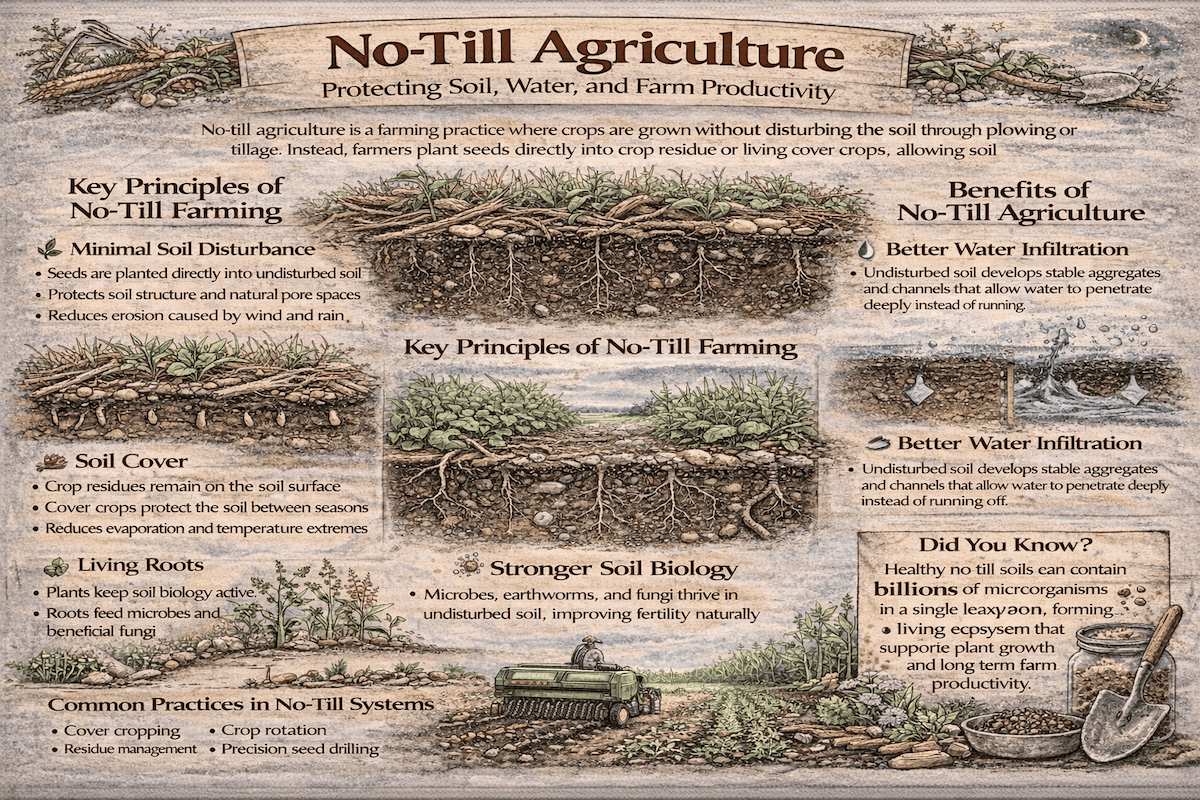
Feel free to share this infographic on your website, blog, or educational resource page. Simply copy the embed code below and include a link back to CropCircleFarms.com as the source.
| Factor | Conventional Tillage | No‑Till System |
|---|---|---|
| Soil disturbance | High | Low |
| Erosion risk | Higher (bare soil) | Lower (residue + cover) |
| Water infiltration | Variable | Improves over time |
| Weed strategy | Cultivation | Cover + mulch + timing |
| Fuel and passes | More field operations | Fewer passes |
Healthy soil is the foundation of productive and resilient farms, and one of the most important advantages of no-till agriculture is its ability to strengthen soil structure over time. Traditional plowing and intensive tillage break apart soil aggregates, expose organic matter to rapid decomposition, and leave the soil vulnerable to erosion from wind and rain. In contrast, no-till systems leave the soil largely undisturbed, allowing natural biological processes to rebuild soil structure and fertility.
Compared with many traditional agriculture systems, which often rely on repeated soil disturbance, regenerative farming approaches prioritize soil protection and long-term ecosystem health. The shift from conventional farming toward modern and regenerative agricultural models reflects a growing recognition that soil health is one of the most valuable assets on a farm.
As crop residues remain on the surface and roots decompose underground, organic matter accumulates and soil aggregates become more stable. These aggregates create pore spaces that allow water, air, and plant roots to move more freely through the soil profile. Over time, this improved structure leads to better nutrient cycling, stronger root development, and soils that are more capable of supporting healthy crop growth. These soil-building strategies are central to many sustainable agriculture systems focused on long-term land stewardship.
One of the most visible benefits of no-till agriculture is improved water management. When soil is repeatedly tilled, the surface can become compacted or crusted, causing rainfall to run off rather than soak into the ground. No-till systems help prevent this problem by maintaining surface residues and encouraging stable soil aggregates that allow water to infiltrate more efficiently.
Crop residues and mulch layers protect the soil from the direct impact of raindrops, which helps prevent surface sealing and erosion. At the same time, biological activity from earthworms, fungi, and microbes creates natural channels within the soil that further improve infiltration rates. These channels act like tiny drainage systems, allowing water to move deeper into the root zone where plants can access it during dry periods.
Many farms combine no-till practices with advanced irrigation technologies such as crop-smart irrigation systems and data-driven monitoring tools. These innovations help deliver water precisely where and when crops need it, reducing waste while improving plant health and overall farm efficiency.
No-till agriculture supports a thriving soil ecosystem. Beneath the surface of healthy soil exists a complex community of microorganisms, fungi, insects, and earthworms that work together to recycle nutrients and maintain soil fertility. When soil is frequently disturbed by plowing or cultivation, many of these organisms are disrupted or destroyed. By minimizing disturbance, no-till farming allows these biological communities to flourish.
Fungal networks, particularly mycorrhizal fungi, play an important role in transporting nutrients and water to plant roots. These networks form symbiotic relationships with crops and can extend far beyond the root zone, helping plants access nutrients that would otherwise remain unavailable. Maintaining these biological networks is a core principle of smart regenerative agriculture, where soil biology is treated as a living infrastructure that supports long-term productivity.
Healthy soils rich in biological activity are also essential for maintaining balanced nutrient cycles. As organic matter breaks down, nutrients become available to plants in forms they can readily absorb. Understanding and managing these processes is a key focus of modern soil fertility management strategies.
Many successful no-till systems rely on cover crops to maintain continuous soil protection and biological activity. Cover crops such as legumes, grasses, and brassicas are planted between main crop cycles to keep living roots in the soil year-round. These plants protect the soil surface, suppress weeds, and add organic matter as they decompose.
When cover crops are terminated and left on the soil surface, they form a natural mulch layer that helps regulate soil temperature and reduce moisture loss. This residue layer also slows erosion and creates a favorable environment for beneficial soil organisms. Over time, the combination of surface residue and living roots builds a more stable and productive soil ecosystem.
These practices are often integrated within broader farm management models such as circular agricultural systems, where nutrients, organic matter, and biological resources are continuously recycled to strengthen farm productivity and environmental resilience.
In addition to environmental benefits, no-till agriculture can also reduce operational costs on many farms. Conventional tillage often requires multiple tractor passes for plowing, disking, and seedbed preparation. Each pass consumes fuel, labor, and equipment wear. By reducing or eliminating these operations, no-till systems can lower fuel use and improve overall farm efficiency.
Modern farms are increasingly combining no-till practices with advanced digital tools such as precision farming technologies and predictive yield modeling. These systems analyze field data, weather patterns, and soil conditions to help farmers make better decisions about planting, irrigation, and crop management.
Many of these innovations fall within the broader field of smart agriculture technologies, which use data analytics, sensors, and automation to improve efficiency and sustainability across modern farming systems. When combined with no-till soil management, these technologies can help farmers create highly resilient agricultural systems that balance productivity with long-term environmental stewardship.
No-till agriculture offers a wide range of environmental, agronomic, and economic benefits. By minimizing soil disturbance and maintaining protective residue on the soil surface, farmers can improve soil structure, conserve water, and build long-term fertility while reducing operational costs. These advantages make no-till systems an important component of modern sustainable agriculture and regenerative farming strategies.
Together, these benefits make no-till agriculture a powerful approach for building resilient farming systems that protect soil resources while supporting productive harvests. When integrated with cover crops, improved soil fertility management, and data-driven farm planning tools such as predictive yield modeling, no-till practices can significantly improve both farm sustainability and long-term profitability.
No-till agriculture is a farming practice in which crops are planted directly into undisturbed soil without traditional plowing or intensive tillage. Crop residues remain on the soil surface to protect against erosion, conserve moisture, improve soil structure, and support beneficial microbial life.
No-till systems improve water infiltration by protecting the soil surface with crop residue, reducing crusting and runoff, and allowing biological activity to create stable pore spaces and channels that move water deeper into the root zone.
Many farms reduce fuel, labor, and equipment costs with no-till because fewer field passes are needed for plowing, disking, and seedbed preparation. Long-term efficiency often improves further when no-till is paired with cover crops, smart irrigation, and biology-focused soil fertility strategies.
No. No-till does not eliminate weeds entirely. Instead, weed control shifts toward cover crops, surface residue, timing, crop rotation, and targeted interventions rather than repeated soil disturbance.
Long-term no-till success depends on consistent residue cover, minimal traffic compaction, healthy soil biology, thoughtful fertility management, and irrigation practices that support deep rooting and stable soil structure.
Want to transition land into a low‑disturbance, water‑smart farm system? Contact Crop Circle Farms for design support—layout, rotations, irrigation, and soil biology strategy.