Growing Beans
Drill Don’t Till Agriculture
The United States leads the world in bean production, growing various types of beans on more than 2 million acres. Number one by far is the soybean, followed by navy beans, pinto beans, black beans, and a wide range of dry and snap beans. Much of this bean crop is grown in vast monocultures and half of it is shipped overseas as commodity bulk product rather than local, fresh food.
Nearly all commercial bean production in the United States is fully mechanized, with beans seeded, sprayed, and harvested by machine instead of by hand. Plant breeders are continually creating genetically modified or highly hybridized beans specifically designed for machine harvesting, transport, and processing. While mechanized agriculture is efficient at scale, it often comes at a cost: years of deep tillage, heavy tractor traffic, and continuous applications of synthetic fertilizer degrade the soil and can eventually create a biological “dead zone” where soil life is diminished and nothing thrives without constant chemical inputs.
When should I plant beans? Direct sow after frost danger passes when soil is at least 60°F (ideally warmer for fast emergence).
Do I need inoculant? The correct Rhizobium inoculant can boost nodulation and vigor—especially if beans haven’t been grown in that soil recently.
How deep and how far apart? Sow about 1 inch deep. Bush beans: 2–4 inches apart; pole beans: 4–6 inches apart plus a sturdy trellis.
How much water? Aim for steady moisture (often about 1 inch/week) with good drainage; avoid waterlogging and excess nitrogen.
Food safety risks also come into play. Frequent outbreaks of Listeria and other pathogens caused by bacteria present in the field or at the processing plant are now common headlines. Mechanical harvesters take the whole plant in a single pass—leaves, stems, pods, flowers, and sometimes roots. Herbicide and insecticide residues, insects, insect eggs, and any plant parts that may be infected are all swept into the harvest stream. In addition, more than 20% of the bean harvest is often lost to overripe or underripe pods that do not meet grade once sorted at the processing plant, further reducing the efficiency of conventional bean farming.
By contrast, smaller farms and market gardens focused on growing beans for fresh, local markets can flip the script. Instead of chasing volume with large tractors and pivot irrigation, they can adopt drill don’t till techniques, high-density planting, and ergonomic layouts that favor hand harvest, flavor, and quality. This is where Crop Circle Farms® technology and spiral field design shine.
Pivot irrigation, once hailed as one of the greatest innovations in modern agriculture, is now recognized as a major driver of aquifer depletion in many regions. Huge reserves of ancient groundwater—subterranean lakes formed millions of years ago—have been severely tapped. In some areas, aquifers have been pumped so low that the underground formations have collapsed and lost their ability to refill and store water effectively.
Despite this, agribusiness is slow to change. Conventional growers push to maintain yields, and aquifers continue to drain and collapse, threatening long-term food security and water security. Before pivot irrigation, beans were often irrigated by flooding trenches between raised rows—a method that wastes enormous amounts of water and leaches nutrients. After pivot irrigation, the future of water for agriculture is anyone’s guess—but it is clear that another innovation is needed. Growers and communities are increasingly seeking sustainable agriculture systems that use far less water, protect soil structure, and keep farms profitable.
Crop Circle Irrigation was developed to address precisely these challenges. Instead of broadcasting water over entire fields or flooding furrows, Crop Circle systems deliver water and nutrients directly to the plant root zone using proprietary irrigators. By cradling plant roots in a controlled, nutrient-rich environment, Crop Circle Farms can grow beans and other crops with as little as 10% of the water and 5% of the fertilizer required by conventional tractor-based farming.
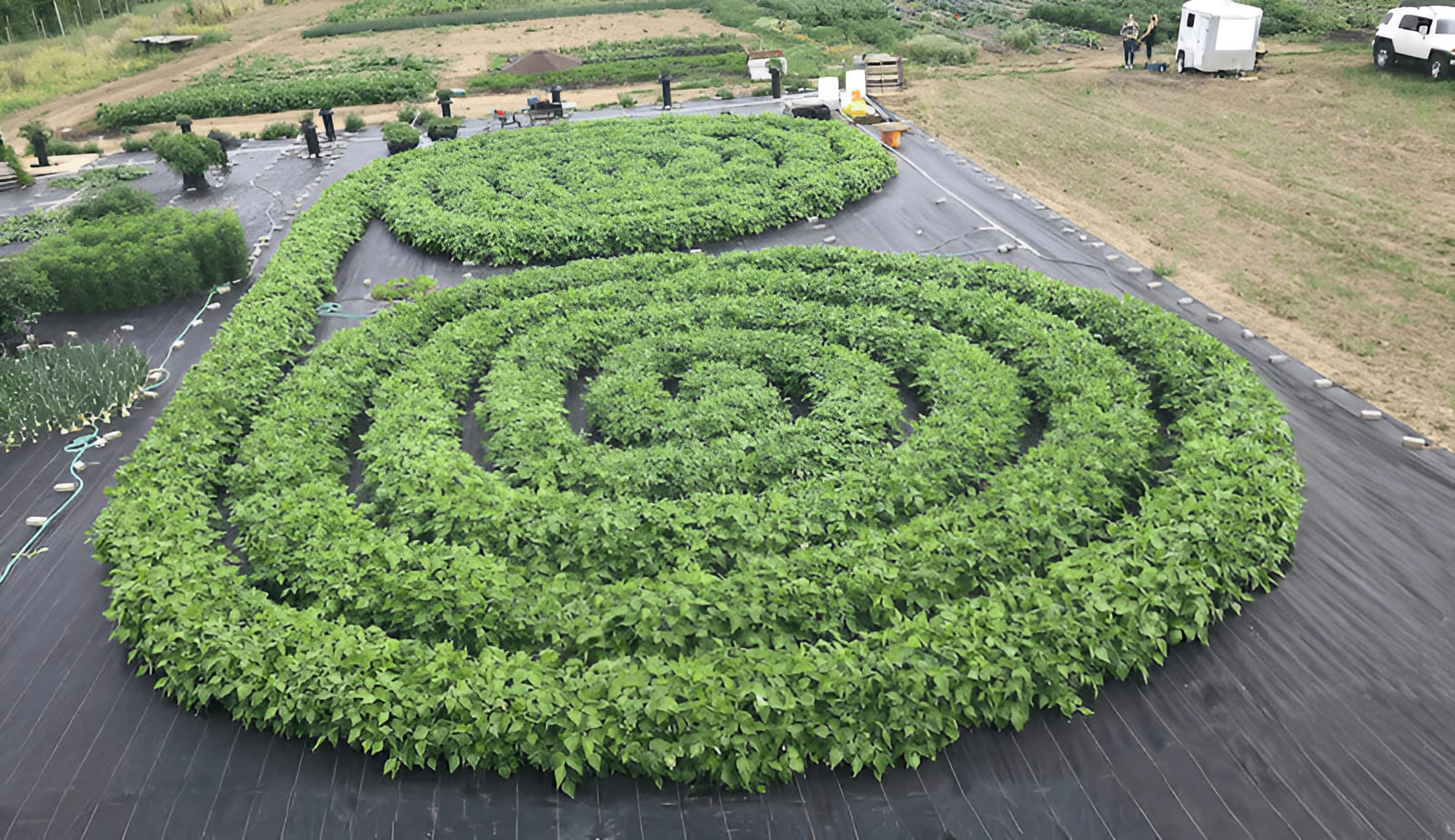
An innovative irrigation and layout system developed by Crop Circle Farms® makes it possible to conserve water, protect soil, and double bean production on small acreages compared to traditional straight-row systems. These spiral-based micro-farms are specifically designed for farmers with small landholdings in isolated rural communities or urban environments where land is scarce and expensive.
Crop Circle Farms are scalable from one-tenth of an acre up to an acre or more. Because tractors cannot easily navigate circular beds and tight spirals, the system is intentionally optimized for hand planting and hand harvest. That means less soil compaction, less dependence on heavy machinery, and more flexibility to grow high-value crops in places where conventional machinery simply cannot operate—rooftops, vacant lots, schoolyards, and urban food deserts.
One of the most important differences between a Crop Circle Bean Farm and a conventional bean field is the planting geometry. Instead of growing beans in parallel raised rows, beans are grown in geometric spirals. These spirals offer several advantages:
Along each spiral, proprietary Crop Circle irrigators are spaced at calculated intervals. Each irrigator delivers a proportionate amount of liquid nutrient solution to the bean roots, balancing growth and preventing waterlogging or drought stress. A permeable ground cover is used to suppress weeds, protect and build soil organic matter, and act as a “solar blanket” that warms the soil in cool weather.
To simplify harvest, a sectional conveyor or rollered gangway extends into the center of the spiral, creating a low-friction pathway to slide bean crates from the spiral out to a harvest truck or packing shed. The combination of circular design, low profile, and ground cover provides a degree of protection from strong, desiccating winds and sudden storms.
Crop Circle Farms employs a “drill don’t till” system of agriculture for growing beans. Rather than tilling the entire field with discs, plows, and cultivators, only the soil directly under the planting openings is worked. A specialized drill or auger excavates a small cavity in the soil, which is then filled with a custom, fertilized growing medium. Bean seeds are sown into this prepared pocket while the surrounding soil remains covered and undisturbed.
This approach mimics the benefits of no-till and minimum-till agriculture while still giving each plant a perfect micro-environment for root development. Drill don’t till agriculture can save up to 90% of the water and 95% of the fertilizer currently used by conventional tractor farming because inputs are concentrated where roots actually are—not broadcast across bare soil.
At the end of the growing cycle, plants are pulled or cut, and the planting cavities are refreshed with new fertilized medium. Growers then replant a different crop—bush beans followed by lettuce, then perhaps peppers or carrots—rotating crops from one cycle to another. This simple rotation restores nutrients, disrupts pest and disease cycles, and echoes the “grandfather method” of rotating crops in the field that was common a century ago, before industrial monoculture took over.
| Type | Spacing | Support | Harvest window | Best for |
|---|---|---|---|---|
| Bush beans | 2–4" in-row (rows 18–24") | No trellis | Shorter, very productive burst | High-density beds, succession planting |
| Pole beans | 4–6" in-row (rows 24–36") | Trellis 6–8 ft | Longer season with continual picking | Vertical growing, extended harvest |
Bush beans are the preferred bean type for Crop Circle Farm technology. These compact plants are naturally suited to high-density planting and hand harvest. Pole beans can also be grown, but they require trellising, which adds cost and complexity. When pole beans are grown, a Fibonacci spiral layout is recommended. Because each loop of a Fibonacci spiral opens wider as it moves away from the center, it provides additional space between rows and better sunlight penetration to compensate for taller trellises.
After a Crop Circle irrigator is fitted over the medium-filled opening, between 15 and 20 bean seeds are broadcast over the surface and covered with about an inch of enriched compost or fine mulch. This sowing density ensures that roughly a dozen vigorous seedlings will establish per opening, forming a dense, productive clump. A white, semi-transparent germination cloth can be used to protect seed from birds, reduce evaporation, and buffer against early-season cold or light frost.
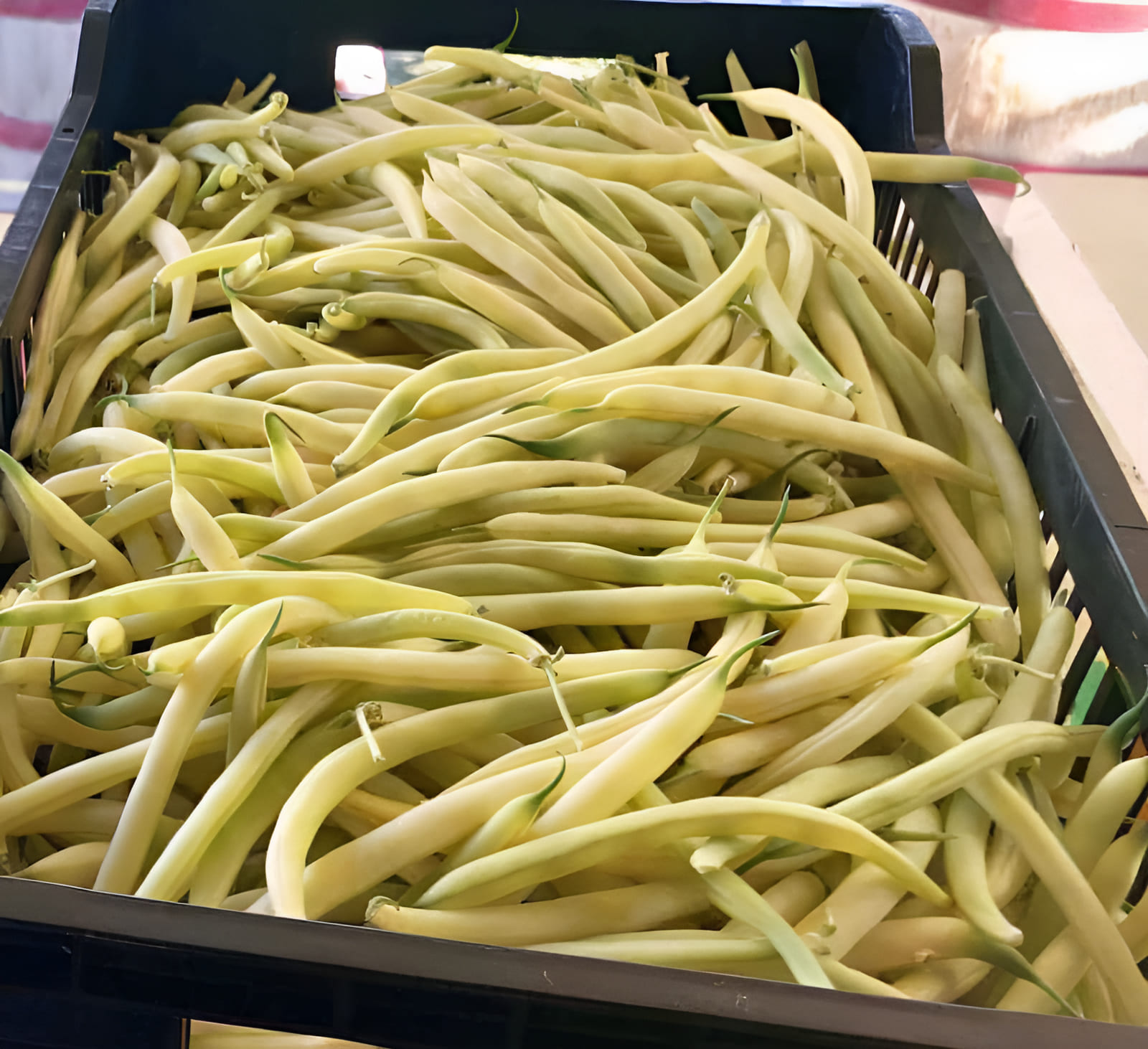
In addition to green snap beans, growers can plant a wide assortment of specialty beans in the spiral formations: yellow wax beans, purple filet beans, Romano beans, edamame (soybeans), bush lima beans, kidney beans, and heirloom dry bean varieties for winter storage. Green bush beans are generally more prolific by weight than yellow or purple beans, often out-yielding them by a two-to-one margin. However, colored beans typically fetch a premium price at farmers markets and restaurants—much like colored bell peppers do—making them excellent candidates for high-value beds.
Amazingly, bush beans create a “so above – so below” synergistic plant structure that shields plants from pests and disease. Above the soil, a continuous canopy of foliage covers the bed, shading the soil surface, reducing splash-back from heavy rains, and keeping weed pressure low. Below the soil, roots from neighboring plants intertwine and interlock, forming a living mesh that stabilizes the medium and supports vigorous nutrient and water uptake.
Because beans are legumes, they host nitrogen-fixing bacteria on their roots, contributing to soil fertility for the crops that follow. When a bean planting is terminated and roots are left in place or lightly incorporated, the rhizobia nodules slowly release nitrogen back into the soil. This makes beans a powerful rotation partner for nutrient-hungry crops such as tomatoes or peppers in Crop Circle systems.
The combination of dense canopies and intertwined root systems helps beans resist environmental stress. Plants buffer one another from hot winds, protect pods from intense sun, and limit the spread of certain pests and diseases. When paired with under-canopy irrigation and permeable ground cover, the result is a resilient mini-ecosystem where the whole is stronger than any single plant.
One of the most compelling aspects of growing beans in spiral-based systems is the yield per square foot. A 1/27-acre Crop Circle Bean Farm covers a 40-foot by 40-foot footprint and grows approximately 2,400 bush bean plants. At an average of 30 pods per plant, that’s about 72,000 bean pods—or roughly 1,000 pounds of marketable beans—per season. This small-footprint farm can generate between $4,000 and $8,000 in gross revenue, depending on variety and the retail market price of $4–$8 per pound.
A quarter-acre Crop Circle Bean Farm (100 feet by 100 feet) scales this model up nicely. With roughly 16,800 bean plants and an estimated 504,000 pods, growers can expect about 4,000 pounds of beans per season. At typical fresh market prices, this translates into $28,800–$57,600 in gross revenue. For many growers, this plot can supply a robust CSA program, multiple farmers markets, and local restaurant accounts.
A half-acre Crop Circle Bean Farm (150 feet by 150 feet) grows around 30,000 bean plants and produces about 900,000 pods, or 7,200 pounds of beans. At $4–$8 per pound, this can generate $48,000–$96,000 in annual revenue. With efficient harvest systems, a small crew, and local distribution, this scaled system can support a full-time farm business focused on regenerative bean production and other compatible crops.
On a full-acre Crop Circle Bean Farm (200 feet by 200 feet), about 60,000 bean plants produce up to 1,800,000 bean pods—approximately 25,000 pounds of beans. Depending on variety and market retail price, gross revenue ranges from $100,000 to $200,000 per acre, a significant improvement over many conventional row-crop models. Instead of shipping beans thousands of miles, these farms put fresh-picked beans into the hands of local families, schools, hospitals, restaurants, and food banks.
For growers who want to benchmark against traditional yields, conventional seed and yield charts show how many pounds per row foot or per acre are considered “average.” Crop Circle Bean Farms are designed to meet or exceed those averages while dramatically reducing water use, fertilizer inputs, and soil degradation.
Whether you are converting a portion of an existing farm, reclaiming a vacant urban lot, or launching a micro-farm on school grounds, a Crop Circle Bean Farm lets you demonstrate what climate-smart, water-smart agriculture can look like in your community. By combining spiral layout, drill don’t till planting, and under-canopy irrigation, you can show neighbors, students, and local officials a practical pathway to higher yields with a much smaller environmental footprint.
Turn your 1-acre property into a high-yield, profitable farm.
Crop Circle Farms specializes in designing and building fully engineered, low-impact farm systems that use 90% less water, 85% less fertilizer, and deliver two to three times the yield of traditional farming.
Whether you have a vacant lot, an empty field, a resort, school, island community, or small family farm, we’ll build it from the ground up for you. Our team handles everything from farm layout and installation to irrigation, root systems, training, and first planting.
Contact Us to explore a custom Crop Circle Farm design for your property.
Help us expand our mission to revolutionize agriculture globally. We are seeking partners to implement Crop Circle Farms to feed people in need. Together, we can build scalable food production systems that save water, reduce costs, and feed thousands of people. Contact Growing To Give
“Drill don’t till” is a method of sustainable agriculture where you avoid plowing the entire field. Instead, you only work the soil in small openings where each plant will grow. In a Crop Circle Bean Farm, a drill or auger creates a cavity that is filled with a custom growing medium. Bean seeds are sown into this pocket while the surrounding soil stays covered and undisturbed. This protects soil structure, reduces erosion, saves water, and concentrates nutrients exactly where the bean roots can use them.
Compact bush beans are ideal for Crop Circle spiral beds because they are naturally suited to high-density, hand-harvest production. Green snap beans, yellow wax beans, and purple filet beans all perform well. You can also grow specialty beans such as edamame (soybeans), bush lima beans, and heirloom dry beans (kidney, black, pinto) in the same layout. Pole beans can be grown using a Fibonacci spiral and trellis system, but bush beans are the most efficient choice for small spiral bean farms.
For a typical Crop Circle Bean Farm, broadcast 15–20 bean seeds into each irrigator opening, then cover with about 1 inch of compost or fine mulch. This usually results in 10–12 strong seedlings per opening, creating a dense clump that covers the soil surface quickly. Fast canopy closure helps suppress weeds, stabilize the soil, and protect pods from sunscald and driving rain.
Because water is delivered directly to the root zone under the canopy, beans in a Crop Circle system use up to 90% less water than beans irrigated with pivots or flooded furrows. Irrigators are designed to hold a small reservoir of nutrient solution that slowly infiltrates the root zone. The canopy shades the soil and a permeable ground cover reduces evaporation, so you can maintain even moisture with short, targeted irrigation cycles rather than long, wasteful runs.
Yes, but you need far less fertilizer than conventional field agriculture. The cavities created by drilling are filled with a balanced, fertilized medium that supports early root growth. Because beans are legumes, they fix nitrogen as they grow and leave behind a nutrient-rich root system for the next crop. Properly managed, a drill don’t till bean farm can cut fertilizer use by as much as 95% compared to broadcast applications in bare tilled fields.
Spiral bean farms are designed to maximize sunlight, airflow, and soil contact per square foot. By eliminating long shadows and concentrating roots around each irrigator, a Crop Circle Bean Farm can match or exceed conventional row-crop yields on a fraction of the land and with far less water. For example, a 1/27-acre spiral bean farm can produce around 1,000 pounds of beans and generate $4,000–$8,000 in revenue depending on variety and market price.
Absolutely. Beans are an excellent rotation partner for high-value crops such as tomatoes, peppers, and carrots. After a bean crop, you can refresh each planting cavity with a small amount of enriched medium and transplant or direct-seed a different crop. Rotating beans with other vegetables helps break pest and disease cycles and takes advantage of the nitrogen beans contribute to the soil through their root nodules.
Weed control in spiral systems starts with permeable ground cover that blocks sunlight between planting openings. Once beans emerge, their dense canopy shades the soil, preventing most weed seeds from germinating. Any remaining weeds are easy to hand pull along the spiral path. Because you are not tilling the entire field, you are not constantly bringing new weed seeds to the surface, which dramatically reduces weed pressure over time.
Bush beans in spiral layouts create a “so above – so below” structure that helps protect plants from pests and disease. Under-canopy irrigation keeps foliage dry, which reduces foliar disease. Healthy, unstressed plants grown in rich, living soil are naturally more resilient to insect pressure. When needed, you can still use targeted organic controls, floating row covers, and biologicals—but the starting point is a system built around plant health rather than chemical rescue.
Yes. Crop Circle spiral layouts were designed specifically to make small parcels of land highly productive. A 40×40-foot footprint can hold a complete bean farm with built-in walkways and harvesting lanes. This makes the system ideal for urban lots, schoolyard gardens, faith-based food ministries, and community farms that want to showcase climate-smart, water-smart growing methods while producing real income from a small area.
Profitability depends on your market, varieties, and labor costs, but the yield potential is strong. An acre of spiral beans in a Crop Circle layout can produce about 25,000 pounds of beans and generate between $100,000 and $200,000 in gross revenue at $4–$8 per pound. Because the system uses far less water, fertilizer, and diesel, operating costs can be significantly lower than in conventional bean fields, improving net margins for small farmers.
If you’d like to implement a Crop Circle Bean Farm or integrate beans into a larger spiral farm system, contact Crop Circle Farms for design and installation support. For community and hunger-relief projects, you can also partner with Growing To Give through the Spiral Farm Project to bring drill don’t till bean farms to neighborhoods and islands that need fresh, local food the most.