Blackberries
Types & Varieties of Blackberries
Blackberries are one of the most adaptable berry crops for home gardens and small farms. Modern breeding has produced a wide range of cultivars, from thornless upright plants ideal for backyard gardens to vigorous trailing varieties known for exceptional flavor and large harvests. Selecting the right blackberry variety depends on factors such as growth habit, fruiting cycle, climate tolerance, and trellis requirements.
Blackberries are commonly classified by their fruiting behavior and cane structure. Some varieties produce berries on second-year canes, while others can fruit on first-year growth. Understanding these differences helps growers plan pruning schedules, trellis systems, and harvest timing for consistent production.
Variety choice also influences labor, infrastructure, and overall yield. Trailing and semi-erect blackberry cultivars typically benefit from trellising systems that support heavy fruit loads, while upright thornless types can often be grown with minimal support. Climate conditions—especially winter chill, summer heat, and disease pressure—also affect berry size, sweetness, and productivity.
In this guide, blackberry varieties are grouped by thorn presence, cane growth habit, and fruiting type, making it easier to select cultivars suited for backyard gardens, market farms, or high-density systems such as Crop Circle planting layouts.
Blackberry plants are typically categorized by their fruiting cycle and cane growth habit. Floricane varieties produce fruit on second-year canes, while primocane varieties can produce berries on first-year growth, often extending the harvest season into late summer or fall. Understanding these growth types helps growers manage pruning, trellising, and crop timing more efficiently.
Blackberries are among the most nutrient-dense berries grown in home gardens. They are rich in vitamin C, fiber, and powerful antioxidants called anthocyanins. Studies show that darker blackberry varieties often contain some of the highest antioxidant levels of any commonly grown fruit.
Feel free to share this blackberry varieties infographic on your website or blog. Please include a link back to this page as the source.
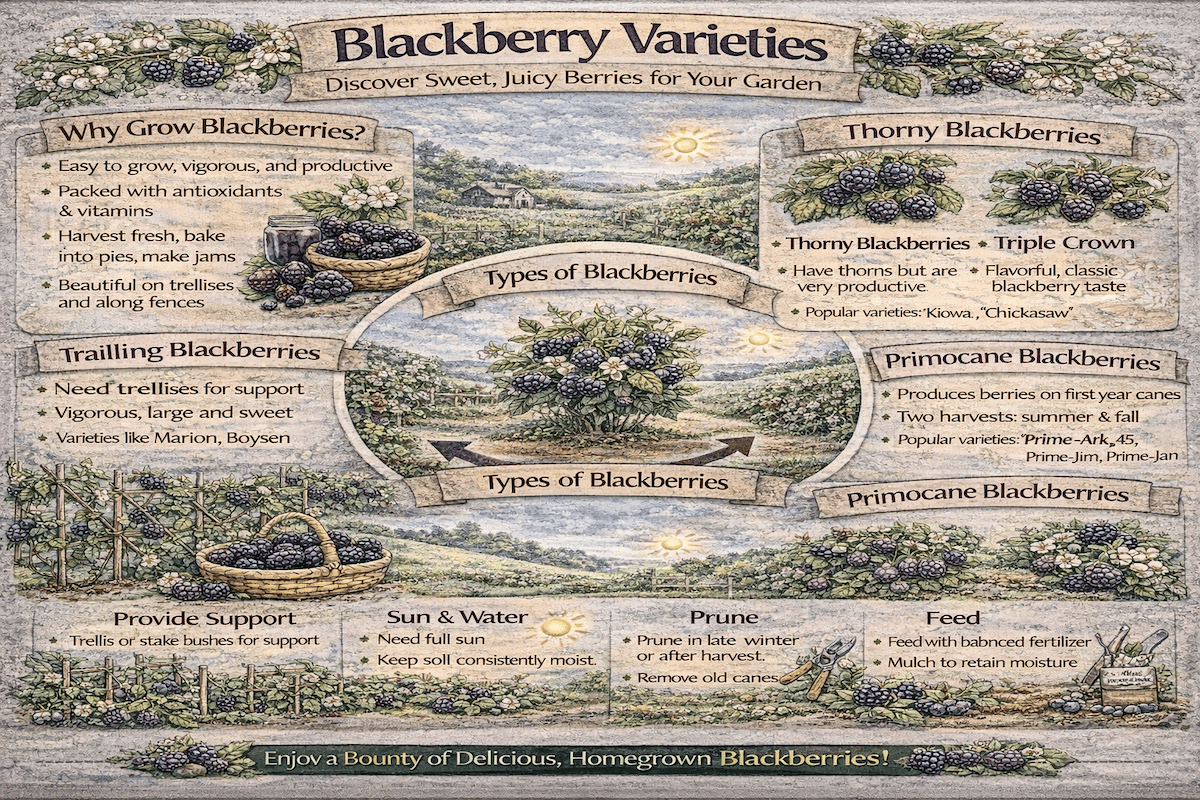
Use this quick checklist to narrow options fast—then use the tables below to choose a type that matches your climate, trellis capacity, and harvest goals.
| Type | Best for | Tradeoffs |
|---|---|---|
| Thornless | Backyards, u-pick, labor efficiency | Choose climate-appropriate cultivars |
| Thorny | Rugged vigor, some warm-region classics | Higher labor and harvest handling |
| Trailing | Premium flavor, processing markets | Requires robust trellis + space |
| Primocane | Extended season; simple “mow-down” pruning option | Heat can reduce fall set in very hot climates |
Thornless blackberries are modern blackberry cultivars bred without the sharp, prickly thorns found on traditional blackberry canes. This trait makes them significantly easier to prune, trellis, and harvest, which is why thornless varieties have become the most widely grown blackberries in both home gardens and commercial berry production. In addition to their ease of management, many thornless varieties produce large, sweet berries with excellent yields and improved disease resistance.
Most thornless blackberries are semi-erect or erect growers that perform well on simple trellis systems and are well suited to backyard gardens, small farms, and high-yield planting systems. Modern breeding programs have also introduced primocane-fruiting thornless varieties that can produce berries on first-year canes, extending the harvest season.
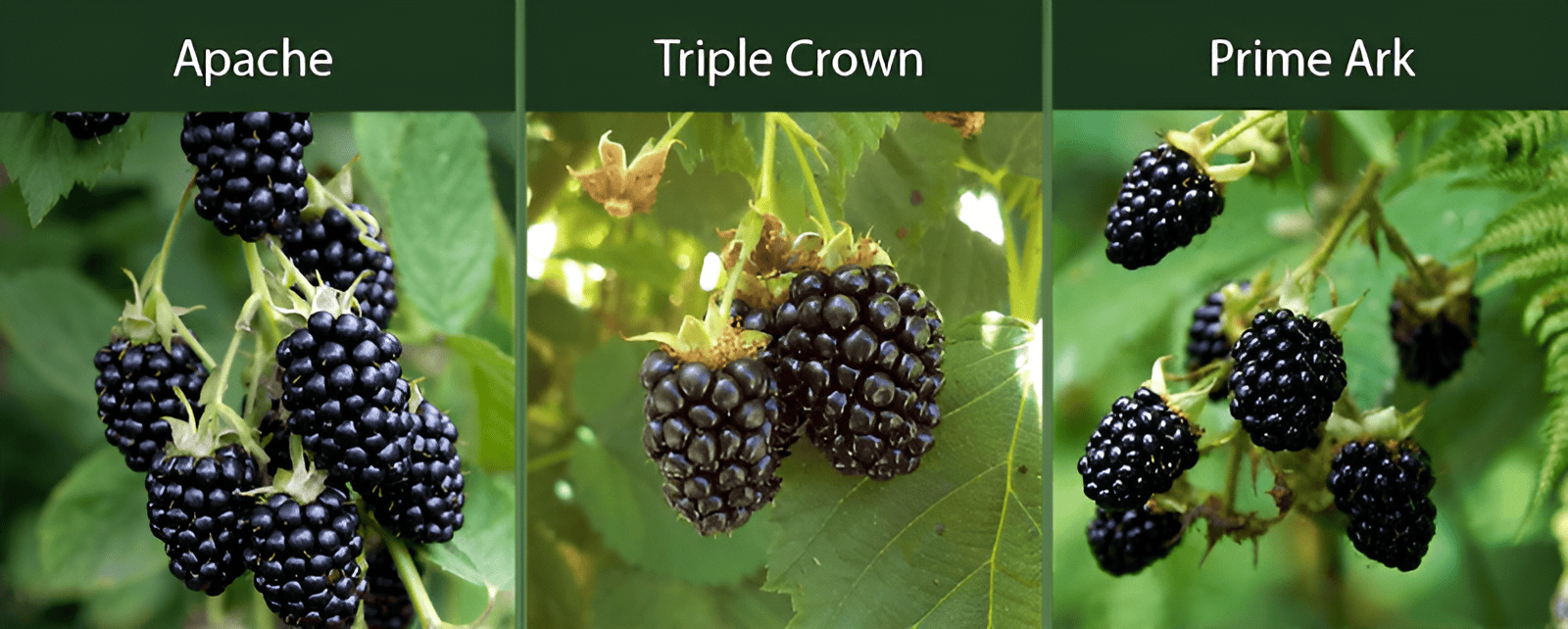
Apache: A vigorous, high-yielding variety known for producing very large, sweet berries with excellent flavor. Apache plants are hardy and show good resistance to several common blackberry diseases.
Arapaho: An early-ripening thornless variety that produces medium to large berries with a balanced sweet-tart flavor. Arapaho is valued for its cold tolerance, disease resistance, and reliable productivity.
Navaho: One of the most widely planted thornless varieties, Navaho produces firm, sweet berries with excellent shelf life. It is also highly regarded for its winter hardiness and strong disease resistance.
Ouachita: A productive mid-season variety that yields large, high-quality berries with excellent flavor and good post-harvest handling characteristics.
Triple Crown: A favorite among growers for its exceptional flavor and heavy yields. Triple Crown produces very large, juicy berries and performs well in many climates.
Chester: Chester Thornless is a dependable late-season variety known for extremely high yields and strong resistance to disease and pests. Its medium-sized berries are sweet and well suited for fresh eating, freezing, or preserves.
Natchez: An early-season variety producing large, elongated berries with a sweet-tart flavor. Natchez is highly productive and valued for its vigorous growth and disease resistance.
Loch Ness: A European thornless variety prized for its heavy crops of large, glossy berries with excellent flavor and firmness.
Hull: A hardy, productive variety that produces medium-sized sweet berries and adapts well to a wide range of climates.
Prime-Ark Freedom: The first thornless primocane-fruiting blackberry released commercially. It produces very large berries and can yield two harvests per season—one on first-year canes and another on second-year growth.
Prime-Ark Traveler: Another primocane-fruiting thornless variety bred for excellent flavor and improved fruit firmness, making it suitable for both home gardens and commercial markets.
Use these tools to estimate yield per plant, scale a berry patch, and model harvest totals over time.
Estimate the expected harvest from a single crop or planting unit. This calculator helps you predict yield per plant, container, or growing space so you can plan production, compare varieties, and scale your planting strategy for higher productivity.
Plan garden layouts, plant spacing, and total harvest potential. Use this tool to estimate how much food your garden beds, rows, or growing area can produce based on plant counts, spacing, and average yield per plant.
Tip: Open pruning and disease-resistant varieties improve fruit quality and usable yield.
Thorny blackberries represent many of the traditional blackberry varieties that still grow wild or are cultivated in older orchard systems. These plants develop sharp thorns along their canes, which help protect the fruit from animals but require careful handling during pruning and harvest. Although thorny varieties can be more difficult to manage, many growers appreciate them for their vigorous growth, high productivity, and the rich, sweet-tart flavor often associated with heritage blackberry cultivars.
In many regions, thorny blackberries are also valued for their adaptability and resilience. Several older varieties were bred to tolerate heat, drought, and variable soils, making them reliable performers in challenging climates. While thornless varieties have become more popular for ease of harvest, thorny cultivars remain an important part of blackberry breeding and production.
Brazos: A classic Texas-developed variety known for its strong vigor and very high productivity. Brazos produces large berries with a bold, slightly tart flavor and performs particularly well in warm climates.
Rosborough: Released by Texas A&M University, Rosborough is a productive variety that produces large berries with a balanced sweet-tart flavor. It is well adapted to southern growing regions.
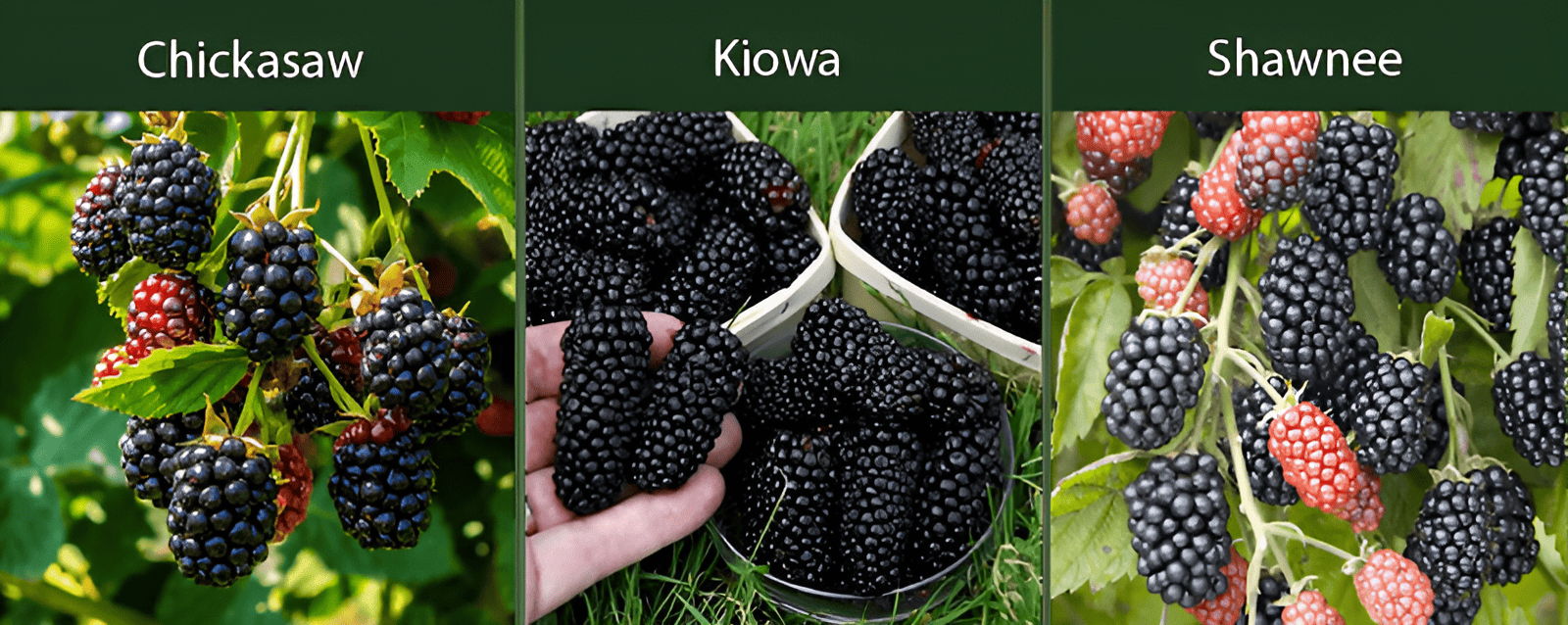
Chickasaw: A vigorous, high-yielding plant that produces very large, sweet berries. Chickasaw is known for strong growth and good disease tolerance.
Kiowa: Famous for producing some of the largest blackberries available, Kiowa offers exceptionally large berries and an extended harvest season. The fruit is sweet and ideal for fresh eating.
Shawnee: A dependable variety known for its long harvest window and abundant yields. Shawnee produces large, flavorful berries and adapts well to many growing regions.
Choctaw: An early-ripening blackberry variety that produces medium-sized berries with excellent sweetness. Choctaw is valued for its early harvest and reliable productivity.
Trailing blackberries, sometimes called vine blackberries, grow long, flexible canes that naturally arch and trail along the ground. Unlike erect blackberry varieties that stand upright, trailing types require support such as conventional trellises, wires, fencing, or specialized vertical-growing systems such as a Tomato Volcano, which is typically used to support indeterminate tomatoes and other vining crops. Keeping the canes elevated improves fruit access and makes training and harvest easier. While trailing varieties often require more space and management, they are widely appreciated for producing some of the most flavorful berries of any blackberry group.
Many trailing blackberry cultivars originated in the Pacific Northwest and coastal regions where mild climates support vigorous cane growth. These varieties typically produce large, aromatic berries with rich sweetness and complex flavor, making them especially popular for fresh eating, jams, desserts, and specialty culinary uses.
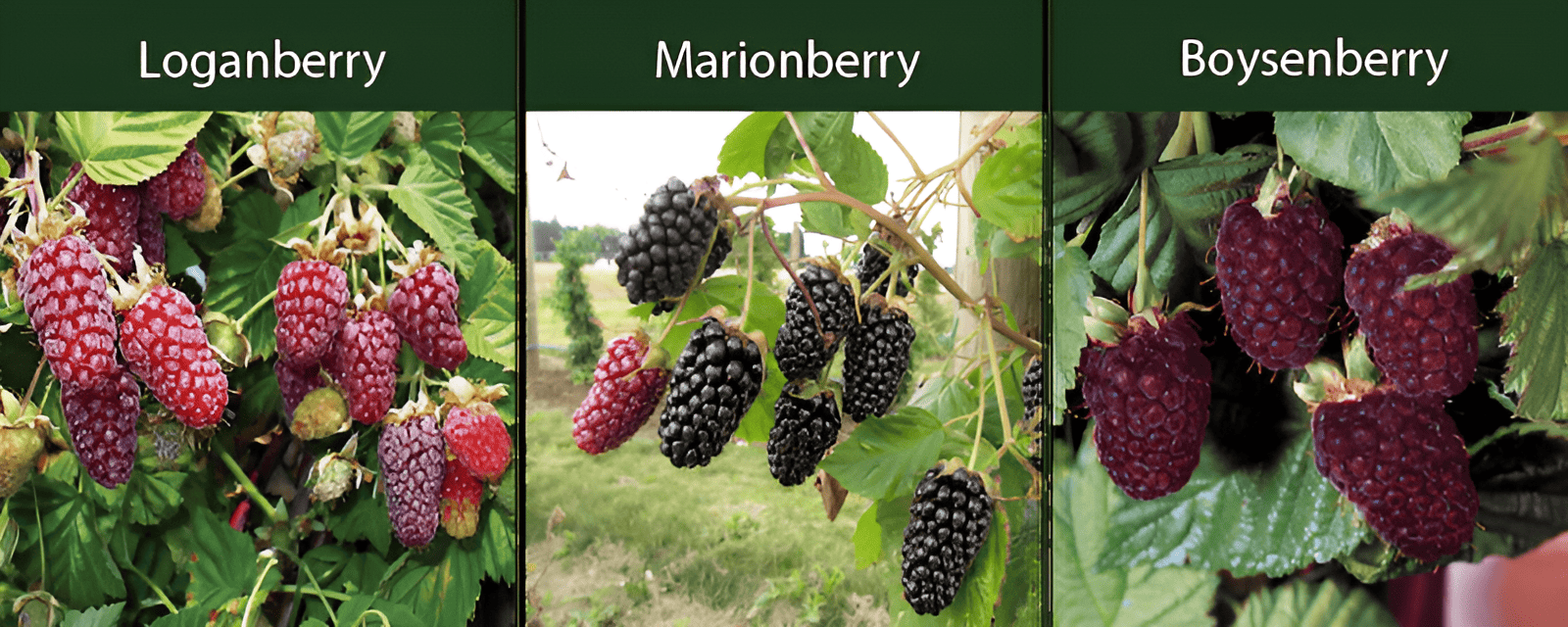
Boysenberry: A famous hybrid berry developed in California, Boysenberry is a cross between blackberry, raspberry, and loganberry. It produces large, deep purple berries that are juicy, aromatic, and richly sweet.
Marionberry: Often considered the signature blackberry of the Pacific Northwest, the Marionberry was developed by researchers at Oregon State University. It is prized for its intense, complex flavor and is widely used in pies, jams, and desserts.
Loganberry: A historic raspberry-blackberry hybrid that produces large, elongated dark red berries. Loganberries are juicy and slightly tart, making them excellent for preserves and baking.
Youngberry: A cross between blackberry and dewberry, Youngberries produce large, soft berries with a distinctive sweet flavor and subtle wine-like aroma.
Kotata: A trailing blackberry known for producing firm, flavorful berries with good disease resistance. It performs well in cooler coastal climates.
Columbia Star: A modern thornless trailing blackberry bred for high yields, machine harvestability, firm fruit, excellent sweetness, and high processing quality.
Primocane blackberries are unique in that they can produce fruit on the current year's growth (primocanes), which allows for a potential double harvest in a growing season. Here are some primocane blackberry varieties:
Prime-Ark 45: This variety produces large, sweet, and tart berries on thorny canes. It's known for its high productivity.
Prime-Ark Freedom: The world's first thornless primocane-fruiting blackberry, this variety is known for high yields of large, sweet berries that can be harvested twice in a growing season.
Prime-Ark Traveler: A thornless primocane-fruiting variety with medium-sized berries, good flavor, reduced acidity, and strong post-harvest storage potential, making it suitable for both commercial production and home gardens.
Prime-Ark Horizon: A newer variety, the Horizon is known for its large, sweet, and firm berries.
Prime-Jan and Prime-Jim: These are earlier varieties of primocane blackberries with thorny canes. They produce medium-sized, sweet, and flavorful berries.
Crop Circle Farms designs and builds resource-efficient agricultural systems tailored to site conditions, crops, water availability, and production goals. Our field-tested systems have demonstrated up to 90% lower water use, up to 85% lower fertilizer requirements, and two to three times the production with selected crops and configurations compared with conventional layouts.
Services can include farm layout, irrigation planning, root-zone systems, crop selection, production modeling, training, and first planting.
Contact Us to discuss a Crop Circle Farm design for your property.
Through nonprofit and community partnerships, Crop Circle farming systems can support sustainable food production, smallholder agriculture, food security, education, and climate-resilience projects in communities around the world. Contact Growing To Give to explore smallholder farm clusters, school farm hubs, and community Crop Circle projects.

Compare popular berry crops, varieties, climate requirements, growing characteristics, harvest patterns, and production strategies.
Compare highbush, rabbiteye, lowbush, and half-high blueberries by climate, chill requirements, soil pH, pollination, and harvest season.
Explore Blueberry Varieties →Compare American, European, and hybrid gooseberries by climate, mildew resistance, fruit size, flavor, pruning, and harvest potential.
Explore Gooseberry Varieties →Compare summer-bearing and primocane raspberries, including red, black, purple, and golden varieties by climate, pruning, trellising, and harvest season.
Explore Raspberry Varieties →Compare June-bearing, everbearing, and day-neutral strawberries by climate, harvest pattern, containers, disease resistance, and yield potential.
Explore Strawberry Varieties →Floricane blackberry varieties fruit on second-year canes. New canes (primocanes) grow the first year, then those same canes flower and fruit the following summer before being removed after harvest. Primocane blackberries, such as Prime-Ark Freedom, Prime-Ark Traveler, and Prime-Ark 45, can fruit on the current year’s growth. In many climates you can mow primocane types back to the crown each winter and still get a late-summer or fall crop, greatly simplifying pruning and cane management.
Modern thornless blackberries like Apache, Arapaho, Navaho, Ouachita, Triple Crown, Chester, and Natchez can match or exceed many thorny cultivars for yield and berry quality. Thornless canes are far easier to prune, tie, and harvest, which reduces labor and makes them ideal for home gardens and u-pick farms. Traditional thorny types such as Brazos, Rosborough, Kiowa, and Shawnee are still valued for their robust, sweet–tart flavor and vigor, but require more careful handling.
Trailing blackberries (vine blackberries) grow long, flexible canes that arch and sprawl rather than standing upright. Classics like Boysenberry, Marionberry, Loganberry, Youngberry, Kotata, and Columbia Star are typically trained along a fence or trellis. They need more support and space than erect types but reward you with intensely flavored berries that are excellent for fresh eating, jams, syrups, and pies.
For most home growers, thornless upright or semi-erect cultivars are the easiest starting point. Ouachita, Triple Crown, Chester, and Natchez offer high yields, good disease resistance, and large, sweet berries with fewer thorns to fight. For more advanced growers wanting extended seasons, primocane types like Prime-Ark Freedom or Prime-Ark Traveler allow potential double cropping and simplified winter pruning.
Blackberries prefer mild winters and warm summers, but there are cultivars for a wide range of climates. Many thornless varieties perform well in temperate regions with moderate winter chill, while trailing types like Marionberry thrive in the cool, maritime Pacific Northwest. In hotter regions, choose heat-tolerant, low-chill types and provide mulch and afternoon shade to protect canes and fruit quality.
For erect and semi-erect varieties, let primocanes grow to about 3–4 feet, then tip (cut off) the growing point to encourage lateral branches. In late winter, shorten laterals to 12–18 inches and remove any damaged or weak wood. Floricane varieties fruit on second-year canes, so cut out spent fruiting canes at the crown after harvest. Primocane types can be mowed to the ground each winter in “single-crop” systems, simplifying maintenance.
Erect and semi-erect blackberries do well on simple T-trellises or V-trellises with two or three catch wires to support canes along the row. Trailing types are often grown on two-wire trellises or more advanced shift/rotating trellises that help manage canopy position for harvest and disease control. Whatever the system, keep rows narrow enough that you can reach berries easily from both sides.
Common disease issues include cane blight, anthracnose, orange rust, and rosette (double blossom). Start with clean, disease-free plants, prune for airflow, and remove infected canes promptly. Soft, thin-skinned blackberries can also attract spotted wing drosophila in many regions, so harvest frequently, chill fruit quickly, and manage nearby wild bramble hosts. For a deeper look at pest and disease management across your farm or garden, see the farm and garden pests and plant diseases guides.
Many modern blackberry varieties are self-fertile, so a single cultivar can set fruit on its own. However, planting more than one compatible variety can improve pollination, berry size, and total yield. Regardless of cultivar, abundant bee activity around your patch will always improve crop performance.
Yes. Choose compact, semi-erect, or primocane varieties and plant them in large, well-drained containers with rich potting mix and consistent drip irrigation. In high tunnels or hoop houses, blackberries can ripen earlier, suffer less rain damage, and be easier to net against birds and insects. Good pruning and ventilation are essential to avoid excessive humidity and disease.
In a Crop Circle or spiral layout, trellised arcs of blackberries can be placed along outer ring paths so pickers have easy access while inner rings host vegetables, herbs, and insectaries. Drip lines can be run along the trellis base with heavy mulch to conserve water and suppress weeds. Integrating blackberries with companion plants and pollinator strips builds a resilient, high-yield system that fits beautifully into the broader Crop Circle Gardens concept.