Traditional Agriculture Systems
A pillar guide to soil • water • diversity • resilience
Traditional agriculture is often misunderstood as outdated, but many of its principles remain among the most effective strategies for building resilient food systems. These approaches focus on strengthening soil structure, water stability, crop diversity, and long-term productivity. Farmers across generations have refined these methods to manage risk, protect fertility, and adapt to changing environmental conditions.
Today, many of the practices considered “innovative” in regenerative and sustainable agriculture are rooted in traditional farming systems. Techniques such as crop rotation, composting, agroforestry, and integrated livestock management help maintain soil health, conserve water, and improve ecological balance.
This guide organizes the most proven traditional agriculture methods into a practical framework for modern growers. Whether you are planning a backyard garden, a market garden, or a diversified farm, these systems can help improve yields, reduce inputs, and create more stable growing environments.
Traditional agriculture systems are farming practices developed over centuries through local knowledge, environmental observation, and practical experience. These systems emphasize soil fertility, water conservation, crop diversity, and integrated livestock management to maintain long-term productivity while working in balance with natural ecosystems.
• Many modern regenerative agriculture practices are adaptations of
traditional farming techniques used for centuries.
• Crop rotations and diversified plantings were historically used to
reduce pests and improve soil fertility without synthetic inputs.
• Traditional farms often combined crops, trees, and livestock to create
self-reinforcing fertility cycles that strengthened soil health.
Feel free to share this traditional agriculture systems infographic on your website or blog. Please include a link back to this page as the source.
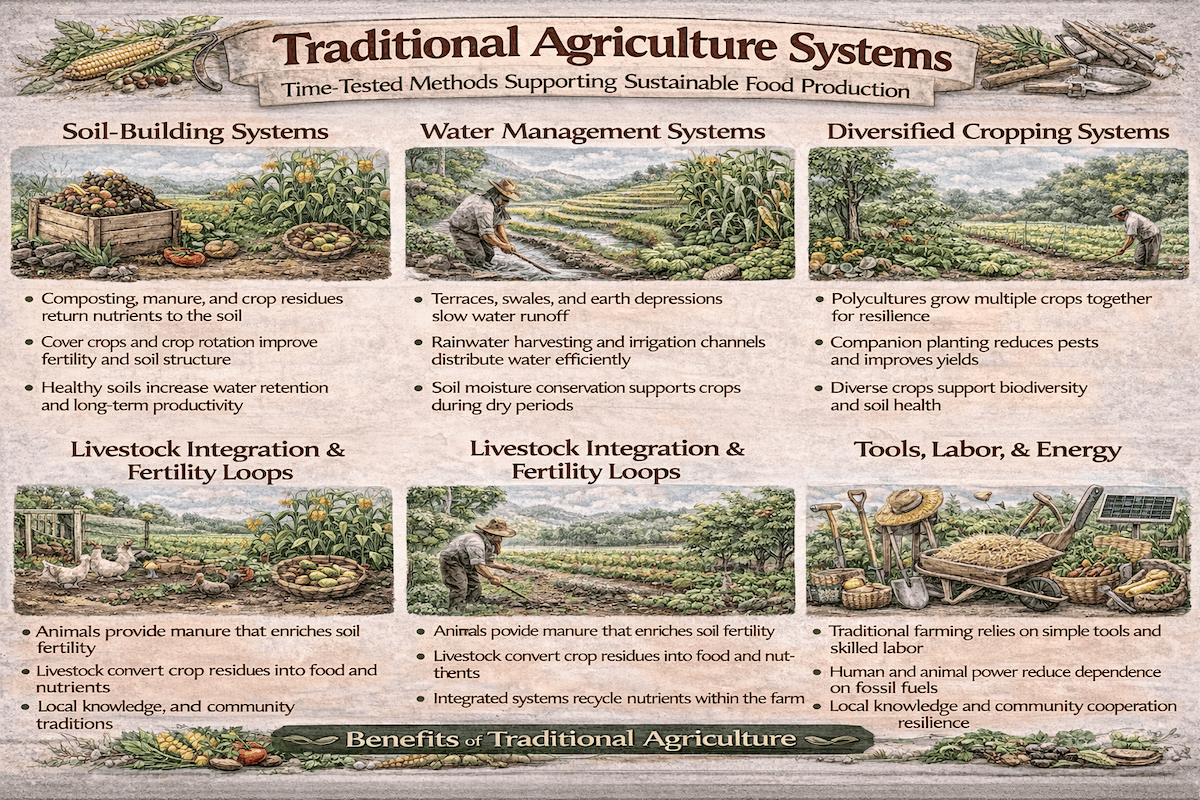
Definition
Traditional agriculture is a collection of locally adapted methods that prioritize resource cycling, water security, and yield stability using available materials and knowledge. It’s not inherently low-yield; many systems achieve strong output by managing water, organic matter, and diversity.
System 1
Soil is the operating system. Traditional practices build structure, nutrients, and biology so crops stay productive with fewer external inputs.
| Method | What it does | Best for | High-impact notes |
|---|---|---|---|
| Compost | Recycles nutrients and microbes; improves structure | All soils | Apply as top-dress; cover with mulch to protect biology. |
| Animal manures | Adds nutrients + organic matter | Low fertility soils | Compost when possible; prevent runoff; time near crop demand. |
| Green manures / cover crops | Builds biomass; protects soil surface | Rotation blocks | Mix legumes + grasses for steadier performance. |
| Mulch | Reduces evaporation; suppresses weeds; buffers temperature | Dry/hot climates | Deep organic mulch can dramatically reduce irrigation need. |
| Biochar (inoculated) | Improves nutrient retention; stabilizes carbon | Sandy/low CEC soils | Charge with compost/tea before use to avoid N tie-up. |
| Rotations | Balances nutrients; disrupts pests/disease cycles | Any multi-crop plan | Rotate plant families; include rest/build phases. |
System 2
Many “traditional methods” are water engineering: slow runoff, infiltrate water, store it, and protect soil from erosion—especially on slopes and in drylands.
| System | Where it shines | Primary goal | Modern upgrade |
|---|---|---|---|
| Terracing | Slopes and hillsides | Stop erosion + infiltrate water | Add drains/overflow; use drip for precision. |
| Swales / contour bunds | Drylands, rolling terrain | Capture runoff + recharge soil | Level-sill spillways; seed groundcovers. |
| Planting basins / zai pits | Semi-arid zones | Concentrate moisture + fertility | Add compost + mulch; micro-dose as needed. |
| Check dams / stone lines | Gullies and channels | Slow water; trap sediment | Design overflow; maintain after storms. |
| Cisterns / storage | All climates | Store rainfall | First-flush diverters; distribute via drip. |
| Mulch + shading | Heat stress zones | Reduce evapotranspiration | Shade cloth in extremes; timed irrigation. |
System 3
Diversity spreads risk and can reduce pest pressure by breaking up host plants, supporting beneficial insects, and stabilizing microclimates.
| Practice | How it works | Benefits | Where to use it |
|---|---|---|---|
| Intercropping | Two+ crops share space/time | Higher total yield; risk spread | Small farms, market gardens, diversified fields |
| Companion planting | Strategic pairing for pest/soil effects | Lower pest pressure; better microclimate | Beds and intensive systems |
| Polyculture blocks | Multiple cultivars/species together | Reduces disease spread; improves stability | Orchards, mixed veg, agroforestry alleys |
| Rotations with cover crops | Sequenced plant families + rest phases | Soil building + pest disruption | Field-scale planning |
| Insectary strips | Flowering habitat near crops | Boosts beneficials and pollinators | Edge rows and paths |
System 4
Trees add wind protection, shade management, nutrient cycling, and long-term resilience. Well-designed agroforestry can raise whole-farm productivity per acre over time.
| System | What it adds | Key design note | Example |
|---|---|---|---|
| Windbreaks | Reduces evap; protects crops | Porosity beats solid walls | Mixed native tree/shrub rows |
| Alley cropping | Shade + nutrient cycling | Keep adequate light; prune as needed | Tree rows with annuals between |
| Silvopasture | Stacked forage + trees | Protect young trees; rotate animals | Grazing lanes under trees |
| Riparian buffers | Water quality + habitat | Use native species; maintain access paths | Streamside plantings |
| Living trellises | Vertical production | Match species to climate | Gourds/beans on living supports |
System 5
Animals can convert crop residues and pasture into fertility—if managed to avoid compaction, runoff, and overgrazing.
| Integration | Why it matters | Best practice | Common mistake |
|---|---|---|---|
| Rotational grazing | Manure cycling + pasture health | Move frequently; rest paddocks | Overgrazing and no recovery time |
| Compost from bedding | Turns waste into stable fertility | Hot compost; cure fully | Applying raw manure in wet seasons |
| Poultry after harvest | Pest cleanup + nutrient return | Short runs; protect soil | Compacting wet soil |
| On-farm fertility budgeting | Reduces purchased inputs | Track N-P-K flows annually | No accounting for exports in harvested crops |
System 6
Traditional systems often reduce fuel use and external dependency. Modern complements include lightweight mechanization, precision irrigation, and better scheduling—without sacrificing soil goals.
System 7
Combine the “why” of traditional systems (soil, water, diversity) with measurement and efficiency. Start with water flow and organic matter, then tune fertility with data.
Summaries
Use these tables to quickly match constraints to the best systems mix.
| Goal | Traditional methods | Modern complements | Outcome |
|---|---|---|---|
| Stop erosion | Terraces, stone lines, swales | Survey levels; engineered drains | More stable yields on slopes |
| Hold moisture | Mulch, basins, contour beds | Drip + scheduling | Better fruit set and less stress |
| Build fertility | Compost, manure, rotations | Soil tests; targeted minerals | Lower fertilizer dependence |
| Reduce pests | Rotations, diversity, habitat | Monitoring; netting; biocontrol | Less pesticide reliance |
| Improve labor efficiency | Simple tool systems | Light mechanization | Lower cost per unit output |
Global Context
Traditional agriculture systems developed independently in many regions of the world, yet they share common goals: conserving soil, stabilizing water, supporting biodiversity, and producing reliable food supplies. Farmers adapted their practices to local climates, landscapes, and cultural traditions, creating highly resilient systems that often remain effective today.
These regional farming systems demonstrate how traditional agriculture can be tailored to vastly different environments—from mountainous terrain and tropical forests to drylands and temperate regions. Understanding these examples provides valuable insight into how local knowledge and environmental observation shaped some of the most durable agricultural systems in history.
In the Andes Mountains of South America, farmers developed intricate terrace farming systems to cultivate steep hillsides. Stone terraces slow runoff, reduce erosion, and create level planting areas that retain moisture and soil nutrients. These terraces often include complex irrigation channels that distribute water from mountain streams. Crops such as potatoes, quinoa, and maize have been grown in these systems for centuries, demonstrating how careful land shaping can transform challenging landscapes into productive agricultural zones.
In parts of West Africa and the Sahel, farmers developed a dryland technique known as zai pits. Small planting basins are dug into the soil and filled with compost or organic matter. These pits capture rainfall, concentrate nutrients, and improve soil infiltration in regions where water is scarce. Crops such as millet and sorghum planted in zai pits often show dramatically improved yields compared with conventional dryland planting. The technique also helps restore degraded soils over time.
Rice terraces across Asia—particularly in countries such as China, Vietnam, and the Philippines—represent one of the most sophisticated traditional water management systems in agriculture. Farmers carved step-like terraces into mountainsides and engineered gravity-fed irrigation channels that move water from upper terraces to lower ones. These systems maintain stable water levels, reduce erosion, and create highly productive rice-growing environments. Many rice terraces have remained continuously cultivated for hundreds of years.
Historically, many European farms operated as mixed farming systems, combining crops, livestock, and orchards within the same landscape. Crop rotations, manure composting, hedgerows, and pasture management created integrated fertility cycles that supported long-term soil productivity. These farms often balanced grains, vegetables, forage crops, and animals to diversify income and reduce risk, making them highly resilient to changing weather and market conditions.
Indigenous farming communities around the world have long practiced forms of agroforestry, integrating trees with crops and livestock to create layered food systems. In tropical regions, farmers often grow fruit trees, timber species, medicinal plants, and staple crops together in multi-story planting systems that mimic natural forest ecosystems. These systems support biodiversity, improve soil fertility through leaf litter, moderate temperatures, and provide multiple food and economic products from the same land.
Although these systems differ in their specific techniques, they share common principles: conserving water, maintaining living soil, diversifying crops, and working with natural ecosystems rather than against them. These principles continue to inspire many modern approaches to regenerative and sustainable agriculture.
For decision-ready tables that clarify tradeoffs in inputs, energy, biodiversity, water use, and resilience:
Estimate yield per crop or planting area and compare efficiency gains over time.
Open calculatorEstimate garden-bed production, spacing, and seasonal output.
Open calculatorModel whole-farm output, efficiency, and scenario-based yield assumptions.
Open calculatorPlan container and home-garden setups with Root Tubes—spacing, inputs, and productivity estimates.
Open calculator