Cosmic Planting Guide
Lunar Phases • Moon Signs (Optional) • Practical Garden Timing • Printable Chart
Cosmic planting is a timing framework that helps gardeners and farmers schedule key tasks—sowing, transplanting, pruning, watering, and harvesting—using lunar phases and seasonal rhythms. Some traditions also incorporate moon signs (zodiac-based categories) as a fine-tuning layer. The most useful approach is practical: use the moon as a planning tool, while letting soil temperature, frost risk, and weather remain the final decision-makers.
If soil is too cold, wind is extreme, or frost is likely—override the calendar. If you choose to use lunar timing, combine it with local growing conditions rather than allowing the calendar to override them.
Feel free to share this cosmic planting infographic on your website or blog. Please include a link back to this page as the source.
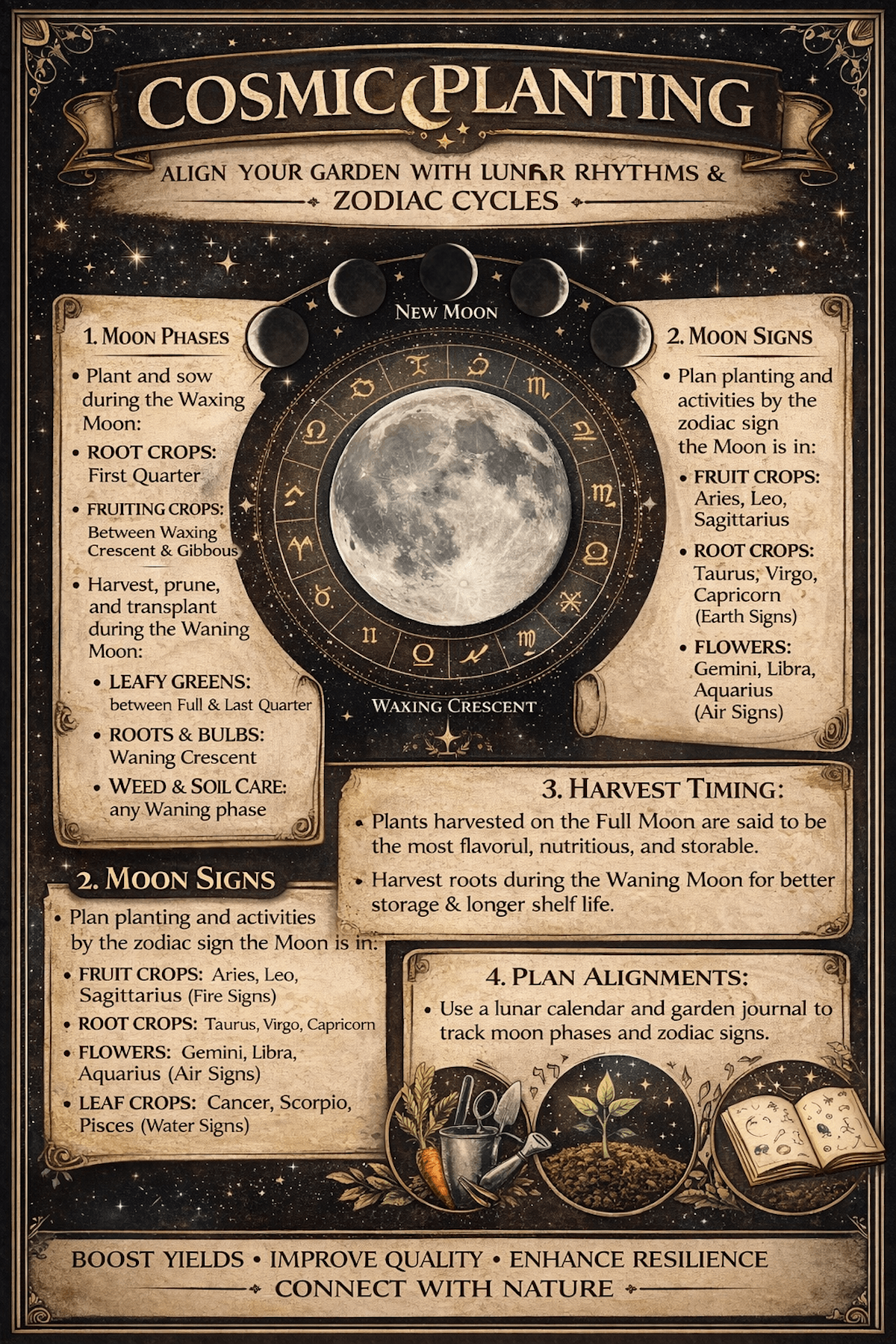
Many gardeners start with lunar phases only because they are simple to track. Moon-sign calendars, often associated with biodynamic traditions, add zodiac-based leaf, flower, fruit, and root categories as another layer.
Traditional lunar planting guides commonly associate the waxing moon with sowing, transplanting, and above-ground crops, while the waning moon is associated with root crops, pruning, weeding, and soil work. These are traditional agricultural timing practices rather than established agronomic rules.
Research continues into how plants perceive very low levels of moonlight, but current evidence does not establish that these specific waxing and waning calendar rules consistently improve germination, yield, pruning response, or storage quality. If you use lunar timing, treat it as a planning framework and compare results in your own growing conditions.
| Moon Phase | Traditional timing association | Traditional cautions |
|---|---|---|
| New Moon → First Quarter (waxing) | Sowing leafy crops, transplanting, gentle watering, establishing seedlings | Heavy pruning; major root disturbance |
| First Quarter → Full Moon (waxing) | Fruiting crops, grafting, foliar feeding, growth-focused work | Overwatering; intensive soil disturbance |
| Full Moon → Last Quarter (waning) | Pruning, weeding, compost turning, pest management, harvesting for storage | Tender transplants in harsh weather |
| Last Quarter → New Moon (waning) | Root crops, soil prep, bed shaping, mulching, repair and maintenance | Major sowing if soil conditions are marginal |
Some cosmic planting calendars (especially biodynamic calendars) categorize days based on moon “signs” into four groups. Many gardeners treat these as a fine-tuning layer. If you are new, start with lunar phases first.
| Day Type | Focus | Examples |
|---|---|---|
| Leaf days | Vegetative growth | Lettuce, spinach, kale, herbs grown for leaves |
| Flower days | Bloom and flowering crops | Broccoli/cauliflower florets, edible flowers, ornamentals |
| Fruit/seed days | Fruiting and seed production | Tomatoes, peppers, beans, corn, squash, cucumbers |
| Root days | Root development | Carrots, beets, onions, potatoes, radishes |
If you choose to use lunar timing, start with three practical checks before following the calendar:
If you like timing-based planning, you may also enjoy biodynamics, polyculture, and soil health monitoring.
| Task | Traditional lunar timing | Notes |
|---|---|---|
| Sowing seeds | Waxing moon (or leaf/fruit days) | Prioritize soil warmth; direct sow after heavy rain can crust soil. |
| Transplanting | Waxing moon | Avoid harsh wind/heat; water-in well; shade cloth helps in desert climates. |
| Pruning | Waning moon | Traditional lunar guides often assign pruning to the waning phase. Actual pruning response depends on species, season, plant condition, and technique. |
| Weeding / cultivation | Waning moon | Pair with mulching for longer weed suppression. |
| Harvest for storage | Waning moon | Harvest dry; cure and store properly—storage quality depends on post-harvest handling. |
| Foliar feeding | Waxing moon | Use calm mornings/evenings; avoid spraying in high heat or direct midday sun. |
Print this page and keep the chart near your seed box or greenhouse. Use it as a planning guide, and override with soil temperature and weather.
| Phase | Traditional lunar timing | Examples |
|---|---|---|
| New → First Quarter Waxing |
Start seedlings, sow leafy greens, transplant hardy starts | Lettuce, spinach, kale; transplant onions and brassicas (when weather is stable) |
| First Quarter → Full Waxing |
Fruiting crops, grafting, growth-focused care | Tomatoes, peppers, cucumbers, beans; grafting fruit trees (when appropriate) |
| Full → Last Quarter Waning |
Pruning, weeding, compost turning, harvest for storage | Prune perennials, pull weeds, turn compost, harvest onions/garlic for curing |
| Last Quarter → New Waning |
Root crops, soil prep, mulching, bed shaping | Carrots, beets, potatoes; add compost and mulch; repair irrigation lines |
Cosmic planting is sometimes discussed within biodynamic farming, which includes philosophical and spiritual interpretations of nature. Many biodynamic practitioners view celestial cycles as part of a larger ecological rhythm, while others use lunar calendars primarily as an organizational tradition.
Research has established that plants respond to daily and seasonal light cycles, and researchers continue to investigate possible biological responses to moonlight. However, evidence that specific lunar phases or zodiac-based planting schedules consistently improve crop performance under field conditions remains limited. Treat lunar calendars as a traditional or testable planning framework rather than a substitute for crop-specific agronomy, soil conditions, irrigation, or weather.
Build closed-loop fertility through composting, residue cycling, water-smart systems, and farm designs that reduce waste and improve resilience.
Deep dive into soil chemistry and biology, nutrient planning, amendments, and regenerative soil-building strategies.
Cosmic planting is a traditional timing approach that uses lunar phases, seasonal rhythms, and sometimes moon-sign or zodiac-based categories to organize gardening and farming activities.
Growers may use these calendars to schedule sowing, transplanting, pruning, soil work, watering, or harvesting. The calendar is best treated as a planning framework rather than a substitute for soil temperature, frost risk, moisture, weather, crop requirements, and other established agronomic factors.
No. The two approaches overlap, but they are not identical. Biodynamic agriculture is a broader whole-farm system that includes composting, biodiversity, internal nutrient cycling, specific biodynamic preparations, and traditions concerning agricultural timing.
Lunar and astronomical calendars are associated with some biodynamic practices, while cosmic or lunar planting can also be used independently by gardeners who do not follow the broader biodynamic system.
No. Local growing conditions should come first. Soil temperature, frost risk, excessive heat, rainfall, wind, soil moisture, and the needs of the crop are more important than a calendar date.
If lunar timing suggests transplanting but frost or extreme heat is expected, wait for safer conditions. Use the lunar calendar as an optional planning layer rather than allowing it to override sound horticultural decisions.
Traditional lunar gardening guides commonly associate the waxing moon with sowing, transplanting, establishment, and above-ground crops. The waning moon is traditionally associated with root crops, pruning, weeding, soil preparation, and some harvest activities.
These are traditional timing associations rather than established agronomic rules. Evidence does not currently show that following specific waxing and waning phases consistently improves germination, plant growth, yield, or harvest quality under field conditions.
No. Moon-sign systems are an optional part of some lunar and biodynamic calendars. They commonly classify days as leaf, flower, fruit, or root days according to astronomical or zodiac-based traditions.
If you want to explore cosmic planting, lunar phases alone provide a simpler calendar to follow. Moon-sign categories can be added later as a traditional fine-tuning method, but they should not replace crop-specific planting requirements or observations from your own garden.
Garden when conditions and your schedule allow. Missing a preferred lunar date does not mean you should delay an important task when the crop, soil, or weather indicates that it should be done.
A practical approach is to use the calendar to create a consistent routine, then keep notes on germination, transplant success, plant growth, pest pressure, and harvest performance. Your observations can help determine whether lunar timing is useful in your particular growing system.
Lunar planting traditions can be followed in containers just as they can in garden beds, but container conditions usually require more immediate attention. Potting mix can heat, cool, dry, and become waterlogged much faster than soil in the ground.
Prioritize container size, drainage, root temperature, irrigation, fertility, sunlight, and heat protection. If you choose to use lunar timing, add it as an optional planning layer after those fundamentals are under control.
Next steps: Explore biodynamic farming, soil health monitoring, crop-smart irrigation, and polyculture for related approaches to farm planning, soil health, water management, and crop-system design.