Crimson Clover
The Perfect Cover Crop
Crimson clover (Trifolium incarnatum) is a widely used annual legume native to the Mediterranean region. Known for its versatility, this pea-family plant serves as a cover crop and forage crop in many agricultural systems.
Crimson clover grows well in many well-drained soils and performs especially well in cool, moist conditions. Winter survival depends on cultivar, establishment, soil conditions, and climate. It commonly overwinters in warmer regions, while colder climates may use it as a winter-killed annual. Crimson clover can be planted in fall where winter survival is suitable or used as a spring or summer annual in cooler regions.
Crimson clover is widely used as a cover crop for nitrogen fixation, erosion protection, ground cover, and soil improvement. Through its association with nitrogen-fixing rhizobia in root nodules, the plant converts atmospheric nitrogen into forms used in plant growth. After termination and decomposition, part of that nitrogen can contribute to the soil organic nitrogen pool and become available to following crops. The amount supplied varies with stand density, biomass, growth stage, soil conditions, and management.
Crimson clover also produces substantial plant residue and ground cover that can help protect soil, reduce erosion, support nutrient cycling, and add organic matter. Its crimson flowers provide abundant nectar and are frequently visited by bees and other beneficial insects.
Beyond these agricultural benefits, crimson clover supports subterranean biodiversity. Its deep roots create habitats for earthworms and beneficial soil organisms, contributing to improved nutrient cycling and fertility. Furthermore, the plant’s nectar-rich flowers attract pollinators like bees, butterflies, hummingbirds, and even dragonflies, promoting a healthier ecosystem.
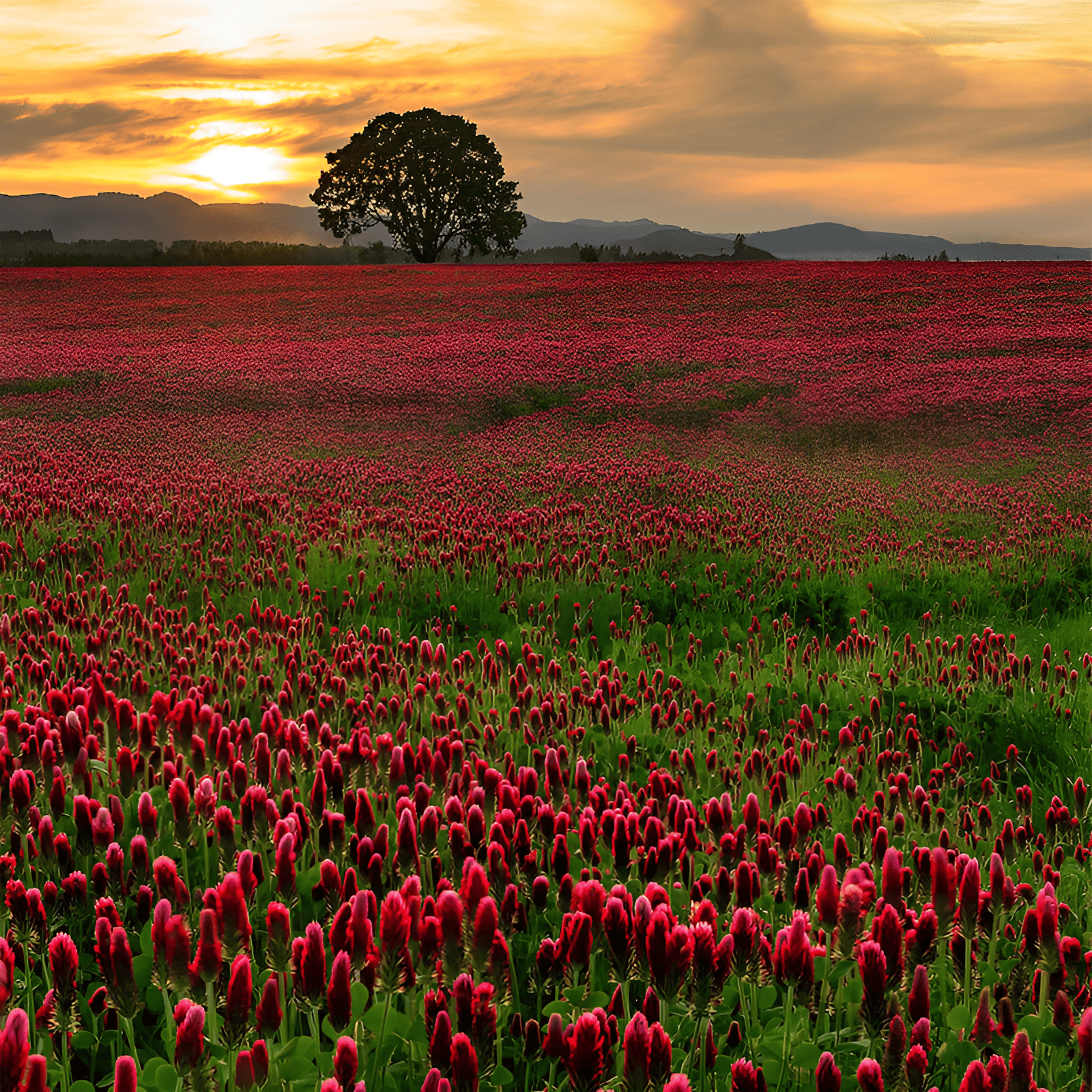
Crimson clover serves several agricultural roles, including cover cropping, forage production, green manure, orchard ground cover, and pollinator habitat. As a legume, it can contribute nitrogen to a cropping system while its above-ground growth provides protective soil cover and organic matter.
Crimson clover can be used as animal feed when managed as an appropriate forage crop. Forage quality varies with plant maturity, growing conditions, harvest timing, and storage method. It may be grazed directly or harvested and properly cured for hay.
Livestock can graze established crimson clover stands, but grazing should be managed carefully. Introduce animals gradually to lush stands, maintain appropriate stocking rates, and provide dry forage when needed. As with other legumes, bloat can occur, so grazing management is important.
Crimson clover can also be cut and cured for hay. Harvest timing affects forage quality and yield, and the material should be dried sufficiently before storage to reduce spoilage and heating.
Crimson clover plant material can also be composted to create an organic soil amendment. Composting converts harvested plant material into stabilized organic matter that can be returned to gardens, fields, and other growing systems.
Crimson clover produces dense crimson flower heads that provide abundant nectar during bloom. The flowers are frequently visited by bees, making crimson clover useful in pollinator plantings, orchards, field borders, and other diversified agricultural systems.
Bees are important floral visitors to crimson clover and move pollen between flowers as they forage. Allowing a portion of a stand to reach bloom can provide a seasonal nectar resource while also supporting beneficial insects within the surrounding growing system.
Flowering time can be managed according to the purpose of the planting. Allowing crimson clover to bloom provides pollinator forage, while terminating the crop before mature seed develops can reduce unwanted reseeding. Where self-seeding is desired, selected areas can be allowed to mature.
Livestock, such as cattle, sheep, and goats, can inadvertently pollinate crimson clover as they walk through fields, transferring pollen between plants. While this effect is typically minor, it contributes to the plant’s reproductive process.
In addition to insects and animals, wind and rain assist in the pollination of crimson clover. The plant produces lightweight pollen grains that can be carried by the wind, while rain washes pollen from flowers to nearby plants, facilitating fertilization.
Crimson clover is used as a cover crop, forage crop, living mulch, pollinator planting, and soil-building legume. The answers below cover common questions about planting, seeding, nitrogen fixation, termination, grazing, and using crimson clover in gardens and agricultural systems.
In mild-winter regions, sow late summer to early fall for spring bloom; in colder climates, sow late summer so plants establish before hard freeze. Spring sowings are possible for summer bloom but provide less weed suppression.
Drill 12–20 lb/acre or broadcast 18–25 lb/acre, adjusting upward for rough seedbeds. Plant 1/4–1/2 inch deep into firm, moist soil. For beds, target roughly 1–2 grams per square meter and keep evenly moist to emerge.
Yes—use the Rhizobium inoculant specific to clovers if the field hasn’t grown clover recently. Inoculation improves nodulation and nitrogen fixation, boosting biomass quality for the next crop.
Well-drained soils with pH around 6.0–7.0. It tolerates a range of textures but struggles in waterlogged clay. Improve drainage and avoid prolonged standing water to protect roots and nodules.
Terminate at early to mid-bloom for a good balance of biomass and easy breakdown. Methods include mowing, crimping, shallow incorporation, or occultation under tarps. Allow 1–2 weeks for residues to mellow before seeding small crops.
If you terminate before full seed set, self-seeding is minimal. Allowing heads to fully mature can lead to volunteer seedlings the following season—use timely termination to manage reseeding.
Yes. Its blooms are excellent bee forage, and it works well as an orchard alley cover. Time termination around bloom to benefit pollinators while preventing excessive seed set.
Yes, in wide-row or perennial systems. Keep clover mowed low between rows and establish clear planting strips so it doesn’t compete with young vegetables for light and moisture.
It can be grazed when managed carefully. Introduce animals gradually, avoid lush wet forage that can cause bloat, and provide access to dry hay. Never graze on fields treated with materials not labeled for forage.
Crop Circle Farms provides site-specific planning and design support for gardens, market gardens, small farms, community food projects, and other growing systems. Services can include site planning, crop layout, irrigation design, production modeling, and implementation support. Contact Us to discuss your site and production goals.
Crop Circle Farms and Growing To Give work with organizations interested in community food production, food security, education, and resource-efficient growing projects. Partnerships can support pilot gardens, demonstration sites, community programs, and larger networks of local food-production systems. Contact Growing To Give to explore a partnership or project.