Remote Sensing Agriculture
Sensing the Entire Farm from Above
Remote-sensing agriculture is transforming how farms are monitored, managed, and optimized. As part of our broader Smart Agriculture Technologies Hub, this approach reduces guesswork by combining field intelligence with real-time visibility. Instead of relying solely on field walks and manual sampling, growers now use satellites, drones, aircraft, and ground-based sensors to observe crops at scale and in real time. The result is a data-rich approach to farming that increases efficiency, reduces waste, and strengthens resilience against climate variability.
At its core, remote sensing agriculture supports precision agriculture by collecting information about crops and soil without physically touching them. Sensors measure reflected light, thermal radiation, and other electromagnetic signals to detect subtle changes in plant health, moisture levels, nutrient status, and even pest pressure. When paired with agricultural IoT systems, what once required days of scouting can now be assessed across thousands of acres in minutes.
Satellite remote sensing provides broad, consistent coverage across regions, states, and even continents. This capability is increasingly used alongside climate risk forecasting to anticipate stress patterns tied to heat, drought, and extreme weather. Platforms operated by organizations such as NASA and European Space Agency deliver multispectral imagery that farmers and agronomists use to calculate vegetation indices like NDVI (Normalized Difference Vegetation Index).
These indices reveal differences in plant vigor that are invisible to the naked eye and complement insights from soil health monitoring technology. A field may appear uniformly green from the ground, but satellite imagery can show early stress patterns caused by:
Because satellites revisit the same location on a regular schedule, they allow growers to monitor change over time. This historical comparison supports outcome tracking for carbon-smart farming and regenerative programs, helping determine whether stress is temporary or indicative of a systemic issue.
For large-scale operations — especially grain, corn, and soy farms spanning thousands of acres — satellite monitoring offers cost-effective surveillance that guides variable-rate fertilizer application and crop-smart irrigation adjustments.
Remote sensing agriculture is supported by decades of research and federal agricultural innovation programs. Organizations such as NASA Earth Observatory publish satellite-derived crop and vegetation analyses that demonstrate how multispectral imagery reveals plant stress patterns and landscape variability.
In the United States, the USDA Precision Agriculture initiatives support adoption of satellite guidance, remote sensing analytics, and variable-rate technologies that improve input efficiency and environmental stewardship.
By aligning field-level implementation with nationally recognized research and innovation frameworks, remote sensing agriculture moves beyond trend — it becomes a validated, data-driven management strategy.
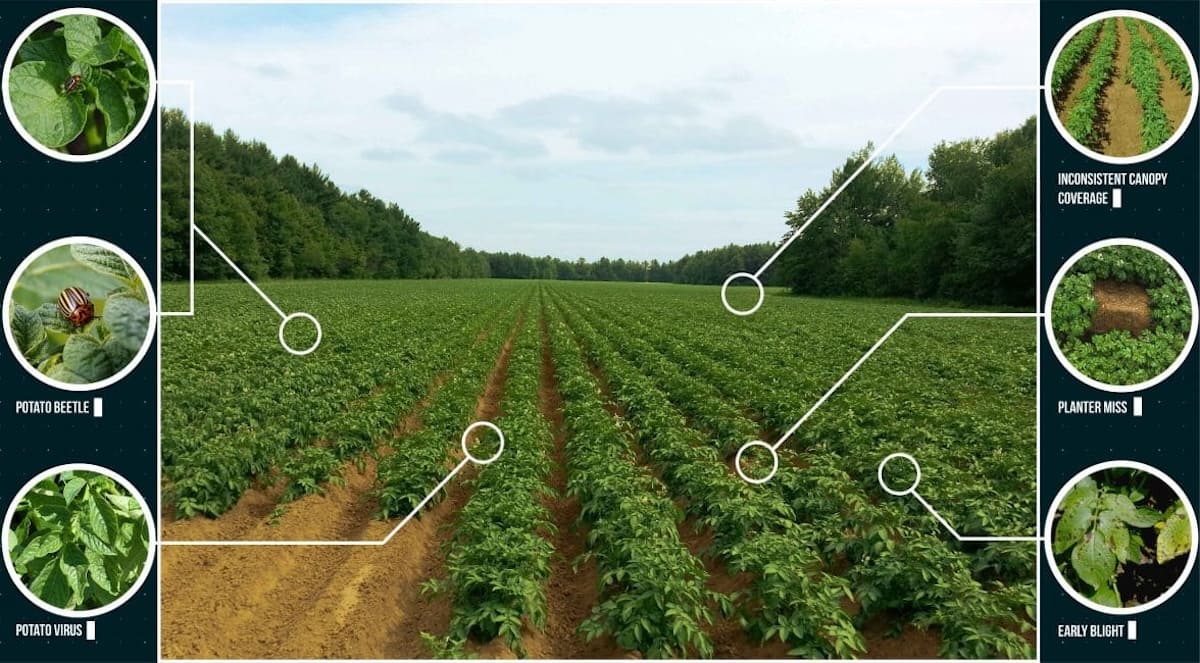
While satellites provide scale, drones deliver precision. Many growers now combine drone mapping with digital twin farming workflows to create a “living field model” that updates as conditions change. Equipped with multispectral or thermal cameras, agricultural drones fly at lower altitudes and capture extremely detailed imagery. Farmers can zoom into specific rows, identify localized stress zones, and even count plants.
Drone-based remote sensing supports:
Unlike satellites, drones can be deployed on demand. After a hailstorm or heatwave, a grower can fly a field the same day to assess damage. This rapid response capability reduces uncertainty and accelerates corrective action, especially when decisions are informed by climate risk forecasting tools.
For specialty crops such as vineyards, orchards, and vegetable systems, drone imaging is particularly valuable because plant spacing and canopy structure vary more than in uniform row crops. In these systems, pairing imagery with soil health monitoring can uncover stress drivers faster and improve response accuracy.
Thermal sensors measure canopy temperature, which correlates strongly with water stress and supports modern water-smart farming strategies. When plants lack adequate moisture, stomata close and canopy temperature rises. Remote thermal imaging allows farmers to identify irrigation gaps before visual wilting occurs.
This capability is especially critical in arid regions like Arizona, where water efficiency directly impacts farm profitability and sustainability. By combining thermal imagery with soil moisture probes and practices from crop-smart irrigation, growers can fine-tune irrigation schedules, reducing water use while maintaining yield.
In many cases, farms implementing remote-sensing irrigation strategies report:
In climates facing increased drought frequency, this technology becomes not just beneficial, but essential — and it fits naturally inside a broader circular agricultural systems framework focused on resource optimization.
Remote sensing is not limited to crop canopy analysis. Hyperspectral sensors can detect subtle soil reflectance patterns that indicate organic matter levels, compaction zones, and nutrient variability. When integrated with GPS-guided equipment — a core pillar of precision agriculture — this information enables variable-rate application of fertilizers.
Instead of applying uniform nitrogen across an entire field, farmers can apply more in deficient areas and less where soil reserves are sufficient. This reduces fertilizer waste, lowers runoff risk, and decreases nitrous oxide emissions — a potent greenhouse gas — reinforcing the goals of carbon-smart farming.
Such integration between sensing and action represents the evolution of precision agriculture from reactive to predictive management, especially when paired with continuous monitoring from agricultural IoT systems.
Remote sensing data increasingly integrates with AI-powered analytics platforms. Weather models, evapotranspiration forecasts, and satellite-derived vegetation indices combine to generate predictive insights. When connected to climate risk forecasting, farmers can anticipate stress before it manifests and plan interventions earlier.
For example:
This predictive layer enhances farm resilience in the face of climate volatility and strengthens long-term planning inside smart regenerative agriculture systems.
In the U.S. Midwest, large-scale corn producers use satellite NDVI mapping throughout the growing season. Early-season imagery identifies uneven emergence caused by planting depth inconsistencies. Mid-season imagery highlights nitrogen deficiencies. Late-season mapping assists with harvest timing and yield estimation — especially when coupled with precision agriculture hardware and analytics.
By pairing imagery with yield monitor data, farms build multi-year performance maps. Over time, this layered dataset improves planting prescriptions and input allocation strategies, increasing yield consistency while reducing unnecessary input costs — outcomes strongly aligned with circular agricultural systems principles.
Remote sensing agriculture is often viewed as advanced technology, but its value is measured in practical outcomes — especially when integrated with digital twin farming and IoT-enabled farm monitoring:
ROI timelines frequently fall within 12–24 months, particularly when integrated with variable-rate technology and GPS-guided equipment. These measurable gains also support verification pathways for blockchain farm traceability and farm data transparency initiatives.
For smallholder farmers, mobile-based satellite data services are expanding access. Subscription platforms now deliver crop health alerts directly to smartphones, democratizing technology once reserved for large enterprises and linking naturally to scalable systems described in our Smart Agriculture Technologies Hub.
Despite its promise, remote sensing agriculture is not without challenges:
However, as AI analytics improve and hardware costs decline, barriers to adoption continue to decrease — especially as more farms adopt integrated stacks across precision agriculture, farm IoT, and predictive analytics.
The future lies in integration. Remote sensing will increasingly merge with autonomous tractors, robotic harvesting systems, digital twin farming models, and blockchain-based farm traceability. Instead of isolated tools, farms will operate as interconnected data ecosystems.
As agricultural systems evolve toward regenerative and climate-smart models, remote sensing provides the feedback loop necessary to measure impact. Whether tracking carbon sequestration, soil health improvement, or water savings, sensing technologies enable transparency and accountability — reinforcing outcomes promoted in our carbon-smart farming and smart regenerative agriculture clusters.
Ultimately, remote-sensing agriculture allows farmers to see what was previously invisible — transforming fields into dynamic, measurable landscapes where decisions are guided by data rather than guesswork. Over time, this becomes a practical foundation for measurable circularity within the Circular Agricultural Systems Hub.
The farm of the future is not just cultivated — it is continuously observed, analyzed, and optimized from above and within.