Climate-Risk Forecasting
Anticipating the Future of a Changing Planet
Climate change is no longer a distant environmental concern—it is a measurable economic, agricultural, infrastructural, and humanitarian risk unfolding in real time. Governments, corporations, insurers, farmers, and investors increasingly rely on climate-risk forecasting to anticipate disruptions before they occur. Much like financial forecasting transformed global markets, climate-risk forecasting is becoming an essential decision-making tool for navigating the 21st century.
At its core, climate-risk forecasting combines climate science, advanced modeling, artificial intelligence, satellite observation, and economic analysis to predict how environmental changes may impact ecosystems, infrastructure, supply chains, and communities over time. Rather than simply describing climate trends, forecasting focuses on actionable foresight—helping organizations prepare for floods, droughts, heat waves, wildfire conditions, sea-level rise, and shifting agricultural productivity.
Traditional weather forecasting looks days or weeks ahead. Climate-risk forecasting operates on a very different timeline, projecting risks years or even decades into the future. These forecasts analyze long-term atmospheric patterns, ocean temperatures, greenhouse gas concentrations, land-use changes, and historical climate behavior.
Modern forecasting systems integrate enormous datasets from satellites, ocean buoys, remote sensors, and ground monitoring networks. Machine learning models process these inputs to simulate possible future scenarios under different emissions pathways or development patterns.
For example, a coastal city may use climate-risk forecasting to estimate:
This shift transforms climate science from an academic discipline into a strategic planning instrument.
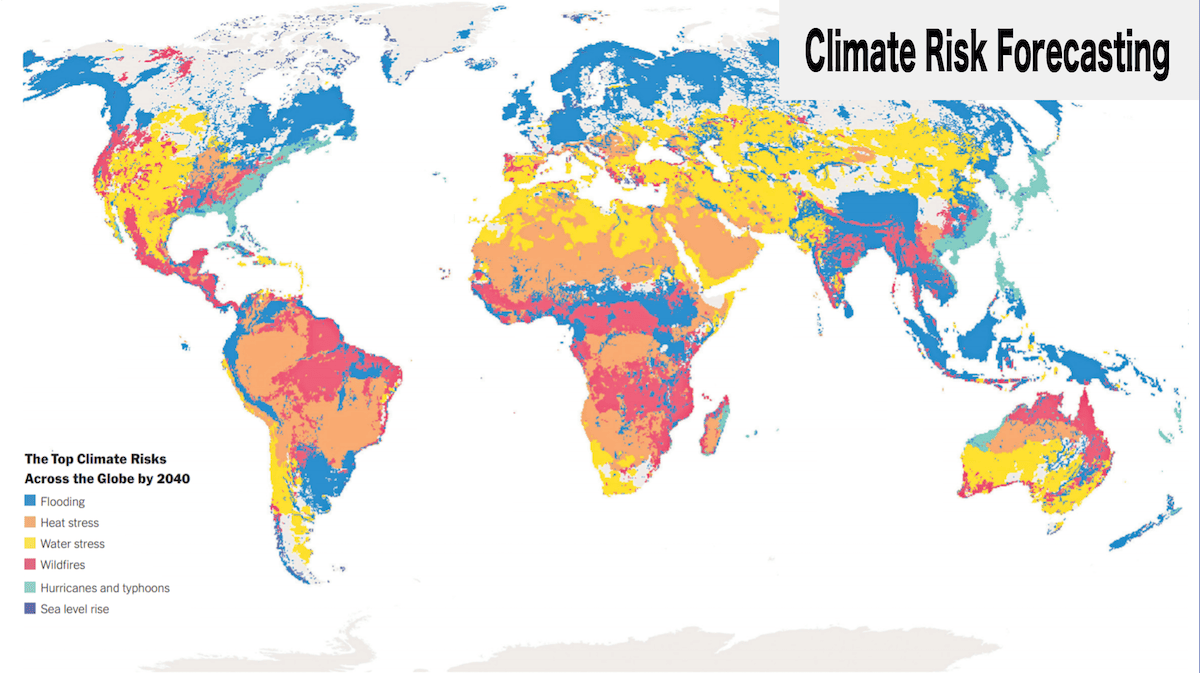
Climate risks increasingly translate into financial risks. Extreme weather events already cause hundreds of billions of dollars in damages annually worldwide. As a result, financial institutions now classify climate exposure alongside credit risk and market volatility.
Use these high-level benchmarks to frame conversations with stakeholders. Refine with local datasets, hazard maps, and scenario planning.
Physical (storms, heat, drought, wildfire) and Transition (policy, markets, technology).
Strategic forecasting looks beyond weekly weather into long-term exposure and adaptation pathways.
Agriculture, infrastructure, insurance, and investment all use climate intelligence to reduce losses.
Climate risks typically fall into two major categories:
These include direct environmental impacts such as hurricanes, haboobs, wildfires, heat stress, crop failures, and water scarcity. Physical risks threaten infrastructure, food systems, and human health.
These arise from economic shifts toward low-carbon systems. Regulatory changes, carbon pricing, technological disruption, and evolving consumer expectations can rapidly alter business models and asset valuations.
Climate-risk forecasting helps organizations understand both categories simultaneously, allowing them to adapt investment strategies, redesign supply chains, or relocate vulnerable operations.
Few sectors benefit more from climate-risk forecasting than agriculture. Farmers historically relied on seasonal experience and regional knowledge, but climate variability is now exceeding historical patterns.
Forecasting models can predict:
This information allows agricultural planners to diversify crops, introduce climate-resilient varieties, optimize irrigation systems, and redesign farming layouts. In drought-prone regions, forecasting may determine whether traditional agriculture remains viable at all.
For emerging regenerative agriculture and agroforestry systems, climate forecasting also supports long-term tree investment models by estimating carbon sequestration potential, survival rates, and ecosystem resilience.
Cities are among the most climate-exposed systems on Earth. Urban planners increasingly depend on climate-risk forecasting to guide infrastructure investments expected to last 50 to 100 years.
Forecast-driven planning influences decisions such as:
Without forecasting, cities risk building tomorrow’s infrastructure using yesterday’s climate assumptions—a costly and dangerous mismatch.
Insurance companies and reinsurance markets are already adjusting premiums based on predictive climate models, signaling how deeply forecasting is reshaping urban economics.
A major advancement in climate-risk forecasting is the emergence of digital twin environments—virtual replicas of ecosystems, cities, or agricultural regions continuously updated with real-world data.
Artificial intelligence enables these systems to simulate thousands of future climate scenarios rapidly. Decision-makers can test interventions before implementing them in reality. For instance, planners might evaluate how wetland restoration reduces flood damage or how reforestation alters regional temperature patterns.
AI-driven forecasting also improves early warning systems, enabling governments to prepare populations weeks or months ahead of severe climate conditions rather than reacting after disasters occur.
Investors increasingly view climate intelligence as a competitive advantage. Asset managers now assess whether portfolios are exposed to climate-sensitive sectors or regions vulnerable to environmental disruption.
Climate-risk forecasting supports:
In many cases, forecasting reveals that proactive adaptation costs far less than disaster recovery. This realization is accelerating investment into resilience projects, ecosystem restoration, and climate-adaptive technologies.
Despite rapid progress, climate-risk forecasting faces important limitations. Climate systems are inherently complex, and uncertainty increases over longer time horizons. Regional forecasting remains particularly challenging due to localized variables such as terrain, urbanization, and microclimates.
Data gaps in developing regions also limit forecasting accuracy, even though these areas are often the most climate-vulnerable.
Another challenge involves translating scientific forecasts into practical policy decisions. Forecasts must be communicated clearly enough for governments, businesses, and communities to act confidently.
Climate-risk forecasting is evolving into a foundational layer of global planning—similar to economic forecasting or national security intelligence. As sensor networks expand, satellite monitoring improves, and AI models mature, forecasts will become increasingly precise and localized.
In the coming decade, climate forecasting may integrate directly into financial reporting, land valuation, insurance underwriting, and agricultural management platforms. Real-time environmental intelligence could guide everything from crop planting decisions to trillion-dollar infrastructure investments.
Ultimately, climate-risk forecasting represents a shift from reacting to environmental crises toward anticipating and designing resilience in advance. In a world defined by rapid environmental change, the ability to see risk before it materializes may become one of humanity’s most valuable tools for sustaining economies, ecosystems, and communities alike.