Growing Peppers
Crop Circle Pepper Farms
Bell peppers are one of the most popular fresh vegetables in the world, appearing in everything from fajitas and stir-fries to stuffed peppers and salads. Globally, more than 70% of bell pepper production comes from Asia, with China leading the way, followed by Mexico and Indonesia. In the United States, California is the top pepper-producing state, and open-field agriculture still dominates commercial production.
How long do peppers take to grow? Many peppers reach first harvest in 60–90 days after transplanting (longer from seed), depending on variety and temperature.
What temperature do pepper seeds need to germinate? Peppers germinate best at 75–85°F (24–29°C). Cooler temperatures slow or stall germination.
How far apart should pepper plants be spaced? Space most types 14–18 inches, or 18–24 inches for larger, heavily loaded varieties.
Why do peppers get blossom end rot? It’s usually caused by irregular moisture and disrupted calcium uptake—keep watering steady and avoid over-fertilizing.
Each year, U.S. farmers grow roughly 2 billion pounds of bell peppers on about 60,000 acres of land. Despite this impressive output, the U.S. still imports around 70% of its bell peppers, most of them from Mexico and Central America. That gap between domestic production and demand represents an enormous opportunity for innovative growers who can produce more peppers per acre using less water, less fertilizer, and more resilient systems.
In colder climates, commercial peppers are often produced in protected environments that extend the growing season. Canada has developed a particularly large greenhouse pepper industry. In 2024, Canadian greenhouse growers produced approximately 175,500 metric tons of peppers, with major production concentrated in Ontario and British Columbia. Canada also imports peppers, particularly during seasonal supply gaps, while exporting substantial greenhouse production to other markets.
Bell peppers can be an extremely profitable crop when managed correctly, but they are also risky. One of the biggest challenges is the pepper plant’s tendency to drop blossoms when night temperatures fall below 60–65°F. Sudden temperature swings, poor soil structure, and inconsistent moisture also impact yield and quality. Healthy pepper production starts with strong pepper plants and optimized soil.
Peppers perform best in well-drained soil with consistent moisture and balanced fertility. Nutrient applications should be based on soil-test results, crop requirements, and existing nutrient levels rather than a fixed fertilizer formula. A mildly acidic soil, generally around pH 6.0–6.8, supports good nutrient availability for peppers.
Magnesium and sulfur are essential plant nutrients, and magnesium sulfate (Epsom salt) can be used to correct a confirmed magnesium deficiency. However, routine Epsom-salt applications are unnecessary when soil and plant magnesium levels are already adequate. Soil or tissue testing can help determine whether supplemental magnesium is actually needed.
Whether you are growing peppers in a backyard garden, a commercial field, or a Crop Circle Pepper Farm, dialing in the right soil fertility, irrigation, and plant spacing is the foundation for high-yield, high-quality pepper production.
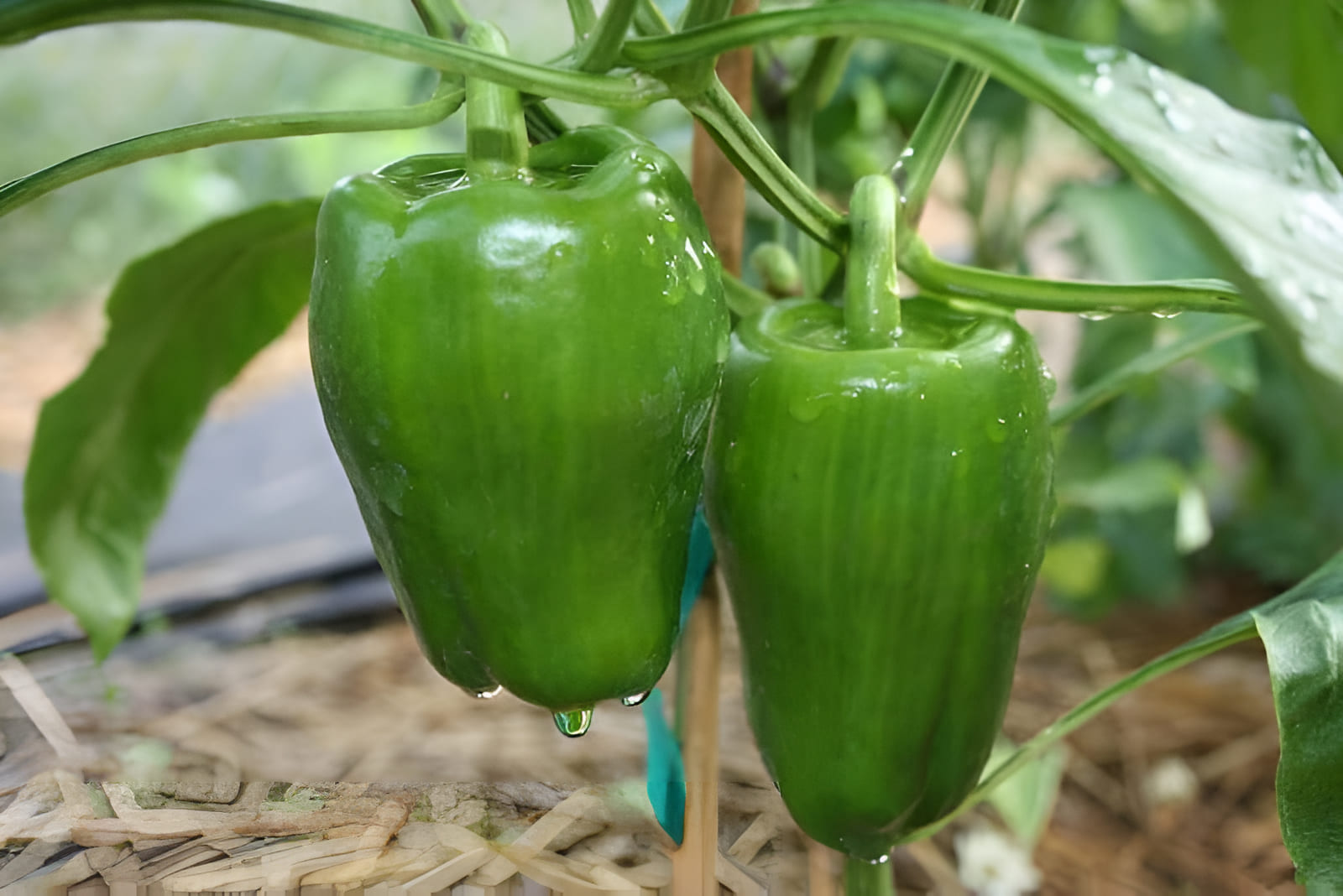
Traditional open-field pepper production typically uses long, straight, parallel rows of plants. Historically, many of these fields are irrigated by flooding furrows between the rows. While flood irrigation is a familiar method, it uses— and wastes— a tremendous amount of water. Much of that water evaporates or travels beyond the root zone rather than being absorbed by pepper plants.
In water-stressed regions, some growers have switched to drip irrigation, which delivers water directly to the root zone and significantly reduces total water usage. However, in places like California, where severe water restrictions continue to tighten, even drip irrigation systems are facing new regulatory and economic pressure. Pepper farms are being forced to rethink how they irrigate, where they plant, and how to maintain profitability while using far less water per pound of peppers produced.
Open-field peppers also face increasing threats from extreme weather events. Pepper plants and their developing fruit are delicate and vulnerable to sudden storms that bring high winds, hail, and driving rain—events becoming more common with climate change. Strong winds can snap stems, shred leaves, and scar fruit, while hail can devastate an entire field in minutes.
Another limitation of row-based systems is the pattern of shadowing between rows. As the sun moves across the sky, tall plants in one row cast shade onto plants in neighboring rows, creating inconsistent light exposure and uneven ripening. This can reduce photosynthesis, impact flower set, and ultimately lower yields.
Conventional pepper production may use synthetic fertilizers, herbicides, insecticides, fungicides, and—in some production regions—pre-plant soil fumigants. The specific inputs vary considerably by region, pest pressure, production system, regulations, and integrated pest-management practices. Improving crop rotation, soil health, irrigation efficiency, and targeted pest management can reduce unnecessary inputs while protecting yield.
Large-scale open-field pepper production comes with a range of agronomic and environmental challenges:
To address these problems and reduce environmental impacts, growers increasingly turn to sustainable farming practices: crop rotation, cover cropping, mulching, beneficial insects, biological controls, and more efficient irrigation. For growers ready to go further, innovative systems such as spiral crop formations and Crop Circle Pepper Farms offer a way to redesign the entire layout of a pepper field for resilience and high yield.
Greenhouse peppers were once seen as a safer alternative to field production. Controlled environments protect plants from wind, hail, and frost, and allow growers to manage temperature, humidity, and CO2 for maximum yield. However, greenhouses come with their own limitations and environmental concerns.
With rising energy costs, heating and lighting greenhouses has become significantly more expensive. There is a limit to how much cost can be passed along to consumers, and many wholesalers resist raising prices, compressing margins and pushing some hothouse operations out of business.
Greenhouse peppers are also vulnerable to fungal outbreaks such as Botrytis (gray mold) and powdery mildew. In a closed environment, these diseases can spread rapidly. If infections are not contained early, entire crops may need to be removed and structures sanitized or fumigated. This is expensive, disruptive, and environmentally costly.
Greenhouse pepper production can also raise several environmental and quality concerns:
Forward-thinking greenhouse growers are responding by improving energy efficiency, exploring passive solar designs, adopting biological pest controls, and shifting toward open-pollinated and heirloom varieties when possible. But even with improvements, the combination of high capital costs and energy dependence makes greenhouse peppers a challenging long-term solution for many regions.
This is where the Crop Circle Pepper Farm model—rooted in spiral crop formations, water-smart irrigation, and modular design—offers a compelling alternative that can be deployed on small parcels of land close to where people live.
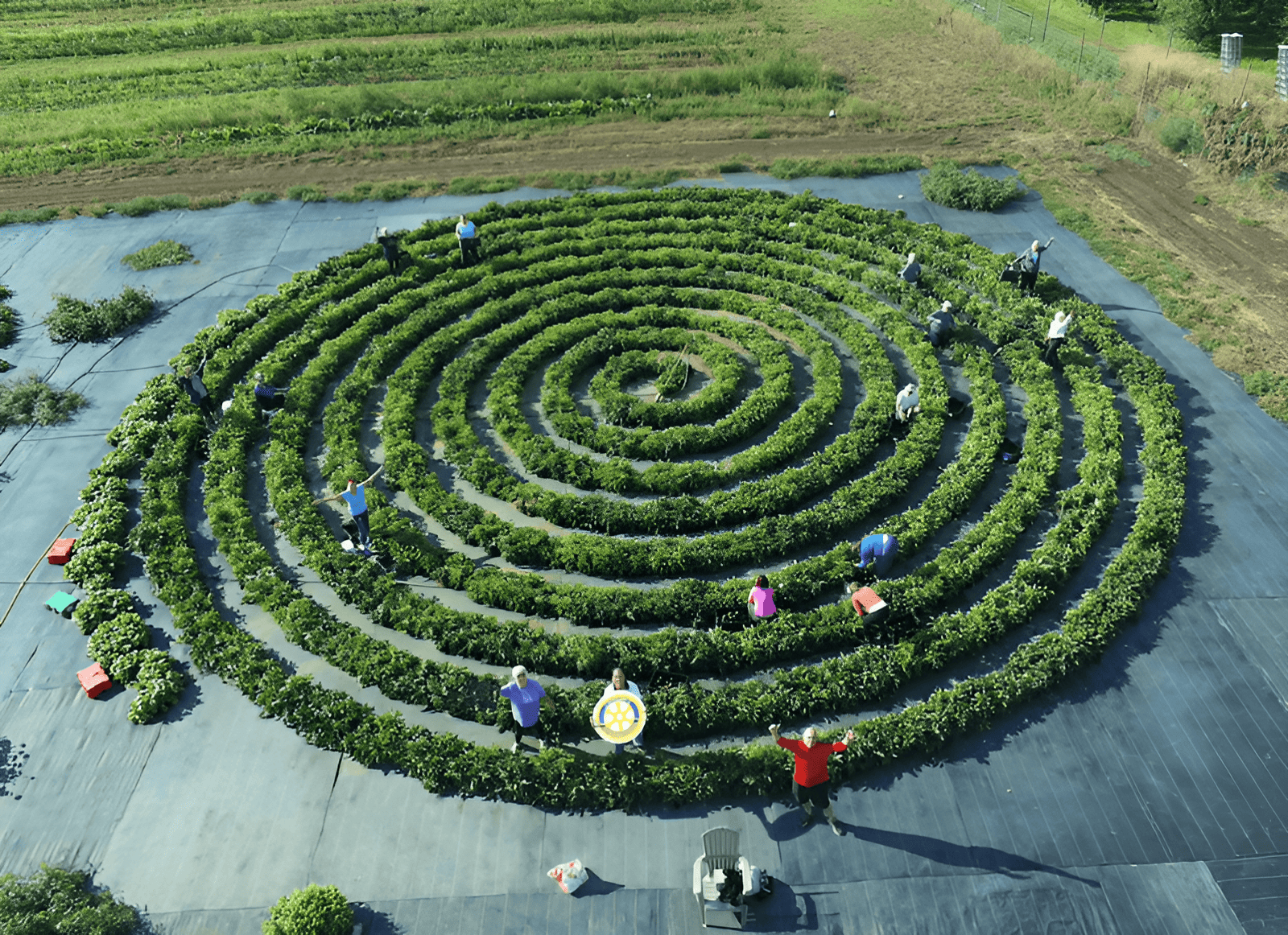
The era of cheap water, cheap fertilizer, and predictable weather is ending. Farms in drought-stricken regions are shutting down, greenhouses are being priced out by energy costs, and synthetic fertilizers have tripled in price in some markets—if you can get them at all. For growers who want to stay in business, it is no longer enough to be efficient; they must become radically efficient.
Crop Circle Pepper Farms® were created with these realities in mind. They are designed to grow peppers with dramatically less water, less fertilizer, and more protection from climate extremes, while increasing yields per acre and bringing production closer to consumers in towns and cities.
The first key innovation is the Crop Circle Irrigator®. These proprietary irrigators concentrate water and nutrients within the active root zone, helping maintain consistent moisture while reducing losses beyond the immediate growing area. This root-focused irrigation system is designed to give pepper plants reliable access to moisture and nutrients throughout the growing season.
Crop Circle Farms systems are designed to use up to 90% less water and 85% less fertilizer than conventional production methods under appropriate operating conditions. Actual savings vary according to climate, soil, crop density, irrigation practices, and the conventional system used for comparison.
The second key element is a permeable, dark-colored ground cover. This fabric suppresses weed growth, reduces surface evaporation, and can moderate soil-temperature fluctuations. By absorbing solar energy during the day, dark ground covers can also help warm the soil and root zone during cooler periods.
The third innovation is the spiral crop formation itself. Instead of growing peppers in straight rows, plants are arranged in large, looping spirals that follow the arc of the sun. This geometry:
Combined with the proprietary irrigator system and soil-structure best practices, spiral crop formations grow bigger, more resilient pepper plants that yield significantly more fruit—in some cases four times more peppers per square foot compared to open-field production.
Higher yields per acre and much lower input costs create excellent pepper profit potential on surprisingly small parcels of land. Crop Circle Pepper Farms can be installed on quarter-acre or half-acre sites near urban centers, allowing growers to serve local restaurants, farmers markets, and grocery stores with fresh, thick-walled, high-quality bell peppers grown sustainably right where most of the buying public lives.
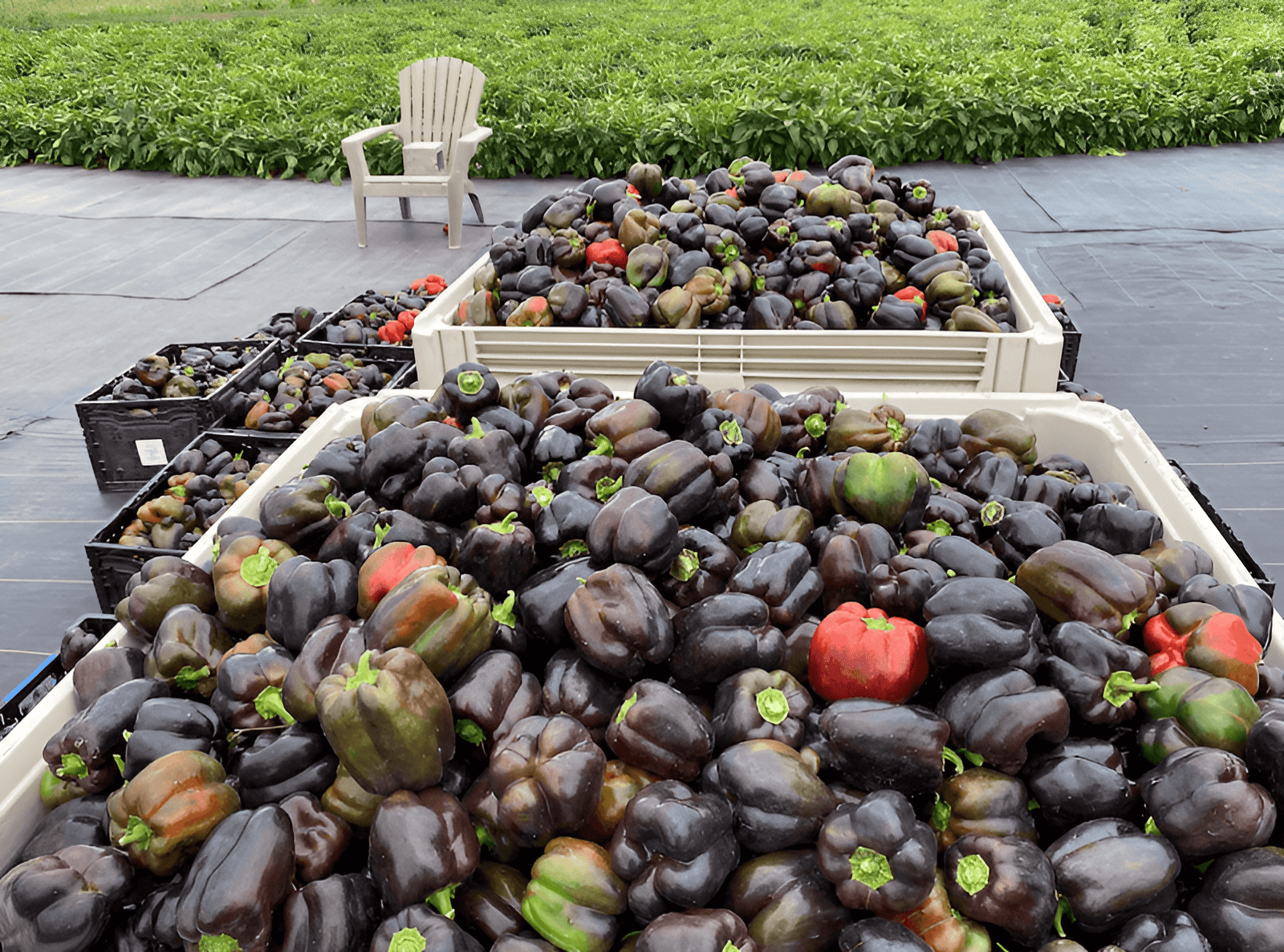
Much like tomato production , a Crop Circle Pepper Farm can exceed the yield of both traditional greenhouse and open-field pepper cultivation—using less water and fertilizer while delivering higher quality fruit.
Here is what a properly designed spiral pepper farm can produce:
Conventional pepper yields vary considerably by region, variety, planting density, climate, irrigation, disease pressure, and management practices. Crop Circle Pepper Farms are designed to increase production per unit of land while reducing water and fertilizer requirements. For additional context on conventional vegetable production yields, see: Average Yield Comparison Per Row Farm Acre .
When you combine higher yields with lower input costs—especially water and fertilizer—a Spiral Crop Circle Pepper Farm offers a powerful model for profitable, climate-smart pepper production in both rural and urban settings.
Turn one acre into a resource-efficient, high-production farm.
Crop Circle Farms designs and builds resource-efficient agricultural systems tailored to site conditions, crops, water availability, and production goals. Our field-tested systems have demonstrated up to 90% lower water use, up to 85% lower fertilizer requirements, and two to three times the production with selected crops and configurations compared with conventional layouts.
Contact Us to explore a custom Crop Circle Farm design for your property.
Help expand our mission to implement proven farm and garden models in food-insecure communities, island communities, schools, and water-stressed regions.
Contact Growing To Give to learn about supporting community food-production projects and resource-efficient growing systems.
Use these pepper-growing FAQs to troubleshoot common problems and improve your seed-to-harvest approach. For additional growing information, explore our growing peppers guide and Crop Circle Farms water-smart growing systems.
Pepper seeds germinate best in warm conditions of approximately 75–85°F (24–29°C). Germination becomes slower as temperatures fall, and cool, overly wet growing media can increase the risk of seed rot and damping-off.
A seedling heat mat can help maintain consistent root-zone temperature. Under favorable conditions, many sweet and hot peppers emerge within 7–21 days, although some slow-germinating and very hot varieties may take longer. Keep the seed-starting mix evenly moist but not waterlogged. Once seedlings are established, gradually increase airflow and light. Learn more about developing healthy pepper plants .
Spacing depends on variety, climate, growing system, and expected plant size. Compact bell peppers, jalapeños, and serranos can often be spaced about 14–18 inches apart, while larger or heavily fruiting plants may perform better at 18–24 inches. Conventional row spacing commonly ranges from about 24–36 inches.
Peppers can also be arranged in blocks, raised beds, or spiral formations where access, airflow, irrigation, and plant size are considered together. Explore our Crop Circle Raised Gardens for an alternative approach to high-density garden layouts. Stakes, cages, or trellis supports can help prevent branches from breaking as plants become heavily loaded with fruit.
Pepper plants generally do not require aggressive pruning. Selective pruning can be useful for removing damaged, diseased, or soil-contacting leaves and for improving airflow in an excessively dense canopy.
As plants grow, remove only enough interior growth to improve airflow and access without stripping away too much foliage. In hot, sunny climates, maintaining adequate leaf cover is particularly important because the canopy helps protect fruit from sunscald. Sanitize pruning tools when disease is present to reduce the risk of spreading pathogens between plants.
Peppers perform best with consistent root-zone moisture. Large swings between very dry and very wet soil can contribute to blossom drop, blossom end rot, fruit cracking, and uneven growth. As a general starting point, many garden peppers require roughly 1–1.5 inches of water per week, but actual irrigation needs vary with temperature, wind, rainfall, soil type, plant size, and container volume.
Drip irrigation and mulch can help maintain more consistent moisture while limiting unnecessary foliage wetting. Fertility should be based on soil-test results, crop needs, and existing nutrient levels rather than a fixed fertilizer formula. Excessive nitrogen can produce vigorous foliage at the expense of flowering and fruit production. A mildly acidic soil, generally around pH 6.0–6.8, supports good nutrient availability for peppers.
Blossom end rot appears as a dark, sunken area at the blossom end of the fruit. It is a physiological disorder, not an infectious disease. It develops when insufficient calcium reaches rapidly growing fruit, often because soil moisture fluctuates or root uptake is disrupted.
To reduce blossom end rot, maintain consistent soil moisture, avoid excessive fertilizer salts, protect root health, and use soil testing to identify actual nutrient deficiencies. Lime, gypsum, or other calcium amendments should only be used when soil conditions indicate they are appropriate.
Misshapen fruit can also result from cool or excessively hot weather during flowering, incomplete pollination, insect injury, or other early fruit-development stresses. Season extension, shade, appropriate irrigation, and protection from temperature extremes can improve fruit development.
Peppers are warm-season plants, but flowering and fruit set can decline when temperatures become too cool or too hot. Many peppers perform well when daytime temperatures are roughly 70–85°F (21–29°C) and nights remain near 60–70°F (15–21°C).
Cool nights can slow growth and interfere with pollination, while repeated daytime temperatures above about 95°F (35°C), especially when nights remain hot, can increase blossom drop. During heat waves, consistent irrigation and appropriately selected shade cloth can reduce plant stress. Low tunnels and row covers can help protect peppers during cool shoulder seasons.
Common pepper pests include aphids, thrips, spider mites, caterpillars, leafminers, and—in some regions—pepper weevil. Regular scouting and integrated pest management can help identify problems before populations become difficult to control. See our guide to farm and garden pests for additional identification and management information.
Pepper diseases can include bacterial leaf spot, Phytophthora root and crown rot, powdery mildew, and several viral diseases. Good drainage, crop rotation, appropriate spacing, resistant varieties where available, sanitation, and careful irrigation can reduce disease pressure. Learn more in our guide to farm and garden plant diseases .
Many peppers can be harvested while green or allowed to mature to their final color. Green peppers are immature fruit and generally have a firmer texture and less developed sweetness than fully colored peppers. Allowing fruit to mature to red, yellow, orange, chocolate, purple, or another final color can change flavor, sweetness, and heat depending on the variety.
Harvest when fruit has reached the desired size, color, and firmness. Use scissors or pruners to cut peppers from the plant rather than pulling them, which can damage branches. Regular harvesting can also encourage plants to continue setting and developing additional fruit.
Beginner-friendly peppers are generally varieties that establish readily, mature within the local growing season, and produce consistently under typical garden conditions. Good options can include:
Very hot peppers such as Carolina Reaper and Trinidad Scorpion often require a longer warm season and can germinate and mature more slowly. In cooler climates, start these varieties indoors early or use protected growing conditions.
Yes. Peppers grow well in containers, raised beds, and Crop Circle growing systems when they have adequate root volume, drainage, sunlight, and consistent moisture. Containers of approximately 5–10 gallons work for many varieties, while larger, vigorous pepper plants can benefit from additional root volume.
Use a high-quality, well-drained potting mix and make sure the container has unobstructed drainage holes. Avoid compacting the growing medium or allowing containers to remain waterlogged. In Crop Circle Raised Gardens and spiral systems, group plants according to mature size and provide stakes or cages for heavily loaded varieties.
Drip irrigation or root-zone irrigation combined with mulch can help maintain consistent moisture, which is especially important in containers that dry rapidly during hot weather. Crop Circle Farms systems are designed to increase production per unit of land while reducing water and fertilizer requirements. Under appropriate operating conditions, selected Crop Circle Farms systems have demonstrated up to 90% lower water use and up to 85% lower fertilizer requirements compared with conventional production methods. Learn more about Crop Circle Farms .
Improve pepper production with practical guides covering plant growth, heat levels, yield planning, and crop nutrition.
Learn how pepper plants grow, flower, set fruit, respond to temperature, and develop into productive sweet and hot pepper plants.
Compare the heat of jalapeños, serranos, habaneros, cayennes, super-hot peppers, and other varieties using Scoville Heat Units.
Estimate crop production from plant counts, expected yield per plant, growing area, and other production assumptions.
Explore crop nutrition, fertilizer efficiency, and approaches designed to deliver nutrients where growing plants can use them effectively.
Combine variety selection, realistic yield planning, balanced nutrition, and consistent irrigation to build a more productive pepper-growing system.