Growing Beets
Archimedean Beet Beds
Key links: Microbial Fertilizers • Cover Crops • Alfalfa Cover Crop • Sustainable Agriculture • Circular Agriculture • Biodiversity Hub • Pollinators • To Bee or Not To Bee • Climate Stress Resilience Calculator • Food Security Calculator.
| Factor | Conventional Rows | Crop Circle Targeted System |
|---|---|---|
| Irrigation | Broadcast / flood | Targeted drip |
| Fertilizer delivery | Field-wide application | Root-zone delivery |
| Water use | Higher | Lower potential (design-dependent) |
| Weed pressure | Higher | Suppressed via mulch/fabric options |
| Soil biology | Often disturbed by tillage | Preserved & built with biology-forward inputs |
Beets are a high-value, storage-friendly crop that performs well in small spaces and market gardens when soil structure and moisture are managed consistently.
About 300 years ago, farmers began growing sugar beet as a local alternative to expensive imported sugar from sugar cane. For generations, sugar beets were grown as an industrial crop, not a kitchen favorite. The arrival of artificial sweeteners and cheap refined sugar over the last 50 years has lowered prices to the point where large-scale sugar beet farming is no longer economical in many regions.
Today, a new kind of beet farming is taking center stage. Instead of growing beets just for sugar, growers are rediscovering table beets—deep red, golden, and candy-striped varieties bred for flavor, color, and texture. These modern garden beets are tender, quick-cooking, and naturally sweet. Both beet roots and beet tops are nutrient-dense, rich in fiber, iron, folate, potassium, and plant compounds that support circulation and liver health. In fact, beet greens often rival or exceed “super greens” like kale in many vitamins and minerals.
Beets are also a fantastic crop for long-term food storage. Properly cured roots can keep for an entire winter in a cool, dark, slightly humid place such as a root cellar, holding their nutrition and flavor. In milder climates, beets can even be left in the ground under a thick mulch layer to overwinter. In spring, the overwintered beet grows new tender tops that can be harvested again and again, providing a continuous supply of nutrient-rich greens.
Many home gardeners throw away beet skins and tops, but they are too valuable to waste. Washed and thinly sliced beet skins add color and nutrients to salads, stir-fries, and soups, and can be blended into juices and smoothies. Beet tops sautéed with garlic and olive oil or added to stews are a simple way to get more nutrition out of every beet you grow.
Present-day commercial beet farms are almost entirely dependent on machinery to till, furrow, seed, weed, irrigate, harvest, and pack. A typical industrial beet rotation begins with deep tillage using a moldboard plow that inverts the soil to a depth of 9 inches or more. A disk ripper or chisel plow is then used to further break up working soil and prepare the seedbed for fertilization.
A tractor-pulled manure spreader or fertilizer applicator broadcasts aged manure or synthetic fertilizer across the entire field, followed by a second tillage pass to work nutrients into the soil. After the soil settles for a week or so, a disk cultivator defines parallel furrows, and a pneumatic seeder sows beet seed in long, straight rows. Herbicides or mechanical cultivators are used for weed control, often requiring multiple passes during early growth.
At harvest, a tractor-pulled lifting fork or beet harvester loosens the roots and feeds them onto a conveyor into a beet truck running parallel to the machine. This heavy, equipment-intensive approach works for commodity production, but it comes with a cost—soil compaction, damaged soil biology, reliance on synthetic fertilizers, and high water use. For smallholder farmers, community gardens, and urban micro-farms, there is a better way to grow beets.
Model outcomes with the Climate Stress Resilience Calculator and estimate community impact with the Food Security Calculator.
Explore how beets connect with sugar production, renewable fuels, nutrient-dense food, and space-efficient Crop Circle growing systems.
Learn how sugar beets are grown as a commercial root crop, how they differ from table beets, and how their stored sugars are used in food and industrial production.
Explore ethanol production, agricultural feedstocks, renewable fuel systems, and the role sugar-rich crops can play in biofuel production.
Learn how crop selection, soil fertility, growing conditions, harvest timing, and food diversity contribute to the nutritional quality of fruits and vegetables.
Explore circular and spiral growing layouts designed to use space efficiently while supporting targeted irrigation, crop diversity, and productive planting systems.
From table beets and sugar crops to soil health and circular growing layouts, these guides explore the wider role of beets in food and agricultural systems.
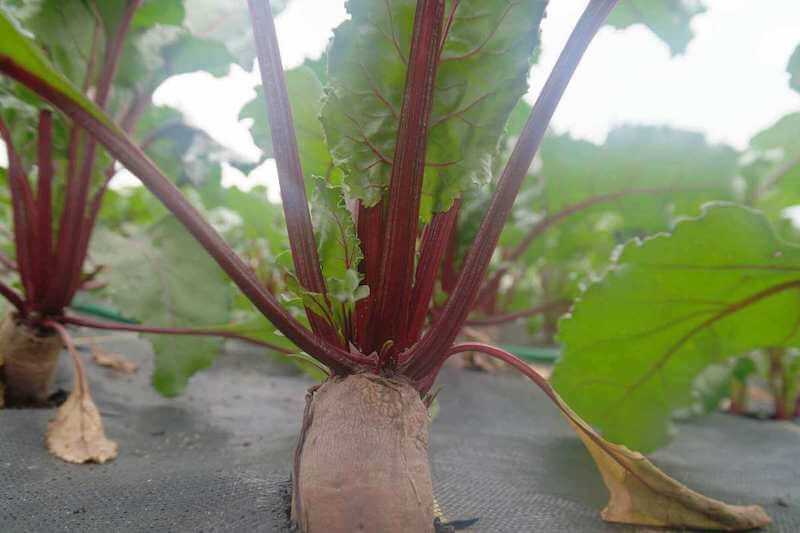
In North America and Europe, most farms larger than five acres, and nearly 80% of farms in many regions of the world, rely on mechanized agriculture. Tractors, diesel pumps, synthetic fertilizers, and chemical herbicides have dramatically increased short-term yields—but they also drive long-term environmental damage. Industrialized beet farming is part of a global food system that is now one of the largest contributors to climate change and ecosystem decline.
To keep growing beets for local markets, CSA programs, and healthy families, a different model is needed—one that works with soil biology, protects water, and builds long-term fertility instead of mining it. That is where Crop Circle Farms® and regenerative agriculture principles come in.

A more sustainable approach to beet farming must be adopted if we are to reverse soil degradation and water waste. Regenerative agriculture focuses on building soil health, restoring biodiversity, and cycling nutrients in closed loops. When combined with water-saving irrigation technologies, regenerative methods can grow more food with dramatically fewer inputs.
Crop Circle Farms® has developed an agricultural system that uses “targeted agriculture” to deliver fertility and water directly to each plant, instead of saturating an entire field. Pre-shaped circular layouts, root tubes, and water-smart irrigators focus resources where they matter most—around each beet root’s active root zone.
Instead of endless parallel rows, Crop Circle Farms grows beets in geometric circles and spirals— Crop Circles® designed for maximum light capture, minimum weed pressure, and efficient irrigation. Curved beds create a compact, high-density layout that can be adapted to backyard gardens, urban rooftops, and smallholder farms.
Each circle or spiral bed is laid out over a ground cover that blocks weeds. Open planting strips are cut into the fabric, exposing just enough soil for seeded beets. Drip lines or micro-emitters run directly along these strips, delivering moisture only where roots can use it. In many projects, Crop Circles use up to 90% less water and 95% less fertilizer compared with conventional broadcast irrigation.
Popular beet varieties for Crop Circle layouts include:
By choosing the right variety for your climate and market—table beets, storage beets, or specialty colors—small farms can diversify their offerings while keeping production efficient and water-smart. Crop Circle layouts also make it easy to integrate cover crops and pollinator strips around beet production zones for truly sustainable agriculture.
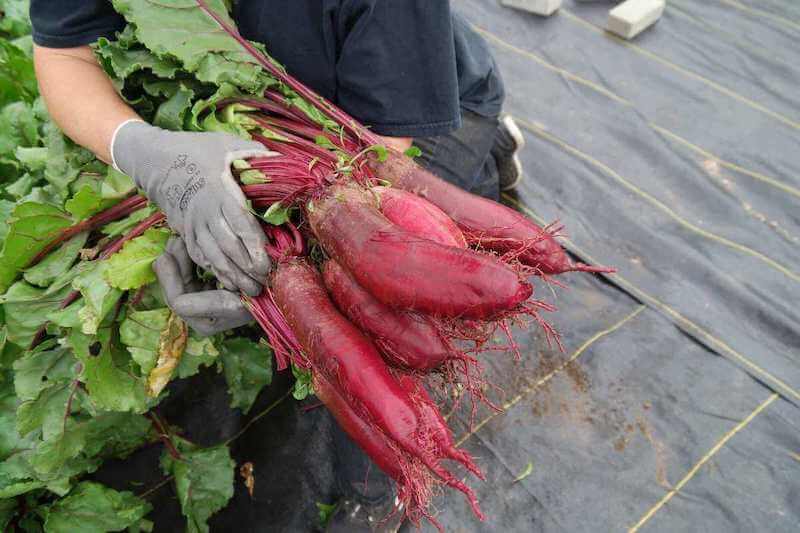
Crop Circle Farming uses a targeted agriculture strategy to feed each plant at the root instead of irrigating and fertilizing large areas with no production value. Water and nutrients are delivered precisely where beet roots can use them, while landscape fabric or living mulches suppress weeds. This combination of direct feeding and weed suppression allows beets to put all their energy into sizing up, not competing.
The result is a uniform stand of large, smooth, deeply colored roots with tender greens—exactly what chefs, CSA members, and fresh-market shoppers are willing to pay more for. In trials and smallholder projects, eliminating plant competition and focusing inputs at the root zone has consistently produced bigger, more flavorful beets in less time compared with conventional rows.
Crop Circle layouts are also ideal for integrating beets into mixed, intensive plantings. Rings of beets can be interplanted with fast-growing salad greens, scallions, or herbs in the outer bands, allowing farmers to harvest multiple crops from the same square foot of soil. For planning yield and revenue, you can use tools like our Farm Yield Calculator to estimate root counts and total harvest from a Crop Circle beet bed.
Whether you are a backyard gardener or a small commercial grower, transitioning from traditional rows to Crop Circle layouts means:
Ready to explore a productive, resource-efficient farm? Crop Circle Farms designs site-specific growing systems based on climate, soil, water availability, crop selection, irrigation, labor, operating requirements, and market goals. Contact Us to explore a Crop Circle Farm design for your property or project.
We work with partners interested in expanding resource-efficient food production in food-insecure communities, island regions, and areas facing water stress. Projects can support local food access, education, workforce development, and community-scale food production. Contact Growing To Give to discuss an initiative or partnership.
Get quick answers to common questions about soil, spacing, watering, fertilizing, pest control, and harvest/storage so you can grow sweet, uniform beets and nutrient-dense greens.
Beets thrive in loose, stone-free soil with good drainage and a slightly acidic to neutral pH of about 6.2–7.0. Heavy clay causes misshapen roots, so work in compost to improve structure. Avoid applying fresh manure right before planting—excess nitrogen encourages hairy roots and lush tops with undersized bulbs. If your soil is very acidic, a light application of lime can help bring pH into the ideal range for healthy beet growth.
Beet “seeds” are actually clusters, so multiple seedlings often emerge from a single spot. For even, market-quality roots, sow clusters about 1 inch apart in rows spaced 12–18 inches apart. Once seedlings reach 2–3 inches tall, thin to 3–4 inches between plants in the row. Don’t toss the extras—use the thinnings as baby beet greens in salads. Proper thinning is one of the most important steps to avoid crowded, misshapen roots.
Beets prefer steady, even moisture. Allowing the soil to swing between very dry and very wet can cause woody texture, cracking, and internal zoning. Drip irrigation or a soaker hose under mulch works best to keep the root zone consistently moist. Focus on even watering from “golf-ball” size until harvest, and avoid frequent, shallow watering that only wets the top inch of soil and encourages weak, shallow roots.
Beets need moderate nitrogen and good levels of phosphorus and potassium to build strong roots. Too much nitrogen produces big tops and small, fibrous bulbs. A balanced organic fertilizer or compost-based program works well, especially when paired with soil testing. Boron is a key micronutrient for beets—deficiency can cause black hearts, cracking, and poor internal quality. If your soil test shows low boron, look for a fertilizer or foliar feed that includes a micro package specifically labeled for root crops, and always follow label rates carefully.
Common beet pests include leaf miners, which tunnel between leaf layers, and flea beetles, which chew small shot holes in foliage. Use light row cover early in the season, or scout regularly and remove heavily mined leaves to break the life cycle. For disease, Cercospora leaf spot is a frequent issue in humid climates. Good crop rotation, adequate spacing, and avoiding overhead watering late in the day all help reduce disease pressure. Remove severely infected leaves to keep the canopy open and healthy.
For the best flavor and tenderness, harvest beets at 1.5–3 inches in diameter. Larger roots can become woody or develop strong, earthy flavors. Loosen the soil around the root and pull gently by the base of the stems. Twist or cut off the tops, leaving about an inch of stem to reduce bleeding. Rinse lightly and store unwashed roots in perforated bags or crates at near-freezing temperatures with high humidity. Properly cured and cooled, beets keep for months, while their nutrient-dense greens are best enjoyed fresh or lightly sautéed soon after harvest.