Sugar Beets
Nothing Could be Sweeter
Sugar beet is a relatively recent crop developed from white fodder beet through selection for higher sucrose content. In 1747, German chemist Andreas Sigismund Marggraf demonstrated that sucrose could be obtained from beets. Continued breeding and improvements in processing during the late eighteenth and early nineteenth centuries helped establish sugar beet as a commercial source of sugar in Europe.
Beet-sugar production expanded substantially during the Napoleonic era, when disruptions to imported cane sugar increased European interest in producing sugar from domestically grown beets.
Commercial sugar beets belong to the species Beta vulgaris, the same species that also includes table beets, Swiss chard, and fodder beets. Sugar beet cultivars, however, are bred specifically for high root yield, sucrose concentration, recoverable sugar, disease resistance, and performance under commercial field conditions.
Unlike common red table beets, commercial sugar beets typically develop large, pale or white roots. Variety selection is usually based on local growing conditions, disease pressure, processor requirements, and regional performance trials rather than root color or culinary characteristics.
Modern commercial sugar beet production relies heavily on hybrid varieties. Seed companies continually introduce cultivars selected for combinations of yield, recoverable sucrose, stand establishment, harvestability, and resistance or tolerance to important diseases and pests.
The best-performing variety can differ considerably from one production area to another. Growers should therefore use current regional variety trials, processor-approved variety lists, and local extension recommendations when choosing seed.
Sugar beet varieties may be selected for several important characteristics, including:
Disease resistance is particularly important because no single cultivar is necessarily best for every field. A variety that performs well in a field with Rhizoctonia pressure, for example, may not be the preferred choice where Cercospora leaf spot, nematodes, or other problems are the primary concern.
Sugar beets should not be confused with the red, golden, striped, or specialty beets commonly grown for fresh-market or culinary use. Table beets are selected primarily for characteristics such as flavor, tenderness, color, shape, and eating quality. Sugar beets are selected primarily for agricultural performance and the amount of recoverable sucrose that can be extracted from the root.
Both crops are closely related botanically, but they are grown for very different purposes and are managed as distinct agricultural crops.
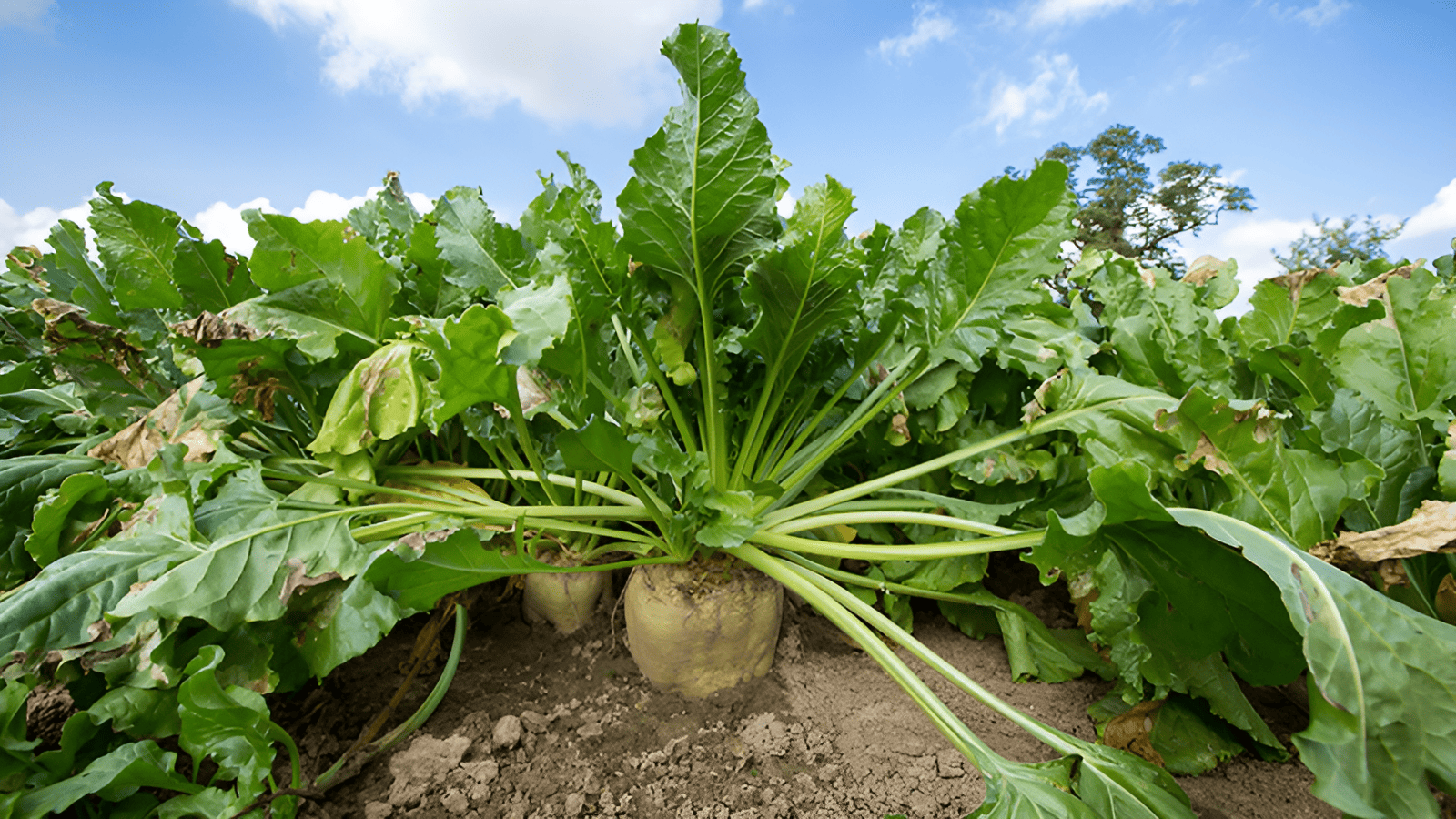
The sugar sector holds a position of considerable prominence in the global industrial landscape. This industry is not only substantial in size but also crucial, considering the wide array of products it impacts. Indeed, sugar finds its utility in an extensive assortment of goods, from confectionery to fizzy beverages, baked delicacies, and an assortment of processed foods.
Moreover, it is important to recognize the crucial role sugar beets play in this industry. To provide perspective, approximately one fifth of the world's sugar is sourced from these robust root vegetables. Therefore, sugar beets indeed have a significant contribution to global sugar production.
After the sugar beets are harvested, they are transported to sugar processing plants. At the processing plant, the sugar beets are washed, sliced, and placed into a diffuser where hot water is added to extract the sugar. The sugar solution is then filtered and purified to remove impurities. Finally, the sugar is crystallized and dried, ready for packaging and shipping.
Chemically, the sugar processed from sugar beet or sugar cane are one and the same and are classified as natural by professional food chemists. It is important however, that the consumption of sugar be limited to no more than 1 tablespoon a day regardless of whether or not the sugar is natural.
Sugar beets are a rich source of various vitamins and minerals, as well as carbohydrates. Here is a breakdown of the nutrient content of sugar beets:
Vitamins:
Minerals:
In addition to these vitamins and minerals, sugar beets also contain trace amounts of zinc, copper, manganese, and selenium.
Much of the nutrient content of a sugar beet is lost during processing. Eating raw cane sugar or molasses, can help retain some of the nutrients.
In addition to sugar, sugar beets are also used to produce molasses, a byproduct of sugar production that is used in the production of rum. Animal feed is produced from the pulp that remains after the sugar has been extracted from the sugar beet and ethanol is produced by the fermentation process.
YYes, beet tops did get used and were considered the other half of the crop before the arrival of chemically induced sugars. Beet greens are a good source of vitamins and minerals, like vitamin C, vitamin K, and iron. Beet greens are also used to make a traditional European soup called borscht.
Sugar beet production depends on climate, soil conditions, crop nutrition, water management, pest control, harvest timing, and post-harvest handling. The answers below cover some of the most common questions about growing sugar beets and producing recoverable sugar.
Sugar beets are generally grown as a cool-season crop and perform well where they have a sufficiently long growing season for root development and sugar accumulation. Deep, well-drained soils with good structure support uniform roots and make harvesting easier. Soil testing should be used to evaluate pH, salinity, nutrient availability, and other site-specific conditions before planting.
Commercial sugar beets are normally precision seeded to establish a uniform stand. Seed spacing and row width vary with the production region, variety, equipment, soil conditions, and harvest system. Consistent emergence and an evenly distributed plant population are important because overcrowding or large gaps can affect root size and overall yield.
Sugar beets require balanced fertility throughout the growing season. Nitrogen is particularly important because too little can restrict growth while excessive late-season nitrogen can encourage continued vegetative growth and reduce recoverable sugar quality. Potassium, phosphorus, and other nutrients should be managed according to soil tests, expected yield, and regional production recommendations.
Sugar beets benefit from consistent soil moisture during establishment, canopy development, and root expansion, but irrigation requirements vary greatly with climate, soil texture, rooting depth, rainfall, and crop stage. Irrigation should be scheduled to avoid prolonged water stress while also preventing unnecessary saturation or late-season over-irrigation.
Young sugar beet stands can be sensitive to weed competition, making early-season weed management especially important. Disease pressures vary by region but can include Cercospora leaf spot, Rhizoctonia root and crown rot, and other fungal or soil-borne diseases. Crop rotation, resistant or tolerant varieties, field scouting, and integrated pest management can help reduce losses.
Sugar beets can be affected by several insects and soil pests depending on the production region. Aphids, leaf miners, and other insects may damage foliage or transmit disease, while certain nematodes can reduce root development and yield. Regular scouting, resistant varieties where available, crop rotation, and locally appropriate integrated pest management practices are important parts of control.
Harvest timing is based on crop maturity, root yield, sugar concentration, weather, soil conditions, processing schedules, and storage requirements. Commercial growers coordinate harvest closely with processors because sugar beets are normally delivered for processing soon after lifting or placed into managed storage piles. Careful harvesting helps limit root damage and excessive soil tare.
Harvested sugar beets may be temporarily stored in piles before they enter the processing plant. Storage conditions are managed to keep the roots as cool as practical while limiting heating, dehydration, rot, and excessive respiration. Storage duration and pile-management practices depend heavily on local temperature and processing schedules.
Recoverable sugar depends on both the amount of beet root harvested and the concentration and quality of sucrose in those roots. Variety, weather, irrigation, fertility, disease pressure, harvest timing, storage losses, and factory extraction efficiency can all influence the final amount of sugar recovered. For this reason, root tonnage alone does not determine sugar yield.
Sugar processing produces useful materials in addition to crystallized sugar. Beet pulp remaining after sugar extraction can be used as an animal-feed ingredient, while beet molasses has several industrial and fermentation uses. Beet tops and other crop residues may also be incorporated into livestock, soil-management, or other agricultural systems depending on local practices.
Turn your 1 acre into a high-yield, profitable farm.
Crop Circle Farms specializes in designing and building fully engineered, low-impact farm systems that use 90% less water, 85% less fertilizer, and deliver two to three times the yield of traditional farming.
Whether you have a vacant lot, an empty field, a resort, school, island community, or small family farm, we’ll build it from the ground up for you. Our team handles everything from farm layout and installation to irrigation, root systems, training, and first planting.
Contact Us to explore a custom Crop Circle Farm design for your property.
Help us expand our mission to revolutionize agriculture globally. We are seeking partners to implement Crop Circle Farms to feed people in need. Together, we can build scalable food production systems that save water, reduce costs, and feed thousands of people. Contact Growing To Give