Aerial Field Surveys
Eyes in the Sky for Precision Agriculture
Aerial field surveys have transformed modern agriculture. What once required days of walking fields, climbing observation towers, or hiring manned aircraft can now be done in hours using unmanned aerial systems (UAS), commonly known as drones—often paired with NDVI crop analysis to detect early stress patterns.
Today, aerial surveys are not experimental—they are operational infrastructure. From small specialty farms to large-scale commercial operations, drones provide high-resolution imaging, multispectral analysis, thermal mapping, and topographic modeling that improve decisions and reduce input waste. Many operations integrate survey outputs directly into crop smart irrigation programs for measurable water savings.
Below is a structured overview of how aerial field surveys work, what they measure, and the drone platforms used in practice—plus how the data feeds advanced systems like digital twin farming and climate risk forecasting.
Aerial field surveys use drones equipped with advanced sensors to collect data about crop health, soil conditions, irrigation performance, pest pressure, and terrain characteristics. In practice, these maps become the “decision layer” that supports precision scouting, variable-rate application, and smarter drone crop monitoring workflows.
These surveys typically capture:
The result is actionable intelligence—not just images.
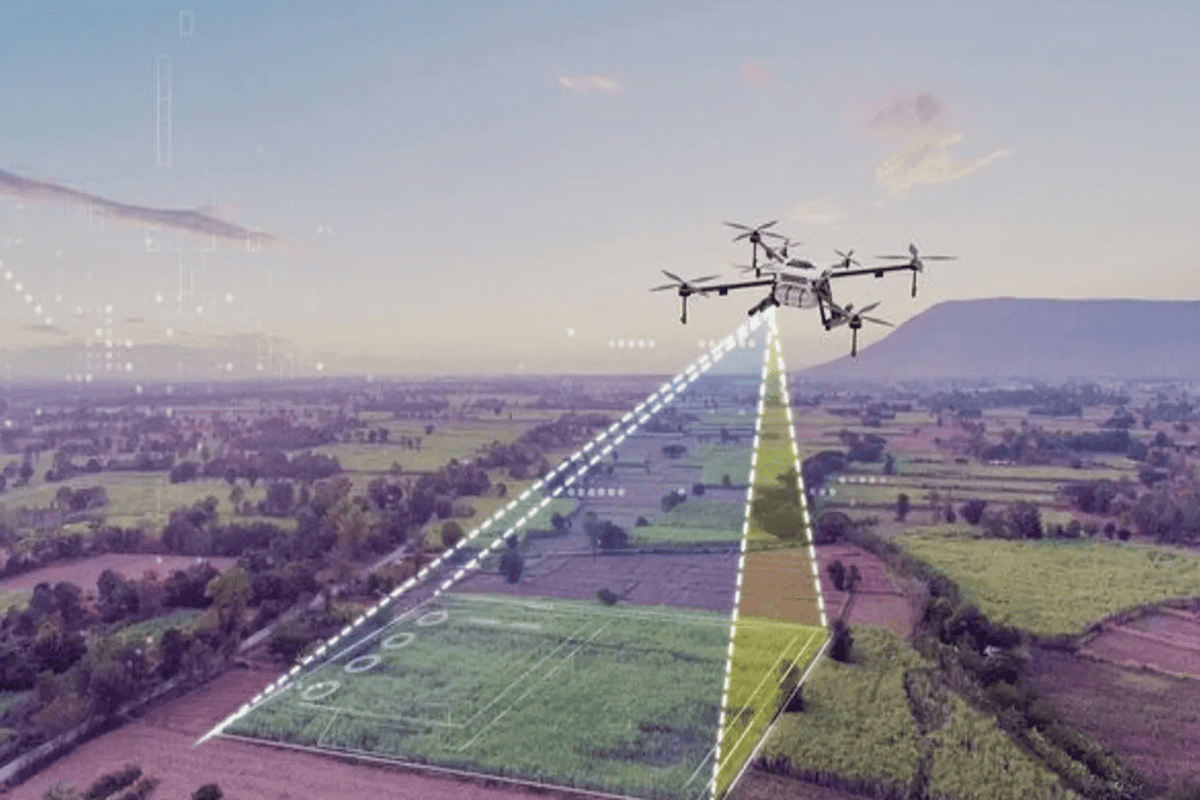
Multispectral sensors detect plant stress before it is visible to the human eye. Variations in chlorophyll absorption reveal: (Learn the underlying index logic in NDVI crop analysis.)
This allows growers to treat specific zones instead of entire fields—often combining aerial scouting with drone crop monitoring flights for rapid re-checks after interventions.
Thermal drones detect canopy temperature differences, revealing water stress patterns that can be translated into irrigation zone changes and run-time optimization in crop smart irrigation systems.
Water-smart agriculture increasingly relies on drone-based diagnostics to reduce groundwater depletion and energy costs—especially when paired with predictive weather and climate risk forecasting.
High-resolution imagery allows early detection of variability that affects harvest outcomes—often feeding decision models used in digital twin farming simulations.
Machine learning models are often layered on top of drone imagery to estimate yield variability across fields and improve decision timing.
LiDAR-equipped drones create detailed elevation models that help farmers design water movement and prevent loss. In regenerative layouts, this supports improved hydrology and spatial design—often reinforced by smart regenerative agriculture.
In regenerative systems, this data supports spiral or circular field designs that improve hydrology and reduce runoff—linking planning back to digital twin modeling and adaptive irrigation strategies.
Aerial field surveys rely on several classes of drones depending on acreage size, sensor requirements, and regulatory environment. Many growers also operate specialized agricultural drones dedicated to mapping, scouting, or spray missions.
These are widely used by growers and ag service providers, especially for high-frequency scouting and rapid diagnostics within drone crop monitoring programs.
Popular Brands & Models:
These platforms typically support:
DJI currently dominates the agricultural drone market due to reliability and sensor integration; many farms pair these platforms with smart irrigation and variable-rate workflows.
Fixed-wing drones cover more ground per flight and are ideal for broadacre operations where frequent, consistent baseline mapping supports strategic planning and risk forecasting.
Common Models:
These drones can survey hundreds of acres per hour with extended flight times—often providing the “big map” inputs that feed digital twin models.
Some agricultural drones perform both surveying and spraying functions. These systems tighten the loop between mapping and action, enabling targeted responses to aerial findings within precision drone operations.
Examples:
These drones are used for:
They integrate survey data directly into precision application workflows, improving efficiency in both water and inputs.
| Drone Type | Ideal Acreage | Flight Time | Primary Use Case | Example Platforms |
|---|---|---|---|---|
| Multirotor (Quad/Hex) | 10–500 acres | 20–45 minutes | High-resolution scouting, NDVI, thermal spot analysis | DJI Mavic 3M, DJI Matrice 350 RTK, Parrot Anafi USA |
| Fixed-Wing Mapping | 500–5,000+ acres | 60–120 minutes | Large-scale orthomosaics, terrain mapping, baseline surveys | senseFly eBee X, WingtraOne GEN II, Trinity F90+ |
| Hybrid VTOL Fixed-Wing | 1,000–10,000+ acres | 90–180 minutes | Long-range mapping with vertical takeoff capability | Quantum Systems Vector, Trinity F90+ |
| Spray & Dual-Purpose | 50–2,000 acres | 15–30 minutes per load | Variable-rate application, targeted nutrient & crop protection | DJI Agras T40, XAG V40, Hylio AG-272 |
| Defense-Derived / Ruggedized | Research / Infrastructure scale | Varies by mission | High-security mapping, rugged terrain, encrypted operations | Skydio X10, Parrot Anafi USA |
Platform selection should align with acreage scale, sensor requirements, terrain complexity, and integration goals such as NDVI analysis, irrigation optimization, or digital twin modeling.
The phrase “military-grade drone” is often used loosely. In agriculture, it usually refers to drones built to defense specifications for durability, encrypted communications, and extended range—useful in remote surveying, infrastructure mapping, and security-sensitive operations.
True military-grade drones include:
These platforms are not used directly in farming due to cost and regulatory constraints. However, defense-derived or hardened commercial platforms are increasingly used in agricultural and infrastructure surveying contexts where reliability and autonomy matter.
These drones offer:
Large-scale research operations and government land agencies may use these systems for high-security mapping—especially where outputs feed planning environments like digital twins.
Drone performance is only as powerful as the sensor payload. Sensor selection determines whether the survey is best for scouting, irrigation diagnostics, terrain modeling, or feeding predictive systems like climate risk forecasting.
Common sensor brands include:
Multispectral sensors allow farmers to calculate vegetation indices such as: (See the full explainer on NDVI crop analysis.)
These indices translate raw light data into biological insights.
The value proposition is clear:
Studies across precision agriculture operations often show:
The ROI for drone surveying can often occur within one or two growing seasons—especially when aerial outputs are operationalized through smart irrigation, modern agronomy, and automation.
The next phase of aerial field surveys is AI integration. High-resolution maps are increasingly converted into predictive recommendations, rather than static reports.
Drone imagery now feeds into:
Rather than reacting to visible crop damage, farmers can proactively manage variability—and test strategies virtually before implementing them.
Aerial surveys are not only about efficiency—they support ecological restoration. Regenerative operations use aerial data to prioritize soil function, water cycling, and biodiversity outcomes within smart regenerative agriculture.
High-resolution mapping allows farmers to:
In regenerative systems, aerial intelligence supports People, Planet, and Profit simultaneously—turning data into land stewardship and long-term viability.
Aerial field surveys are no longer futuristic—they are foundational tools in modern precision agriculture. From compact quadcopters to fixed-wing mapping systems, and even defense-derived drone platforms, the industry now has scalable tools for farms of every size.
The future of agriculture will not be guided by guesswork. It will be guided by data from above.
A 1,200-acre almond orchard in California implemented aerial thermal mapping as part of a seasonal precision irrigation program. Drone surveys revealed temperature inconsistencies across multiple pivot zones, indicating uneven water distribution that was not visible from ground inspection.
Detailed analysis identified a 14% pivot misalignment caused by pressure variation and partial nozzle obstruction. The issue had been gradually increasing water demand without improving canopy performance.
After recalibration and zone adjustments informed by the aerial survey data, irrigation uniformity improved significantly. Over the following season, the operation reduced total applied water by approximately 320 acre-feet while maintaining stable yields and kernel quality.
The cost of drone mapping and data analysis was recovered within a single growing season. More importantly, the orchard transitioned from reactive irrigation management to proactive, data-driven decision-making—demonstrating how aerial field surveys convert detection into measurable return.
Aerial field surveys help turn variability into measurable improvements by linking detection → decision → action. These commonly reported performance ranges are frequently seen when survey data is operationalized through precision scouting, targeted inputs, and automation.
Why this matters: visual impact blocks improve skim readability, increase dwell time, and strengthen problem → solution clarity—signals that can improve snippet eligibility when paired with clean headings.