Agricultural Drones
The Future of Precision Farming
Agricultural drones have rapidly evolved from experimental tools into essential components of modern precision agriculture. Today’s farming drones do far more than capture aerial photos — they collect multispectral data, generate prescription maps, apply inputs, monitor livestock, and integrate directly with farm management software.
As input costs rise and climate variability increases, agricultural drones provide farmers with something increasingly valuable: timely, actionable intelligence. By combining high-resolution imagery, sensor data, and automation, drones enable growers to make faster and more accurate decisions at the field level.
Agricultural drones are unmanned aerial vehicles (UAVs) designed specifically for farm operations. They may carry advanced sensors, mapping cameras, or spraying systems. Unlike satellites, drones operate at low altitude, allowing for centimeter-level resolution and on-demand deployment.
These systems typically integrate with GPS guidance, mapping software, and precision application tools, forming part of a broader smart agriculture ecosystem. High-resolution drone mapping plays a critical role in modern crop smart irrigation strategies.
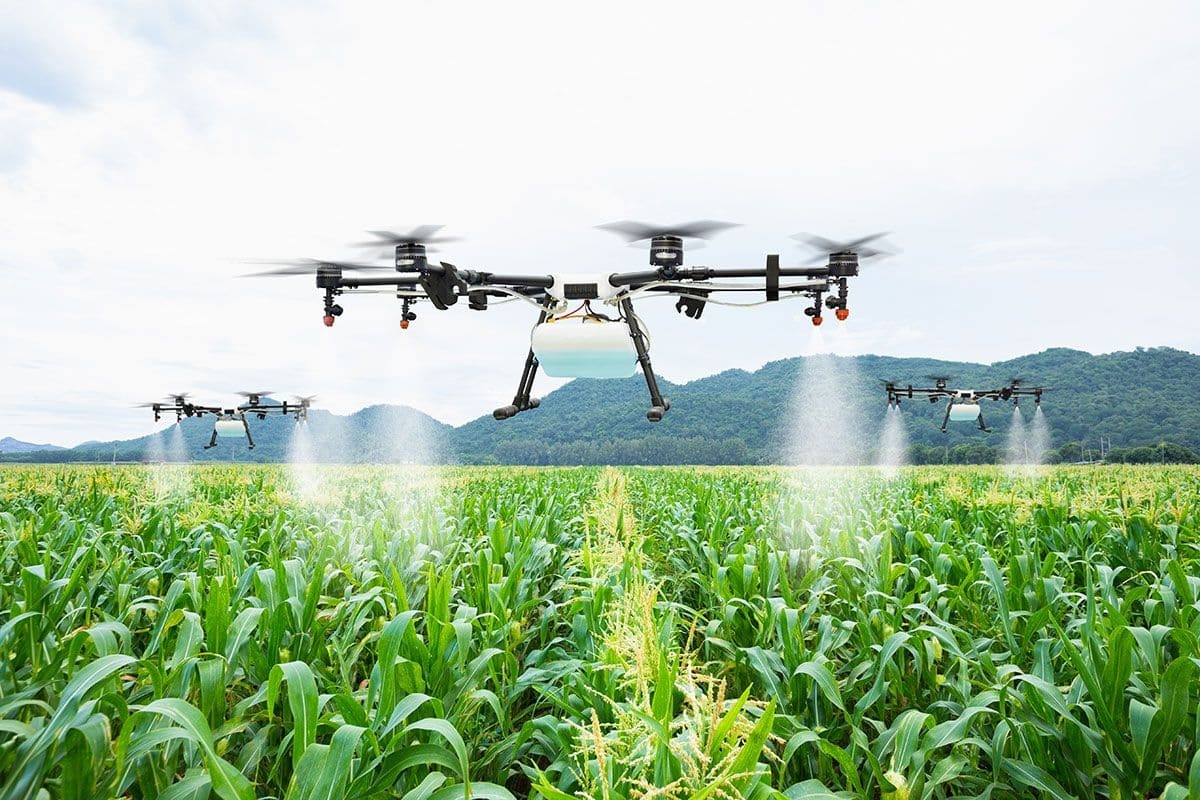
Agricultural drones can be categorized by design and function.
Fixed-wing drones resemble small airplanes. They are efficient for covering large acreages and can stay airborne longer than multi-rotor drones.
Best for:
Because they glide rather than hover, fixed-wing drones are ideal for row crop operations covering hundreds or thousands of acres.
Multi-rotor drones are the most common type in agriculture. They can hover, fly at low speeds, and operate with high maneuverability.
Best for:
Their ability to hover makes them ideal for close inspection of problem areas.
Hybrid drones combine fixed-wing efficiency with multi-rotor vertical takeoff capability.
Best for:
These drones provide long endurance while maintaining operational flexibility.
Spraying drones are equipped with tanks and precision nozzles to apply fertilizers, pesticides, or biological treatments.
Best for:
Some agricultural drones are designed to distribute cover crop seed, granular fertilizers, or soil amendments.
Best for:
These drones can access muddy, waterlogged, or steep land where tractors struggle.
Drone capability depends largely on the sensors they carry.
Standard high-resolution cameras used for visual scouting and stand counts.
Capture specific wavelength bands used to calculate vegetation indices such as NDVI, NDRE, and EVI.
Detect canopy temperature variations, useful for irrigation monitoring and water stress detection.
Create 3D terrain models and canopy height maps, useful for orchard management and land planning.
Drones detect crop stress before visible symptoms appear. Multispectral imaging reveals nitrogen deficiency, disease pressure, and uneven growth patterns.
This allows farmers to intervene early and avoid widespread yield loss.
Drone imagery is converted into prescription maps for variable-rate fertilizer application.
Benefits include:
Thermal imaging highlights areas experiencing water stress. Farmers can detect clogged lines, leaks, or uneven irrigation zones.
Water savings can be significant, particularly in drought-prone regions.
Aerial imagery reveals early canopy stress patterns associated with fungal or insect outbreaks.
Instead of blanket spraying entire fields, growers can treat only affected zones.
High-resolution RGB imagery allows accurate plant population analysis shortly after planting.
This provides rapid feedback on planter calibration and seed placement performance.
In pasture systems, drones monitor herd movement, fence integrity, and grazing patterns.
This is especially valuable in large rangeland operations.
Drone mapping identifies drainage issues, erosion channels, and compaction zones.
This supports regenerative agriculture strategies and soil conservation planning.
Agricultural drones improve profitability by:
Over time, data-driven management improves both environmental performance and financial returns.
While powerful, agricultural drones require:
Drones are most effective when integrated into a broader farm management system rather than used as standalone tools.
Drone technology continues to evolve rapidly. Emerging innovations include:
As technology improves, agricultural drones will become increasingly autonomous, intelligent, and seamlessly connected to farm operations.
The future of farming will not depend solely on larger machines or greater inputs — it will rely on better data and smarter decisions. Agricultural drones provide a critical layer of aerial intelligence that transforms farming from reactive management to predictive precision.
In an era defined by climate uncertainty and resource constraints, agricultural drones represent more than technology. They represent a shift toward informed stewardship of land, water, and food production systems.