The Farm-to-Table Movement
Crop Circle Farms
Farm-to-table describes food systems and marketing relationships that connect farms more directly with consumers, restaurants, institutions, farmers markets, Community-Supported Agriculture programs, and regional food hubs.
These shorter or more transparent supply relationships can support freshness, producer-consumer connections, regional purchasing, and traceability. Actual environmental and economic outcomes depend on production practices, distribution, scale, transportation, pricing, and local market conditions.
Key links: Sustainable Agriculture • Circular Agriculture • Urban Agriculture • Rooftop Agriculture • Cover Crops • Food Security Calculator • Climate Stress Resilience Calculator.
| Factor | Industrial Supply Chain | Farm-to-Table |
|---|---|---|
| Distance | Long food miles | Local / regional |
| Freshness | Lower | Higher |
| Traceability | Limited | High |
| Producer margin | Lower | Higher potential |
| Resilience | Centralized risk | Diversified local |
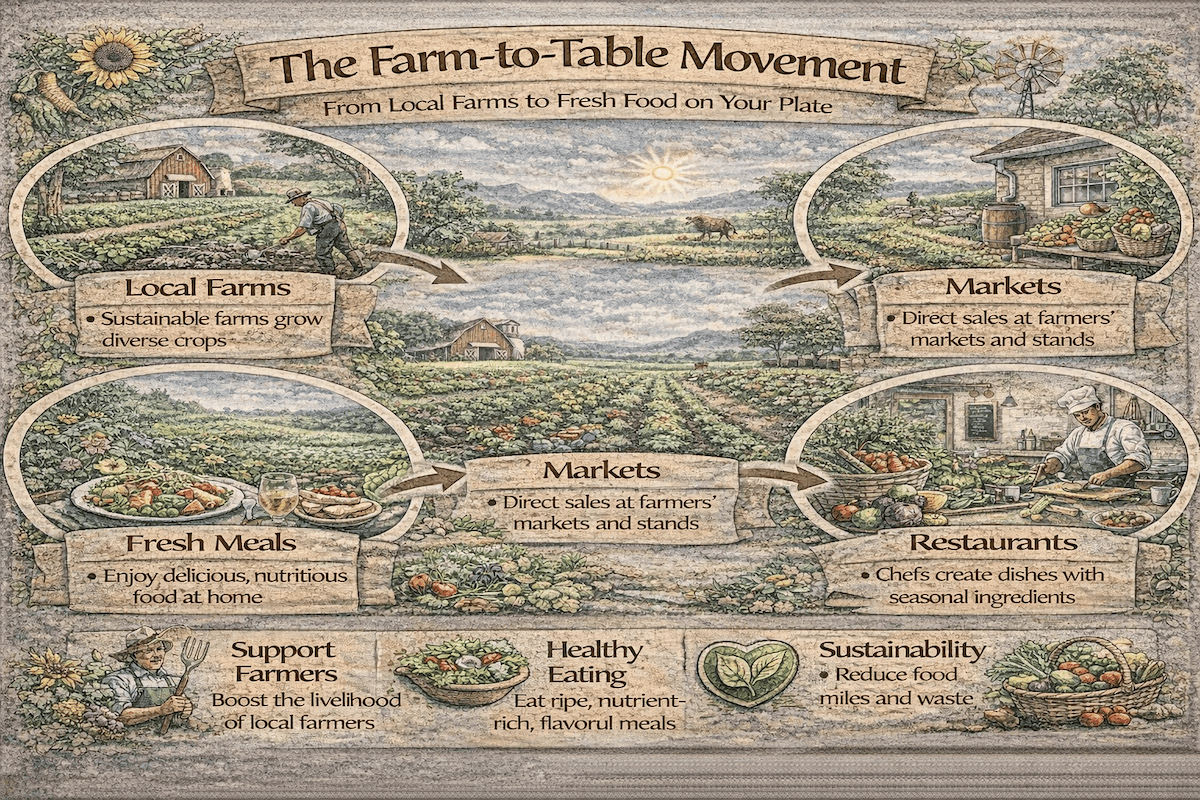
Farm-to-table systems shorten supply chains and improve transparency by connecting growers and eaters directly through CSAs, food hubs, and local procurement. Below is a quick snapshot of the outcomes regional programs often target.
Community-Supported Agriculture (CSA) is a direct farm-marketing model that connects consumers with farms through advance subscriptions or memberships. Members typically pay before or during the growing season and receive recurring shares of produce or other farm products.
Advance payments can provide participating farms with earlier and more predictable cash flow for seeds, labor, equipment, and other seasonal expenses. In return, members receive a share of what the farm produces. CSA arrangements vary considerably: some offer fixed weekly boxes, while others use flexible shares, market-style pickup, workplace delivery, or multi-farm partnerships.
CSA can also strengthen connections between producers and consumers. Members may learn what is in season, how crops are grown, and how weather and other farming conditions influence the harvest. These relationships can support regional food economies, although economic, environmental, and community outcomes vary among farms and locations.
The modern CSA movement became established in the United States in the mid-1980s, influenced by earlier cooperative and community-based agricultural models in Europe, Japan, and other regions. Since then, CSA has become one of several direct-marketing approaches used by small and regional farms.
The farm-to-table movement emphasizes closer connections between food producers and consumers. Restaurants, households, institutions, farmers markets, CSA programs, and regional food hubs may purchase food directly from nearby farms or through relatively short regional supply chains.
Farm-to-table does not automatically mean that food is organic, regenerative, or produced with a particular environmental standard. Those characteristics depend on the practices of the individual farm. The term primarily describes a closer relationship between the source of food and the people or organizations purchasing it.
Potential advantages include shorter time between harvest and consumption, greater transparency about food sources, opportunities for direct farmer-consumer relationships, and increased regional purchasing. Environmental benefits depend on factors such as production practices, transportation efficiency, refrigeration, packaging, food waste, and consumer travel.
Food sold through conventional supply chains can travel hundreds or even thousands of miles between farms, processors, distribution centers, retailers, and consumers. Farm-to-table systems can shorten parts of that journey by connecting farms more directly with restaurants, markets, institutions, and households.
Shorter distance does not automatically mean a smaller carbon footprint. Transportation method, shipment size, refrigeration, production practices, packaging, and consumer travel all affect the environmental impact of a food supply chain.
Community-Supported Agriculture is one established form of direct farm marketing. Thousands of farms in the United States and Canada use CSA-style subscriptions and seasonal shares, although program structure, farm size, crops, pricing, and distribution methods vary widely.
Feel free to share this farm-to-table movement infographic on your website or blog. Please include a link back to this page as the source.
Use the Food Security Calculator to model people reached and program impact.
The revolution is not just about eating; it's about understanding where our food comes from, how it's grown, and how it gets to our table. It's about recognizing the value of farmers, the chefs, and everyone else involved in the food chain. It's about celebrating food in its purest, freshest form and appreciating the seasons and the bounty they bring.
Farm to Table is also about making conscious food choices. It's about choosing to support local farmers and artisans over big corporate food conglomerates. It's about understanding the impact of our food choices on the environment, our health, and our local economies. It's about making a stand for what we believe in and using food dollars to support those beliefs.
Community-Supported Agriculture plays a pivotal role in sustainable agriculture. It provides farmers with a secure income, which allows them to focus on implementing and improving sustainable farming practices. These can include organic farming methods, crop rotation, and soil conservation techniques, which help to protect the environment, the soil, and promote biodiversity.
CSA also helps to reduce food waste, as farmers only grow what they know is presold. This is in stark contrast to the industrialized food system, where vast amounts of food are wasted from overproduction and over the top aesthetic perfect looking produce standards imposed by supermarkets.
Moreover, CSA promotes a more balanced diet because consumers receive a diverse range of seasonal produce such as lettuce in spring, carrots in throughout the summer and squash in the fall. This not only encourages people to eat more fruits and vegetables but also exposes them to new varieties that they may not typically be aware of.
The impact of CSA on fresh produce and organic farming is profound. As a provider for CSA, Crop Circle Farms can vouch for the unparalleled freshness and quality of the produce. Since the food is grown locally, it doesn't have to travel long distances and can be harvested at its peak, ensuring optimal freshness, flavor and nutrition.
CSA also provides a viable market for organic farmers, who often struggle to compete with conventional farmers because their produce is generally more expensive. By committing to buy directly from the farmers, CSA members ensure that organic farmers receive a fair price for their produce. This not only supports the organic farming industry but also encourages more farmers to transition to more sustainable organic farming methods.
Furthermore, CSA helps to preserve heirloom and heritage varieties of fruits and vegetables, which are often overlooked by the commercial market due to their irregular shapes and sizes. These varieties are not only delicious but also important for maintaining genetic diversity in our food system.
Food miles describe the distance food travels between production and consumption. Local and regional food systems can shorten that distance, but transportation distance alone does not determine a food's total environmental footprint.
Production methods, fertilizer use, energy sources, refrigeration, packaging, transportation mode, storage, food waste, and consumer travel can all influence greenhouse-gas emissions. Efficient local distribution can reduce transportation needs, while inefficient small deliveries or individual car trips can offset some of those gains.
Seasonal production can allow consumers to purchase crops when they are naturally available in their region and can strengthen connections between regional farms, markets, and consumers. Flavor, quality, and nutritional composition still depend on crop variety, maturity, handling, and storage conditions.
Farmers markets and Community-Supported Agriculture are complementary forms of direct farm marketing. Farmers markets allow producers to sell directly to shoppers, while CSA members typically commit to a farm or farm group in advance and receive recurring shares during the season.
Farmers markets can also give consumers opportunities to meet producers, ask questions about farming practices, learn what is in season, and discover locally produced foods.
Product selection varies considerably by market, region, and season. Some farmers markets feature unusual cultivars, heritage varieties, specialty crops, prepared foods, and other products that may be difficult to find through conventional retail channels.
Farmers markets can expose consumers to different crops, varieties, and food products, although the range available depends on participating vendors, local production, seasonality, and market size.
The locavore movement emphasizes food produced relatively close to where it is consumed. It often overlaps with CSA programs, farmers markets, regional food hubs, farm stands, and other forms of direct farm marketing.
Supporters may value characteristics such as seasonal availability, relationships with producers, regional food traditions, and shorter supply chains. Environmental outcomes still depend on how food is produced, transported, stored, and consumed.
The Slow Food movement promotes food systems described as good, clean, and fair, with an emphasis on food culture, biodiversity, traditional foods, responsible production, and the people involved in producing food.
CSA programs can align with some of these principles, although individual farms vary considerably in their production practices, labor models, pricing, crops, environmental performance, and business structure.
CSA can provide a relatively direct relationship between consumers and producers. Members may receive information about where food was grown, when it was harvested, how it was produced, and which farm supplied it.
This relationship can improve transparency, but CSA membership does not by itself guarantee organic production or greater food safety. Farms must still follow appropriate food-safety practices for growing, harvesting, washing, packing, storage, and distribution.
Crop Circle Farms designs growing systems intended to reduce contact between produce, soil, and standing water where appropriate. Food safety still depends on sanitation, water quality, handling, worker practices, storage, and other controls.
Some CSA members choose farms based on factors such as production methods, pesticide use, soil management, animal welfare, labor practices, environmental stewardship, local ownership, or organic certification.
These characteristics should be evaluated farm by farm rather than assumed from CSA membership alone. Direct relationships can make it easier for consumers to ask producers how food is grown and how farms address environmental and social concerns.
Ethical consumption can include considering where food comes from, how it is produced, how workers and animals are treated, how resources are used, and how purchasing decisions affect farms and communities.
CSA programs can introduce households to seasonal crops, specialty varieties, heirloom produce, and foods associated with regional agriculture.
Their influence on regional cuisine varies by community, farm, culinary traditions, available crops, cultural history, and consumer participation. CSA can complement other local food institutions that help maintain connections between agriculture and regional food traditions.

CSA also encourages people to eat a diverse range of seasonal produce, which can inspire creativity in the kitchen and lead to the development of new, exciting meals that can be enjoyed by the entire family. Moreover, by preserving heirloom and heritage varieties, CSA contributes to the richness and diversity of our culinary heritage – think the Mexican Southwest and the French influence of New Orleans.
One of the many benefits of CSA is the access to nutrient-dense food. Because the produce is grown locally and harvested at its peak, it is fresher and often more nutritious than the produce found in supermarkets, which often travels long distances and is stored for extended periods.
It is a fact, that nutrient content of a vegetable or fruit declines exponentially as it travels from the farm by truck to the supermarket.
Moreover, CSA farmers typically use organic, sustainable farming methods, which result in healthier soil. Healthy soil is rich in nutrients, and these nutrients are absorbed by the plants, growing more nutrient-dense food.
Edible landscaping is a farm and garden activity that combines beauty and utility by incorporating edible plants into ornamental landscapes. It's a wonderful way to make the most of our urban spaces, grow our own food, and create beautiful, productive gardens.
CSA can play a role in promoting edible landscaping, by providing a market for the produce grown in these gardens. It can also inspire people to start their own edible gardens, by exposing them to a wide variety of fruits and vegetables, including many that are not typically found in supermarkets like heirloom tomatoes, for example.
Urban agriculture and CSA are a perfect pair and work extremely well together. Urban agriculture grows food in urban areas, which can range from small backyard gardens to large community gardens, re-imagined city spaces or even rooftops. It's a powerful tool for improving food security, promoting sustainability, reducing food miles, and strengthening communities.
CSA can support urban agriculture by providing a close market for the produce grown in urban farms. It can also inspire city dwellers to start their own gardens or join a community garden, by showing them the benefits of growing their own food.
Community-Supported Agriculture is more than just a way to buy fresh, local produce; it's a powerful tool for transforming our food system. It supports sustainable agriculture, promotes healthier eating habits, reduces food miles, and strengthens communities. It encourages us to question where our food comes from, how it's grown, and what impact it has on the world around us.
Ready to transform your land into a high-yield, sustainable farm? Let Crop Circle Farms design and build a custom, low-impact, and water-efficient farm tailored to your site and market. From yield modeling and farm layout to irrigation design and crop selection, we help you double your income and cut your costs in half. Contact Us to explore a Crop Circle Farm design for your property.
Help us expand our mission to revolutionize agriculture globally. We are seeking partners to implement Crop Circle Farms in food-insecure communities, island nations, and water-stressed regions. Together, we can build scalable food production systems that save water, reduce costs, and feed thousands of people year after year. Contact Growing To Give to support an initiative or program.
The farm-to-table movement connects food producers more directly with consumers, restaurants, institutions, farmers markets, Community-Supported Agriculture programs, and regional food hubs.
The term generally refers to shorter or more transparent supply relationships. It does not automatically mean that food is organic, regenerative, locally certified, or produced under a particular environmental standard.
Community-Supported Agriculture (CSA) is a direct farm-marketing model in which consumers typically purchase a seasonal membership or subscription and receive recurring shares of farm products.
CSA structures vary. Some farms provide fixed weekly boxes, while others use flexible shares, market-style pickup, workplace delivery, or multi-farm distribution models.
Advance payments can provide farms with cash flow at a time when expenses for seeds, soil amendments, equipment, labor, irrigation, and other production needs may be highest.
The arrangement can also share some production risk between farmers and members because the exact quantity and mix of crops can vary with weather, pests, disease, and other growing conditions.
Farm-to-table systems can reduce transportation distance in some cases, but shorter food miles do not automatically mean a smaller overall environmental footprint.
Production methods, fertilizer use, irrigation, energy sources, refrigeration, packaging, transportation efficiency, food waste, and consumer travel can all affect the total environmental impact of a food supply chain.
Local and regional food systems often shorten the distance between farms and consumers, but the result depends on how food is distributed.
A full delivery truck serving many customers can be more transport-efficient than many individual vehicle trips to a farm or market, so distance should be considered together with transportation method and shipment size.
No. CSA describes a marketing and membership relationship between farms and consumers; it is not an organic certification or production standard.
CSA farms can use conventional, organic, regenerative, hydroponic, low-input, or other production systems. Consumers should ask individual farms about certifications and growing practices if those factors are important to them.
Local produce may reach consumers relatively soon after harvest, which can provide advantages in freshness, flavor, texture, and storage life.
Nutritional composition depends on crop variety, maturity at harvest, growing conditions, handling, temperature, processing, storage time, and preparation. Local food is therefore not automatically more nutritious than food sold through conventional retail channels.
Direct and regional marketing can allow farmers to build closer customer relationships, diversify sales channels, and potentially retain a larger portion of the final food dollar.
CSA prepayments can also improve early-season cash flow. Actual profitability depends on pricing, labor, yields, distribution costs, member retention, production efficiency, and local demand.
A CSA usually involves an advance subscription or membership that provides recurring farm shares during a defined period.
A farmers market is a marketplace where producers sell directly to customers, usually on specific days and without requiring a seasonal subscription. Many farms use both models as part of a diversified marketing strategy.
Local and regional food networks can diversify supply sources and create additional relationships among farms, food hubs, restaurants, institutions, markets, and households.
These networks can complement larger supply chains, but resilience depends on production capacity, crop diversity, infrastructure, storage, transportation, energy, labor, affordability, and the ability to respond to disruptions.