Plants that Regenerate Soil
Mother Earth’s Natural Soil Builders
Plants that regenerate soil are species that naturally improve soil fertility, structure, and biological activity. These plants build organic matter, cycle nutrients, increase microbial life, and improve water infiltration through their roots and plant residues.
Common soil-regenerating plants include legumes such as clover and vetch that fix nitrogen, deep-rooted plants such as alfalfa and sunflowers that bring nutrients up from deeper layers, grasses such as rye that build organic matter, and brassicas such as daikon radish that break up compacted soil.
When used in cover crop systems or regenerative farming rotations, these plants restore soil health, increase biodiversity, and support long-term agricultural productivity.
This guide explains how soil-regenerating plants work, which species are most effective, and how farmers and gardeners can integrate them into regenerative rotations, cover crop mixes, and Crop Circle Farm layouts.
• Healthy soil can contain billions of microorganisms in a small amount of soil. These organisms play important roles in nutrient cycling, organic matter decomposition, and long-term soil fertility.
• Cover crops such as clover, rye, and vetch can build soil organic matter over time by adding roots and plant residues while protecting the soil from erosion and moisture loss.
• Deep-rooted plants like daikon radish and alfalfa can penetrate compacted soil layers and create natural channels that improve water infiltration, aeration, and access for future crop roots.
| Plant Type | Examples | Primary Soil Benefit |
|---|---|---|
| Legumes | Clover, Peas, Beans | Fix nitrogen and improve soil fertility |
| Deep-rooted plants | Comfrey, Sunflower | Bring nutrients from deep soil layers |
| Grasses | Ryegrass, Wheatgrass | Increase soil organic matter |
| Brassicas | Radish, Turnips | Break up compacted soil |
| Dynamic accumulators | Buckwheat, Comfrey | Recycle minerals and nutrients |
Feel free to share this soil-regenerating plants infographic on your website or blog. Please include a link back to this page as the source.
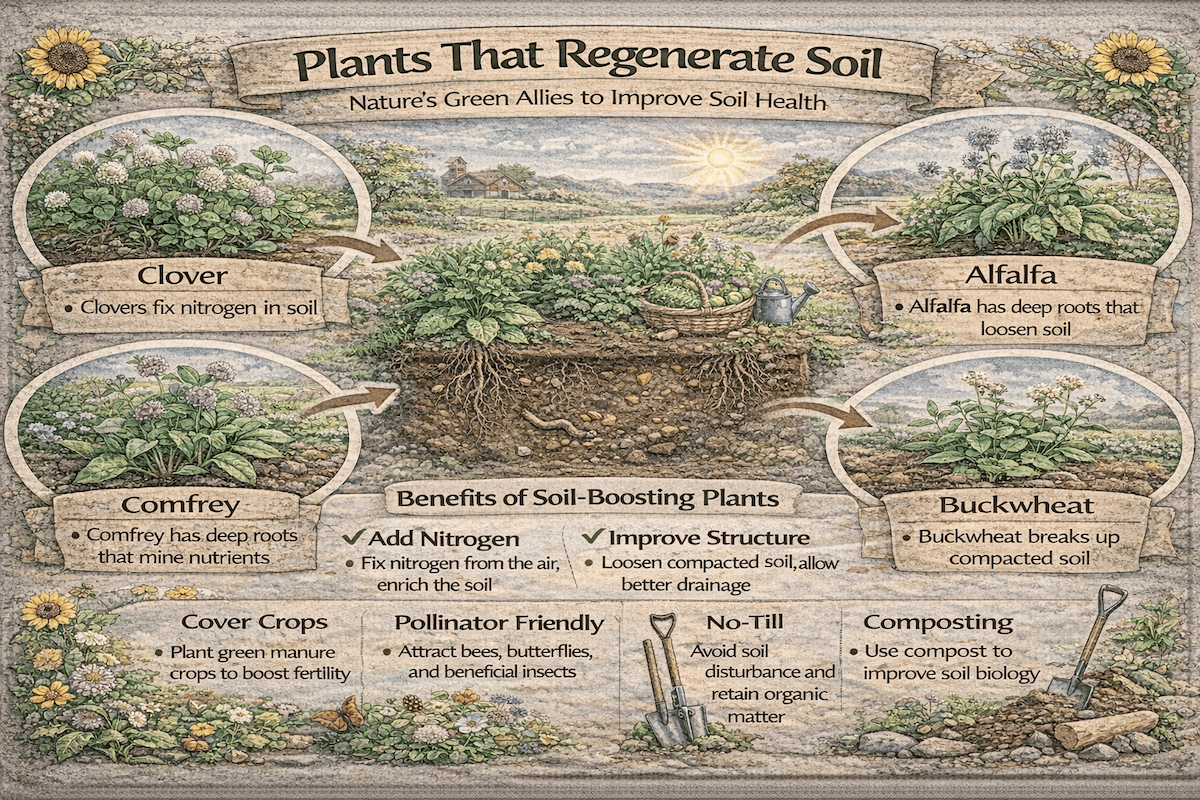
Cover crops are among the most effective tools in regenerative agriculture. Rather than being grown for harvest, these plants are used to rebuild soil health, improve fertility, reduce erosion, and support beneficial soil biology. By maintaining living roots in the ground, cover crops feed microbial communities that help cycle nutrients and stabilize soil structure.
Many regenerative farmers use diverse cover crop mixtures that combine legumes, grasses, brassicas, and flowering plants. Each plant group contributes unique functions that support long-term soil regeneration.
Legumes are some of the most valuable soil-regenerating plants because they work with beneficial rhizobia bacteria to capture nitrogen from the atmosphere and convert it into plant-available nutrients. This natural process helps reduce the need for synthetic fertilizers.
When legumes decompose, the nitrogen stored in their tissues becomes available to future crops, naturally improving soil fertility and productivity.
Grasses are excellent for increasing soil organic matter and improving soil structure. Their extensive root systems create channels that allow water and oxygen to move more easily through the soil profile.
These grasses produce significant biomass that can be rolled, mowed, or incorporated as mulch, protecting soil from erosion and improving moisture retention.
Brassicas are often referred to as “bio-tillage crops” because their powerful taproots can penetrate compacted soil layers and improve soil structure naturally.
As these plants grow, their roots break through dense soil layers and create channels that improve water infiltration and allow future crop roots to grow more deeply.
Deep-rooted plants can access nutrients from different parts of the soil profile. When their leaves, stems, and roots decompose, nutrients taken up during growth are recycled into the soil organic matter and become available for future plant growth.
These plants are commonly used in regenerative gardens and farms to recycle nutrients and increase soil fertility naturally.
Flowering plants also contribute to soil regeneration by supporting pollinators and beneficial insects that help regulate pest populations and maintain ecological balance.
By attracting beneficial insects such as lady beetles and lacewings, these plants reduce the need for chemical pesticides and help protect soil life.
The most effective regenerative farming systems combine multiple plant types into diverse cover crop mixes. Each species performs a specific role that supports soil health and ecosystem resilience.
Together these plants build organic matter, improve soil structure, increase biodiversity, and create long-term regenerative agricultural systems.
Plants play a central role in rebuilding soil fertility, improving water retention, and restoring biological activity in agricultural systems. By integrating soil-regenerating plants into rotations, cover crop mixes, and regenerative farming designs such as Crop Circle Farms agricultural systems, farmers and gardeners can restore soil health while increasing productivity year after year.
Many plants contribute directly to soil regeneration by fixing nitrogen, improving soil structure, increasing organic matter, or cycling nutrients from deeper soil layers. Integrating these plants into crop rotations, cover crop systems, or regenerative farm designs can significantly improve long-term soil fertility and productivity.
The following plants are widely used in regenerative agriculture because of their ability to rebuild soil health naturally.
| Plant | Type | Primary Soil Benefit |
|---|---|---|
| Clover | Legume | Fixes nitrogen and improves soil fertility |
| Hairy Vetch | Legume | Adds nitrogen and produces large biomass |
| Alfalfa | Deep-rooted legume | Breaks compacted soil and builds organic matter |
| Cereal Rye | Grass | Produces biomass and prevents soil erosion |
| Oats | Grass | Improves soil structure and adds organic material |
| Daikon Radish | Brassica | Breaks compacted soil and improves water infiltration |
| Mustard | Brassica | Produces biomass and helps improve soil structure |
| Buckwheat | Dynamic accumulator | Mobilizes phosphorus and recycles nutrients |
| Comfrey | Deep-rooted perennial | Pulls nutrients from deep soil layers |
| Sunflowers | Deep-rooted flowering plant | Improves soil structure and supports beneficial insects |
Each of these plants contributes to soil regeneration in different ways. Legumes increase nitrogen availability, grasses add organic matter, brassicas break up compacted soils, and dynamic accumulators recycle minerals from deeper layers. When these plants are combined in diverse cover crop mixtures, they create powerful regenerative systems that rebuild soil health naturally.
Selecting the right plants to regenerate soil depends heavily on climate, rainfall patterns, and seasonal growing conditions. While many soil-building plants perform well across multiple regions, choosing species adapted to local environments helps ensure stronger growth, deeper roots, and greater soil improvement.
Farmers and gardeners practicing regenerative agriculture often select cover crops and soil-building plants based on temperature, growing season length, and water availability. The goal is to keep living roots in the soil as much as possible throughout the year.
Temperate climates with moderate rainfall and distinct seasons support a wide variety of cover crops and soil-building plants. These regions often use cool-season crops in fall and winter and warm-season crops in spring and summer rotations.
These plants help build organic matter, protect soil from winter erosion, and prepare the ground for spring planting.
In dry or desert climates, drought-tolerant plants are essential for maintaining soil cover and preventing erosion. Deep-rooted species that can access moisture from lower soil layers perform particularly well in these environments.
These plants grow quickly, provide shade for the soil surface, and produce biomass that improves soil organic matter while conserving moisture.
Tropical regions often benefit from fast-growing cover crops that thrive in warm temperatures and high rainfall. Many tropical soil-building plants are legumes that fix nitrogen and produce abundant biomass.
These plants improve soil fertility, reduce erosion during heavy rains, and help maintain year-round living root systems.
In cooler climates with shorter growing seasons, fast-establishing cover crops are often used to protect soil between primary crop cycles. Cold-tolerant species can continue improving soil even during cooler months.
These plants protect soil from erosion, capture leftover nutrients, and provide organic matter when they decompose in the spring.
The most successful regenerative systems combine plants with complementary traits. Farmers often mix legumes for nitrogen, grasses for biomass, brassicas for soil aeration, and flowering plants for beneficial insects.
When integrated into crop rotations, cover crop systems, or regenerative layouts such as Crop Circle Farms agricultural designs, these plants work together to rebuild soil fertility, improve water retention, and support long-term agricultural sustainability.
Farmers practicing regenerative agriculture often plant multi-species cover crop blends that combine these functions. These living systems increase soil biodiversity, improve water retention, and support long-term agricultural productivity while reducing reliance on synthetic inputs.
Plants regenerate soil through several natural biological processes that improve soil fertility, structure, and microbial activity. In regenerative agriculture systems, living plants continuously feed soil organisms and cycle nutrients, creating healthier and more productive soils over time.
Different plant groups contribute to soil regeneration in unique ways. When farmers combine these plants in cover crop systems or diverse rotations, they create powerful biological systems that restore soil health naturally.
| Soil Regeneration Process | How Plants Improve the Soil |
|---|---|
| Nitrogen Fixation | Legumes such as clover, peas, and vetch work with beneficial rhizobia bacteria to capture nitrogen from the atmosphere and convert it into plant-available nutrients. |
| Root Channels | Deep-rooted plants like alfalfa, sunflowers, and daikon radish create channels that loosen compacted soil and improve water infiltration and aeration. |
| Organic Matter Creation | Grasses such as rye and oats produce large amounts of biomass that decompose into organic matter, improving soil structure and water retention. |
| Microbial Feeding | Living roots release sugars and compounds called root exudates that feed beneficial soil microbes, strengthening the soil food web. |
| Nutrient Cycling | Dynamic accumulators such as buckwheat and comfrey draw nutrients from deeper soil layers and return them to the surface through decomposing leaves and roots. |
These natural soil-building processes explain why regenerative farmers aim to keep living plants growing in the soil as much as possible. By combining nitrogen-fixing legumes, deep-rooted plants, biomass-producing grasses, and nutrient-cycling species, farmers can rebuild soil fertility while reducing reliance on synthetic fertilizers.
Ready to transform your land into a high-yield, sustainable farm? Let Crop Circle Farms design and build a custom, low-impact, and water-efficient farm tailored to your needs. Double your income and cut your costs in half! Contact Us
Help us expand our mission to revolutionize agriculture globally. We are seeking partners to implement Crop Circle Farms to feed people in need. Together, we can build scalable food production systems that save water, reduce costs, and feed thousands of people. Contact Growing To Give
Building healthy soil requires understanding how plants, microbes, water, and nutrients work together. The following guides explore key regenerative agriculture practices that improve soil fertility, support biodiversity, and strengthen resilient food production systems.
Many plant groups can contribute to soil improvement in different ways. Legumes such as clover, hairy vetch, field peas and alfalfa can add biologically fixed nitrogen. Grasses such as cereal rye and oats produce extensive roots and biomass. Brassicas such as daikon radish and turnips can create deep root channels, while flowering and deep-rooted plants can support nutrient cycling, soil cover and biodiversity.
Legumes form relationships with rhizobia bacteria that convert atmospheric nitrogen into forms used within the plant. When roots and plant residues decompose, a portion of that nitrogen can become available to following crops. Clover, hairy vetch, peas, beans and alfalfa are commonly used as nitrogen-fixing plants in cover crop and rotation systems.
Grasses such as cereal rye, oats, barley and sorghum-sudangrass develop extensive root systems and can produce substantial plant residue. As roots and above-ground biomass decompose, they contribute organic material to the soil. Their living roots also help protect the soil surface, support soil organisms and create channels for water and air movement.
Deep-rooted brassicas such as daikon radish, forage radish, mustard and turnips can penetrate some compacted soil layers and create root channels. After the roots die and decompose, those channels may improve pathways for water, air and future crop roots. Their effectiveness depends on soil type, compaction depth, growing conditions and the severity of the compaction.
Deep-rooted plants can take up nutrients from different parts of the soil profile. Nutrients contained in their leaves, stems and roots can later be returned to surface soil as plant material decomposes. Plants such as alfalfa, sunflowers, buckwheat and comfrey can be incorporated into broader soil-building systems where their rooting patterns and residues complement other crops.
Flowering cover crops can contribute roots and plant residues while also providing nectar or pollen for pollinators and beneficial insects. Species such as phacelia, buckwheat, alyssum and sunflowers may be incorporated into diverse plantings where appropriate. Their value depends on flowering period, climate, management and the needs of the surrounding cropping system.
Living roots interact continuously with the soil environment. Roots release carbon compounds known as root exudates that can support soil microorganisms, while growing root systems help maintain soil structure and biological activity. Keeping living plants in the soil for more of the year is therefore a common goal in regenerative agriculture and cover crop systems.
A mixture can combine several functions within the same planting. For example, a legume may contribute nitrogen, a grass can provide biomass and fibrous roots, a brassica can develop a deep taproot, and a flowering species can support beneficial insects. A single species may still be the better choice when a grower has one specific objective, so mixtures should be designed around crop rotation, climate, water availability and management goals.
Match species to temperature, rainfall or irrigation, planting season and available growing time. Cool and temperate regions often use crops such as rye, oats, clover, vetch and peas. Warm or dry regions may use plants such as cowpeas, sorghum-sudangrass, sunn hemp, buckwheat or sunflowers. Tropical systems can also use warm-season legumes and grasses adapted to extended growing periods.
Soil-building plants can be incorporated into rotations, temporary cover crop zones, permanent living-cover areas and pollinator plantings within a Crop Circle Farm. Different rings or growing zones can be managed with legumes, grasses, brassicas or flowering species according to crop schedules and soil needs. Soil testing, plant performance and field observations can then be used to adjust the mix over time.