Nutrient Cycling in Soil
Carbon Flow • Soil Biology • Nitrogen Cycle • Compost • Cover Crops • Regenerative Fertility
Nutrient cycling is the biological and chemical movement of nutrients through soil, plants, microorganisms, organic matter, and water. It determines whether nutrients become stable fertility—available when crops need them—or are lost through leaching, runoff, or gaseous pathways.
Feel free to share this nutrient cycling infographic on your website or blog. Please include a link back to this page as the source.
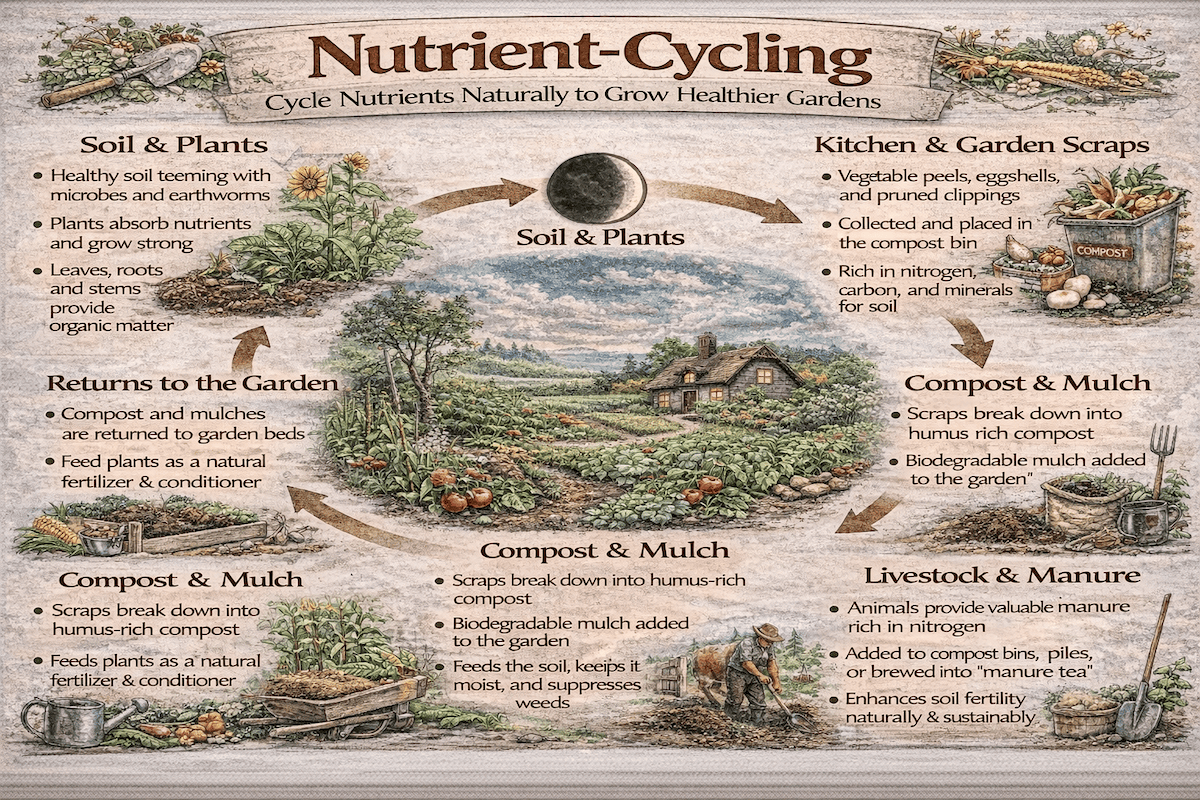
Nutrient cycling is closely connected to carbon flow. Living roots, crop residues, compost, and other organic inputs provide carbon that supports soil organisms and contributes to soil organic matter. Over time, well-managed organic matter, living roots, soil cover, and reduced unnecessary disturbance can support aggregation, infiltration, nutrient retention, and biological activity.
Fertilization is the act of adding nutrients. Nutrient cycling describes how nutrients are retained, transformed, taken up, reused, or lost within the soil-plant system. Effective nutrient management can improve nutrient-use efficiency when fertilizer source, rate, timing, placement, soil conditions, and crop demand are considered together.
| Factor | Fertilization | Nutrient Cycling |
|---|---|---|
| Primary focus | Supplying nutrients required by the crop | Movement, transformation, uptake, storage, and loss of nutrients within the soil-plant system |
| Crop response | Can correct nutrient deficiencies when the source, rate, timing, and placement are appropriate | Influences when nutrients become available to plants and how efficiently they are retained and reused |
| Soil effects | Depend on fertilizer source, rate, placement, soil properties, and management | Influenced by organic matter, residues, living roots, microbes, moisture, temperature, and soil chemistry |
| Loss risk | Nutrients can be lost when applications exceed crop uptake or are poorly timed relative to rainfall and irrigation | Practices such as cover crops, erosion control, nutrient timing, and appropriate irrigation can reduce some nutrient-loss pathways |
Mineralization occurs when soil microorganisms decompose organic materials and convert organically bound nutrients into inorganic forms that plants can use. The rate depends on factors such as temperature, moisture, residue quality, carbon-to-nitrogen ratio, and soil biological activity.
Immobilization occurs when microorganisms temporarily incorporate available nutrients into their own biomass while decomposing organic materials. High-carbon residues can temporarily reduce plant-available nitrogen, but those nutrients may return to the soil as microbial biomass and residues decompose.
Nitrification is the microbial conversion of ammonium into nitrate. Nitrate is readily used by many crops but is also mobile in soil and can be lost through leaching when water moves below the active root zone.
Denitrification occurs when microorganisms transform nitrate under low-oxygen conditions, potentially releasing nitrogen gases to the atmosphere. Waterlogged soils, poor drainage, and excessive irrigation can increase denitrification risk.
Nitrogen is dynamic. It can be fixed biologically (notably by legumes), mineralized from organic matter, taken up by crops, or lost through leaching and gases. Many growers improve nitrogen use efficiency with legumes and cover crops, then fine-tune with split applications or fertigation matched to crop demand.
Phosphorus is generally less mobile in soil than nitrate, but it can be lost through erosion, runoff, and movement of dissolved phosphorus. Availability is strongly influenced by soil pH and reactions with iron, aluminum, and calcium compounds. Mycorrhizal fungi can also improve plant access to phosphorus by extending the effective nutrient-absorbing area beyond the immediate root zone.
Potassium regulates water balance, sugar movement, and many enzyme functions. It cycles through plant residues and soil minerals and is influenced by CEC and moisture.
Practices that support nutrient cycling—such as cover crops, soil cover, organic-matter management, erosion control, and nutrient and irrigation timing—can improve nutrient capture, reduce some losses, and support soil structure and infiltration.
Results vary with soil type, climate, crop, management history, and the practice being used. Measure progress rather than assuming a specific yield or fertilizer-cost response. Useful indicators include soil-test trends, organic matter, aggregate stability, infiltration, crop nutrient status, and observations following major rainfall or irrigation events. For ongoing tracking, see soil health monitoring technology.
| Loss pathway | What causes it | High-impact prevention |
|---|---|---|
| Leaching | Excess water moving nitrate below the root zone | Cover crops, split applications, mulch, irrigation tuning |
| Runoff/erosion | Bare or poorly protected soil exposed to intense rainfall, irrigation, or erosion | Ground cover, residue protection, buffers, erosion control, improved aggregation |
| Volatilization | Surface-applied urea or ammoniacal nitrogen under conditions that favor ammonia loss | Appropriate incorporation, rainfall or irrigation timing, fertilizer placement, and source selection |
| Denitrification | Waterlogged or low-oxygen soil | Improve drainage, avoid over-irrigation, and maintain good soil structure |
| Practice | What it improves | Why it increases cycling |
|---|---|---|
| Compost | Carbon inputs, microbial food, structure | Feeds biology and increases stable nutrient holding |
| Cover crops | Living roots, nutrient capture, aggregation | Prevents bare soil and captures leftover nutrients |
| Mulches / residues | Moisture buffering, erosion control | Reduces evaporation swings and surface loss |
| Biochar (where appropriate) | Retention, habitat, CEC support | Can improve nutrient holding and microbial habitat in some systems |
| Precision irrigation / fertigation | Timing and placement efficiency | Supports biological activity and can improve nutrient retention and soil structure |
For carbon-focused fertility planning, see carbon-smart farming and regenerative agriculture.
Nutrient cycling is biological, but availability is also chemical. Two of the most important foundations are soil pH and cation exchange capacity (CEC).
Many crops perform well when soil pH is roughly 6.0–7.0. Outside that range, some nutrients become less available and some toxicities become more likely. The key is to test, then adjust with a long-term plan—not with one-off fixes.
Cation exchange capacity (CEC) measures the soil’s capacity to retain exchangeable positively charged ions such as potassium, calcium, magnesium, and ammonium. Clay and soil organic matter provide many of these exchange sites.
CEC does not directly measure nitrate retention. Nitrate is negatively charged and generally moves readily with soil water, which is why irrigation, rainfall, rooting depth, and nitrogen timing are especially important for managing nitrate leaching.
The rhizosphere is the biologically active zone surrounding plant roots. Roots release compounds that support microbial communities, while microorganisms participate in nutrient transformation and cycling. Mycorrhizal fungi can extend the effective root system and improve access to relatively immobile nutrients such as phosphorus. In some soils and crops, these associations can also improve water access and plant tolerance to dry conditions.
High-performing nutrient systems typically combine:
To manage nutrient cycling like a system, track metrics that reflect biology and structure—not only NPK.
| Metric | What it indicates | Why it matters |
|---|---|---|
| Soil organic matter | Carbon foundation | Supports water holding, CEC, and microbial habitat |
| Aggregate stability | Structure and infiltration | Reduces erosion/runoff and improves oxygen balance |
| Microbial activity | Biological engine strength | Relates to mineralization and nutrient turnover |
| CEC | Cation-retention capacity | Helps interpret the soil's capacity to hold positively charged nutrients such as potassium, calcium, magnesium, and ammonium |
| Soil respiration | Biological metabolism | Useful trend metric when interpreted with context |
Build closed-loop fertility through composting, residue cycling, water-smart systems, and farm designs that reduce waste and improve resilience.
Deep dive into soil chemistry and biology, nutrient planning, amendments, and regenerative soil-building strategies.
Next steps: Explore soil fertility, soil health monitoring, no-till agriculture, and polyculture for related approaches to nutrient retention, soil biology, water management, and long-term fertility.
Turn one acre into a resource-efficient, high-production farm.
Crop Circle Farms designs and builds resource-efficient agricultural systems tailored to site conditions, crops, water availability, and production goals. Our field-tested systems have demonstrated up to 90% lower water use, up to 85% lower fertilizer requirements, and two to three times the production with selected crops and configurations compared with conventional layouts.
Contact Us to explore a custom Crop Circle Farm design for your property.
Help expand our mission to implement proven farm and garden models to feed people in need. Contact Growing To Give .
Nutrient cycling is the biological and chemical movement of nutrients through soil, plants, microorganisms, organic matter, and water. Nutrients are continually taken up, released, transformed, stored, and sometimes lost from the soil-plant system.
Soil organisms play an important role through processes such as mineralization and immobilization, while plant roots and fungi help capture available nutrients. Effective nutrient cycling helps synchronize nutrient availability with crop demand.
Keep soil covered, maintain living roots when practical, and match fertilizer applications to crop demand. Cover crops, mulches, residue protection, erosion control, buffer areas, and appropriate irrigation can all help reduce nutrient losses.
Timing also matters. Avoid applying large amounts of soluble nutrients immediately before heavy rainfall or excessive irrigation, and use split applications or fertigation where appropriate to improve nutrient-use efficiency.
Leaching occurs when water carries soluble nutrients below the active root zone. Nitrate is particularly vulnerable because it is negatively charged and generally moves readily with soil water.
Heavy rainfall, excessive irrigation, shallow rooting, poorly timed nitrogen applications, and limited crop uptake can increase leaching risk. Irrigation scheduling and nutrient timing are therefore important parts of nutrient management.
Many agricultural and garden crops perform well in soils with a pH of roughly 6.0 to 7.0, where many essential nutrients are reasonably available. The ideal range varies by crop and soil type.
At lower or higher pH levels, some nutrients can become less available while others may become excessively soluble. Use a soil test before making significant lime, sulfur, or amendment applications.
Legume cover crops such as clovers, peas, beans, and vetches can obtain nitrogen through biological nitrogen fixation when effective Rhizobium associations are present.
Much of that nitrogen initially supports the legume itself. Nitrogen may later become available to subsequent crops through root turnover, residues, termination, decomposition, and longer-term nutrient cycling. The amount varies with species, biomass, growing conditions, and management.
Some changes can be observed within a season, particularly improved soil cover, nutrient capture, erosion protection, or irrigation management. Other changes, such as increases in soil organic matter and improvements in aggregation, generally develop over longer periods.
The rate of change depends on climate, soil type, cropping system, starting conditions, organic inputs, disturbance, irrigation, and management consistency. Track soil tests and field observations over time rather than expecting a fixed timeline.
Useful practices include maintaining living roots, using cover crops, returning crop residues, applying appropriate compost or organic amendments, reducing unnecessary soil disturbance, controlling erosion, and maintaining suitable soil moisture.
Nutrient applications should also be matched to soil-test information and crop demand. No single practice is universally best—the most effective combination depends on soil conditions, climate, crop requirements, and the nutrient-loss pathways present in the field or garden.
Next steps: Explore soil fertility, soil health monitoring, no-till agriculture, and polyculture for related approaches to nutrient retention, soil biology, water management, and long-term fertility.