Types of Soil
Clay, Peat, Chalk, Sandy, and Loam Soil
Soil type determines how water moves, how nutrients are stored, and how easily roots can grow. Texture, structure, organic matter, and mineral balance all influence whether soil drains quickly, holds moisture, or compacts under pressure.
Most agricultural and gardening soils fall into broad texture groups—sand, silt, clay, and loam—but performance also depends on pH, salinity, and cation exchange capacity (CEC). Understanding these characteristics makes it possible to improve almost any soil with the right management approach.
This guide explains the major soil types, how to identify them, how they affect plant growth, and what practical steps can be taken to improve drainage, fertility, and structure in gardens, raised beds, containers, and farms.
Globally, soil types are incredibly diverse, differing in texture, composition, and fertility. These differences are due to factors like climate, topography, vegetation, and geology. However, these soils can be broadly divided into eight main categories: clay, peat, chalk, sandy, loam, silt, rocky, and gravel soil.
Soil consistency refers to how well soil particles adhere to each other. The three primary types of soil consistencies are sandy, loamy, and clayey. Sandy soils are loose and grainy, with particles that don't stick together, while clay soils are dense, sticky, and tend to clump together. Loamy soils strike a balance between sandy and clay soils, incorporating both large and small particles, making them ideal for the majority of plants.
Soil composition alludes to the elements that constitute the soil. The four principal components are mineral matter, organic matter, water, and air. While mineral matter comprises the bulk of the soil, organic matter is derived from decomposing plants and animals. Water and air are vital components aiding in the transportation of nutrients and oxygen to plant roots.
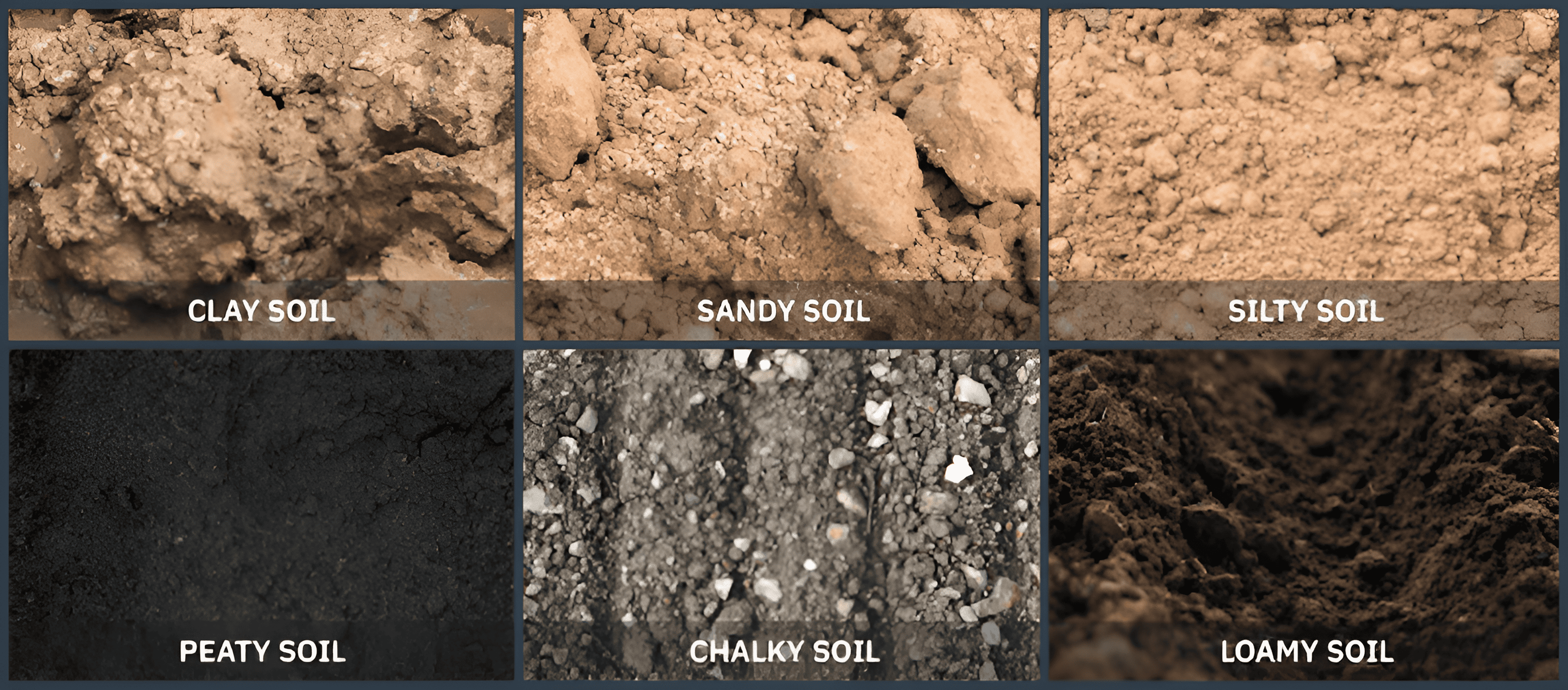
Clay Soil - Clay soils are dense, heavy, and sticky when wet, restricting water and air penetration. These soils are mineral-rich and hard, making them suitable for short root crops like onions.
Peat Soil - Consisting of partially decomposed plant material, peat soil is acidic and retains high amounts of water. It is typically found in boggy areas and, despite being difficult to cultivate, is ideal for growing acid-loving plants like blueberries and cranberries.
Chalk Soil - Chalk soil is alkaline and rich in calcium carbonate. It drains well but does not retain moisture effectively. It's suited to plants that thrive in alkaline conditions, like brassicas, legumes, and alliums.
Sandy Soil - Sandy soil is loose, gritty, and drains water swiftly. It's low in nutrients but warms up quickly in the spring, making it perfect for root crops like carrots, parsnips, and radishes.
Loam Soil - A balanced mix of clay, sand, and silt, loam soil is highly fertile and retains moisture effectively, making it suitable for a wide variety of plants, including fruits, vegetables, herbs, and flowers.
Silt Soil - Composed of fine particles, silt soil feels smooth to touch and is highly fertile, retaining moisture well, making it suitable for crops like corn, wheat, and barley.
Rocky Soil - Containing large rocks and boulders, rocky soil is difficult to cultivate but is good for growing fruit-bearing bushes.
Gravel Soil - Composed of large gravel-sized particles, gravel soil drains well but does not retain moisture, making it suitable for plants that prefer drier conditions like lavender and rosemary.
Different plants favor different soil types. Understanding the perfect soil type for each crop can boost yields and enhance the health and robustness of plants. Some examples of vegetables and their preferred soil types include:
Onions - Clay soils are preferred as they provide firm soil structure for proper bulb development.
Carrots - Sandy soils are ideal as they allow carrots to grow long and straight.
Tomatoes - Tomatoes favor loamy soil as it balances moisture retention and drainage, thereby preventing waterlogging and root rot, common problems in areas with above-average rainfall.
Potatoes - These tubers thrive in loose, well-draining soils like sandy loams, needing good aeration to prevent tuber rot.
Lettuce - Preferring fertile, well-drained soil with a high organic matter content, lettuce thrives in loamy soil with a slightly acidic pH.
Peppers - Both sweet and hot peppers prosper in soils with good drainage, high organic matter content, and a slightly acidic pH. Sandy loam or loamy soil is perfect for growing peppers.
Beans - Beans prefer fertile, well-draining soil with a slightly acidic pH. A loamy soil with high organic matter content yields excellent beans.
Cabbage - Cabbages prefer fertile, well-drained soils with a slightly alkaline pH. A loamy soil with high organic matter content is required to grow full-size cabbages.
Knowing the different soil types and their characteristics is paramount in deciding which crops to grow in a specific area. Providing the right soil type for a specific crop is critical for maximum yields and healthy, thriving plants.
Crop Circle Farms uses targeted soil cavities to match each crop with its ideal soil profile, allowing growers to optimize root conditions regardless of native field soil.
This targeted approach to farm soil agriculture proves especially beneficial when cultivating different vegetables requiring different soil types in the same irrigated geometric crop circle.
Turn your 1 acre into a high-yield, profitable farm.
Crop Circle Farms specializes in designing and building fully engineered, low-impact farm systems that use 90% less water, 85% less fertilizer, and deliver two to three times the yield of traditional farming.
Whether you have a vacant lot, an empty field, a resort, school, island community, or small family farm, we’ll build it from the ground up for you. Our team handles everything from farm layout and installation to irrigation, root systems, training, and first planting.
Contact Us to explore a custom Crop Circle Farm design for your property.
Help us expand our mission to revolutionize agriculture globally. We are seeking partners to implement Crop Circle Farms to feed people in need. Together, we can build scalable food production systems that save water, reduce costs, and feed thousands of people. Contact Growing To Give
These frequently asked questions cover soil fertility, organic matter, nutrient cycling, nitrogen, phosphorus, potassium, soil biology, irrigation, and practical ways to build healthier growing soil.
Healthy soil combines good structure, organic matter, biological activity, available nutrients, air, and water. Productive soil should allow roots to penetrate easily while holding enough moisture for plant growth without remaining waterlogged.
Healthy soil also supports earthworms, fungi, bacteria, and other organisms that break down organic materials and help recycle nutrients into forms plants can use.
Organic matter improves soil structure, moisture retention, nutrient-holding capacity, and biological activity. Compost, plant residues, roots, mulches, and other organic materials provide food for soil organisms while gradually returning nutrients to the soil.
Increasing organic matter can be especially valuable in sandy soils that drain too quickly and compacted soils that need improved aggregation and pore space.
Nutrient cycling is the movement and reuse of nutrients through soil, plants, microorganisms, organic matter, water, and decomposing plant material. Nutrients taken up by crops can eventually return to the soil through roots, crop residues, compost, manure, and other organic inputs.
Efficient nutrient cycling can reduce nutrient losses while helping maintain a productive root zone over multiple growing seasons.
Nitrogen is essential for chlorophyll, proteins, enzymes, and vigorous vegetative growth. Plants with inadequate nitrogen may develop pale or yellowing leaves and reduced growth.
Excess nitrogen can also create problems by encouraging excessive foliage, delaying flowering or fruit development, and increasing the potential for nutrient losses from the soil.
Phosphorus supports root development, energy transfer, flowering, seed formation, and early crop establishment. Young plants need access to adequate phosphorus as their root systems develop.
Because phosphorus can become chemically bound in soil, maintaining appropriate soil pH and biological activity can influence how available it is to plant roots.
Potassium helps regulate water movement within plants and supports stem strength, stress tolerance, flowering, fruit quality, and overall crop resilience.
Adequate potassium becomes particularly important for productive fruiting crops and plants growing under heat, drought, or other environmental stress.
Soil microorganisms decompose organic matter and participate in processes that release or transform nutrients. Bacteria, fungi, protozoa, earthworms, and other organisms form part of the soil food web.
Healthy biological activity can improve nutrient cycling, aggregation, root-zone structure, and the gradual release of nutrients from organic materials.
Water transports dissolved nutrients toward plant roots, so nutrient availability and irrigation management are closely connected. Soil that becomes excessively dry can limit nutrient uptake, while saturated soil can reduce oxygen around roots and contribute to nutrient losses.
Drip irrigation, targeted watering, mulch, and improved soil organic matter can help maintain more consistent moisture within the active root zone.
A soil test is one of the best ways to determine existing nutrient levels and soil pH before applying fertilizer. Adding nutrients without knowing what the soil already contains can waste fertilizer and potentially create nutrient imbalances.
Fertilizer applications should be matched as closely as practical to crop demand, soil conditions, irrigation practices, and expected yield.
Compost can provide nutrients and improve soil structure, moisture retention, biological activity, and organic matter, but its nutrient concentrations vary. Depending on the crop and soil test results, compost may supply some or much of the required fertility, while additional nutrients may still be needed.
The best approach is to treat compost as part of a broader soil-building and nutrient-management program rather than assuming every compost provides the same fertility.
Cover crops protect exposed soil, add organic matter, support soil biology, reduce erosion, and capture nutrients that might otherwise be lost. Legume cover crops can also contribute biologically fixed nitrogen when properly managed.
Deep-rooted cover crops may help improve soil structure and bring nutrients from deeper soil layers into the active growing zone when their residues decompose.
Building healthy soil is a long-term process. Useful practices include adding compost and other organic materials, maintaining living roots when practical, reducing unnecessary soil disturbance, using mulch, rotating crops, growing cover crops, and managing irrigation carefully.
Regular soil testing can help track changes in pH, organic matter, and nutrient levels so amendments can be adjusted rather than applied unnecessarily.
Crop Circle Farms systems are designed around targeted root-zone management, efficient irrigation, organic matter, soil biology, and nutrient delivery. Rather than treating an entire growing area uniformly, inputs can be concentrated where plant roots are actively growing.
This approach can help improve water and nutrient efficiency while supporting productive growing systems on farms, gardens, schools, urban sites, and other limited-space locations.