Rainwater Capture Calculator
Estimate how much roof runoff can support a garden, market garden, or food system
The Rainwater Capture Calculator estimates how much water you can collect from a roof and direct into storage for use in a garden, market garden, rooftop farm, or small food-production system.
Use this calculator to estimate gallons captured per rainfall event, projected monthly and annual collection, and whether your current tank capacity is large enough to store the water you collect.
This is a practical planning tool for homeowners, schools, restaurants, community gardens, NGOs, and farm designers who want to use rainfall more efficiently and reduce dependence on municipal or pumped irrigation water.
Rainwater harvesting becomes even more valuable when it is paired with mulch, drip irrigation, efficient plant spacing, and targeted watering. For water-smart growing systems, captured rain can help reduce costs while improving resilience.
Feel free to share this rainwater capture calculator infographic on your website or blog. Please include a link back to this page as the source.
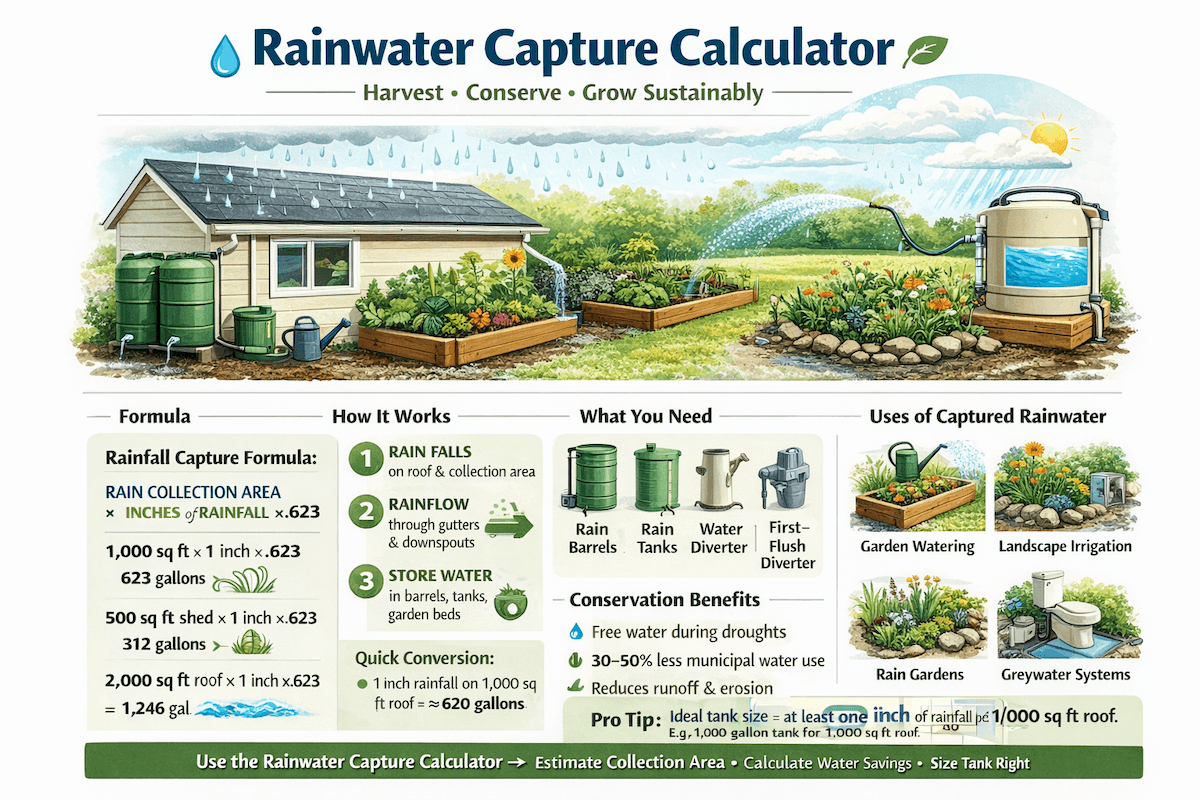
A common way to estimate roof runoff is to multiply your roof area by your rainfall depth and then adjust for runoff efficiency. Not all rain that lands on a roof makes it into a tank: some is lost to splash, first-flush diversion, imperfect gutters, overflow, and filtration.
Estimated gallons captured = Roof area × Rainfall × 0.623 × Efficiency
In that formula:
The calculator below handles the math automatically and shows both the raw potential and the usable captured water based on your assumptions.
Enter your roof area, rainfall assumptions, runoff efficiency, and storage capacity to estimate usable rainwater capture for irrigation planning.
Adjust the values below to model a specific roof, storm, or growing system.
Quick planning view for event capture, storage fit, and irrigation potential.
Notes: Results are estimates. Actual capture varies with roof type, gutter condition, downspout routing, first-flush diversion, debris load, storage design, overflow handling, and local rainfall patterns.
Water-smart growing systems, rooftop agriculture, and resource-efficient food production.
See it in practice
Use roof space for growing food and capturing water more efficiently.
See it in practice
Build productive food systems close to market with less waste.
Related tool
Compare water use and savings across different growing approaches.
Capturing roof runoff is one of the simplest ways to add resilience to a food-production system. A roof can collect a surprisingly large volume of water, especially when rainfall is routed into tanks, cisterns, or connected storage systems.
For a home garden, captured rainwater can reduce the need for hose or municipal irrigation. For a market garden, school garden, restaurant garden, or rooftop growing project, it can become part of a broader water-efficiency strategy that includes mulch, drip irrigation, efficient spacing, and careful timing.
Rainwater harvesting is especially useful where water is expensive, seasonal, limited, or unreliable. By using the Rainwater Capture Calculator, growers can quickly estimate whether a given roof area and tank size can support a meaningful share of irrigation demand.
Actual rainwater collection depends on more than just roof size. Real performance will vary with:
Water-smart agriculture works best when multiple efficiency strategies are stacked together. Captured rainwater can be paired with spiral layouts, targeted irrigation, mulch, root-zone management, and reduced evaporation to support high-output growing with less waste.
If you are planning a new planting, see our general guide to planting trees for tips on soil prep, staking, and long-term care.
The Rainwater Capture Calculator helps growers connect roof area, rainfall, storage, and irrigation demand into one simple planning model. Whether you are building a home garden, a school project, a restaurant garden, or a commercial food-production site, understanding water capture potential is an important first step.
When you know how much water a roof can provide, you can make smarter decisions about:
Captured rainwater will not replace every irrigation need in every climate, but it can become a valuable part of a resource-smart food system designed to lower costs and improve resilience.
Want help designing a productive, water-efficient growing system? Crop Circle Farms can help you evaluate site layout, water strategy, food production potential, and resource-smart growing methods. Contact Us to discuss your project.
We are also interested in working with partners, sponsors, schools, and nonprofits who want to build climate-smart, water-efficient food systems in underserved or water-stressed communities. Contact Growing To Give to support a food-security project.
Sustainable agriculture refers to farming systems designed to produce food while conserving soil, water and other natural resources over the long term. Practices can include efficient irrigation, reduced soil disturbance, crop diversity, responsible nutrient management and protection of beneficial organisms and wildlife habitat.
Sustainable agriculture generally emphasizes healthy soil, efficient water use, responsible nutrient management, biodiversity, climate resilience and economically practical food production. The combination of practices used depends on the crop, climate, soil, available water, farm size and production goals.
Sustainable farms can protect soil by reducing unnecessary disturbance, maintaining organic matter, using compost and cover crops where appropriate, keeping living roots in the soil and managing nutrients according to crop needs. These practices can support soil structure, biological activity, water infiltration and long-term fertility.
Water conservation can include drip irrigation, low-pressure irrigation, soil-moisture monitoring, mulching, improved soil structure and irrigation scheduling based on crop demand. These approaches help concentrate water within the active root zone and reduce unnecessary evaporation, runoff and overwatering.
Biodiversity can support more resilient agricultural systems by providing habitat for pollinators, beneficial insects, soil organisms and other species. Farms may encourage biodiversity through diversified crops, flowering plants, pollinator areas, windbreaks, trees, shrubs and reduced disturbance of surrounding habitat.
Smallholder farms can use sustainable practices to make efficient use of limited land, water and agricultural inputs. Diversified planting, efficient irrigation, soil-building practices and carefully planned crop layouts can help farmers improve resource efficiency while producing food for households, local markets and community food programs.
Yes. Sustainable agriculture principles can be adapted to urban farms, community gardens, school gardens, rooftops, vacant lots and other limited-space environments. The system must be designed around available sunlight, water, soil or growing media, structural limitations, crop selection and local conditions.
No. The terms overlap but are not identical. Organic agriculture operates under defined production standards when certification is used, while regenerative agriculture generally emphasizes improving soil and ecosystem function. Sustainable agriculture is a broader concept that can incorporate practices associated with organic, regenerative, conservation and climate-smart farming systems.
They can support reporting when appropriate measurements and records are maintained. Farms may track irrigation use, fertilizer inputs, soil management, crop production, biomass and other performance indicators. Participation in formal carbon-credit or environmental markets usually requires additional baseline measurements, approved methodologies, monitoring and independent verification.
Crop Circle Farms designs agricultural systems around efficient irrigation, productive use of growing space, soil and nutrient management, diversified planting and reduced unnecessary soil disturbance. Individual projects can also incorporate compost, cover crops, pollinator habitat, monitoring technology and other practices according to the crops, climate, water availability and goals of the site.
Jump to the next tool, or explore supporting resources.