People • Planet • Profit
The Triple Bottom Line for the Future of Agriculture
Agriculture in the 21st century faces unprecedented challenges. Farms must produce enough food for a growing global population while also restoring soil health, protecting biodiversity, conserving water resources, reducing carbon emissions, and sustaining rural economies. The traditional model—focused primarily on maximizing short-term yield—no longer addresses the full complexity of modern food systems.
A growing number of farmers, land stewards, and agricultural innovators are adopting a more holistic design framework known as People • Planet • Profit, often referred to as the triple bottom line. This approach recognizes that successful agricultural systems must balance social well-being, ecological resilience, and long-term economic viability.
When agricultural systems are thoughtfully designed, these three goals can reinforce each other:
The future of farming is not about choosing between environmental responsibility and financial success. It is about designing intelligent agricultural systems where human prosperity, ecological health, and economic performance grow stronger together.
The triple bottom line is a sustainability framework that evaluates success using three interconnected measures: social well-being (People), environmental stewardship (Planet), and economic performance (Profit). In agriculture, this approach encourages farming systems that support communities, regenerate ecosystems, and remain financially sustainable over the long term.
• The term “triple bottom line” was popularized in the 1990s as a way to measure
success beyond traditional financial profit.
• Regenerative agriculture practices—such as cover cropping, agroforestry, and rotational
grazing—often improve soil carbon storage and water retention.
• Farms that integrate ecological health with sound business planning are often more
resilient to drought, pests, and market volatility.
Feel free to share this people, planet, profit infographic on your website or blog. Please include a link back to this page as the source.
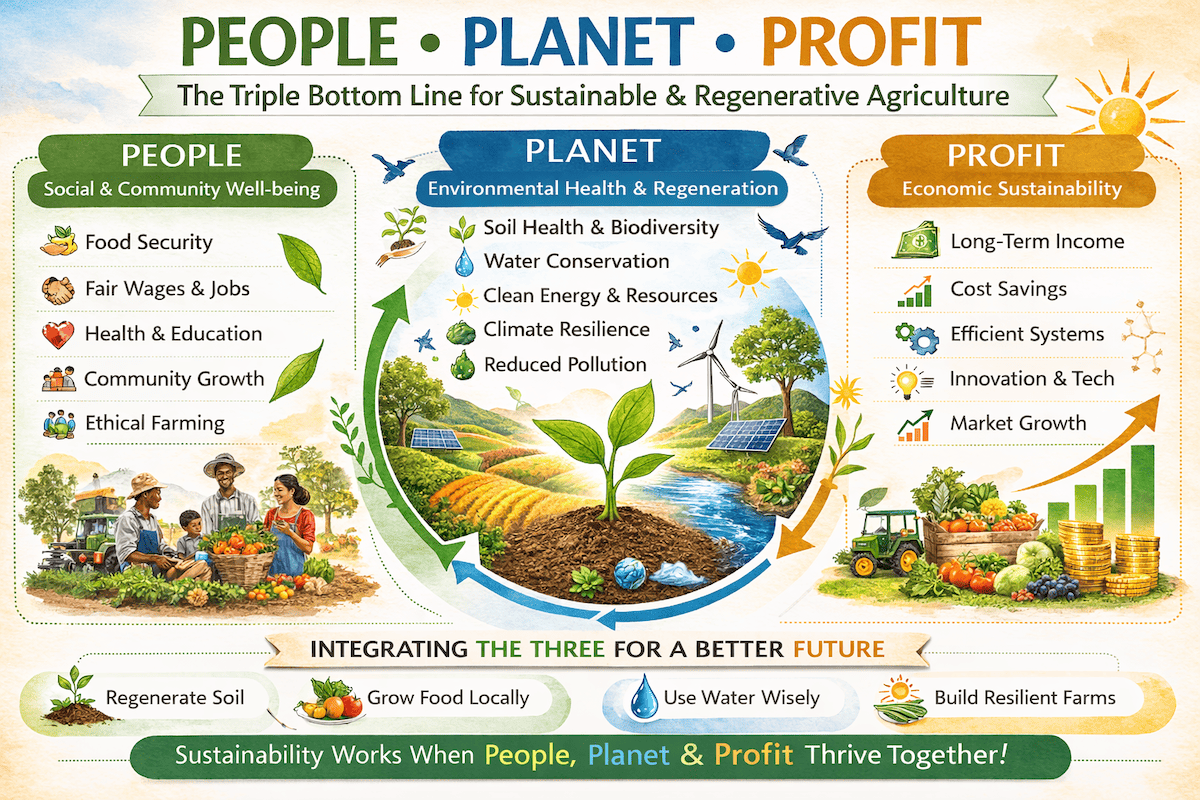
Agriculture exists to serve people—farmers, communities, and consumers. A people-centered system prioritizes:
When farming becomes extractive—chemically, economically, or socially—communities weaken. But when farming is regenerative and intelligent, it builds local capacity.
Circular models, decentralized production, and data-driven decision systems empower growers rather than trapping them in high-input dependency cycles. Farmers regain control over water, nutrients, yields, and margins.
A system that works for people is stable. Stability builds trust. Trust builds markets.
Agriculture occupies nearly 40% of the Earth’s land surface. It is either one of the largest drivers of ecological degradation—or one of the greatest opportunities for restoration.
Planet-focused agriculture emphasizes:
Water-smart irrigation, precision nutrient delivery, and ecological planting patterns dramatically reduce waste. Instead of overwhelming soil biology with synthetic inputs, regenerative systems support microbial ecosystems that naturally cycle nutrients.
A healthy farm is not sterile. It is biologically active, structurally diverse, and hydrologically balanced.
When farms are designed to cooperate with ecosystems rather than dominate them, production and environmental restoration can happen simultaneously.
Sustainability without profitability is temporary. Farms that cannot generate stable returns eventually collapse or revert to extractive models.
Profit in the People–Planet–Profit framework is not about short-term maximization. It is about:
Precision systems often reduce inputs dramatically while increasing yield consistency. This improves margins even when commodity prices fluctuate.
The most resilient agricultural businesses are those that align ecological performance with financial performance.
When environmental efficiency increases, profitability often follows.
Crop Circles represent a systems-based approach to agriculture that integrates geometry, irrigation efficiency, nutrient cycling, and ecosystem design into a single regenerative pattern.
Unlike traditional linear row systems, crop circle layouts optimize root-zone hydration, airflow, solar exposure, and nutrient distribution. Circular symmetry reduces edge effects, improves plant density distribution, and supports uniform microclimates.
From a People standpoint, crop circles increase local food production capacity while simplifying irrigation and maintenance logistics.
From a Planet perspective, circular irrigation systems dramatically reduce water waste and nutrient runoff, supporting soil microbiology and carbon stability.
From a Profit standpoint, higher productivity per square foot and lower input costs increase return on land, especially in water-constrained regions.
Crop circles are not decorative—they are functional geometry applied to regenerative agriculture.
Agricultural performance is deeply influenced by spatial design. Linear row agriculture evolved for mechanical convenience, not ecological efficiency.
But geometry influences:
Small shifts in spatial design can compound into significant gains in yield and resource efficiency.
Traditional row agriculture prioritizes mechanical alignment. Spiral systems prioritize biological and hydrological performance.
Spiral designs concentrate irrigation energy toward plant root zones, increase usable planting edge length, and create layered microclimates that improve space utilization.
Comparative modeling shows that spiral-based layouts can significantly outperform rows in yield per acre under optimized management conditions.
You can model the differences using the Spiral vs Row Acre Yield Calculator, which demonstrates how geometry alone can shift production metrics.
The implication is powerful: agricultural productivity is not only a function of inputs—it is also a function of design.
When People, Planet, and Profit align, agriculture becomes regenerative by default.
Each pillar reinforces the others:
| Pillar | Strengthens |
|---|---|
| People | Labor efficiency, community resilience, food access |
| Planet | Soil carbon, biodiversity, water conservation |
| Profit | Margin stability, scalability, investment appeal |
Investors are increasingly evaluating agricultural systems through ESG (Environmental, Social, Governance) frameworks. Carbon markets, water credits, and regenerative premiums are creating new revenue streams.
Agriculture is shifting from:
To:
Systems like crop circles that use spiral agriculture are not fringe ideas—they are part of a broader redesign movement focused on maximizing land productivity while reducing ecological strain.
The farms that thrive in the coming decades will be those that:
People • Planet • Profit is not a slogan. It is a design constraint.
When agricultural systems are built around all three pillars simultaneously:
The future of agriculture is not about producing more at any cost.
It is about producing intelligently.
And intelligent design 🌀 whether through crop circles, spiral systems, smart irrigation, or digital modeling will define the next era of food production.
People • Planet • Profit (the triple bottom line) is a framework for designing farm systems that improve human well-being, regenerate ecosystems, and remain economically viable. In agriculture, it means building operations that strengthen communities, restore soil and water health, and produce reliable margins—without sacrificing one pillar to achieve another.
It can be—especially over time—because regenerative systems often reduce input costs (water, fertilizer, pesticides), improve yield stability, and lower risk from climate variability. Profitability depends on crop type, management, and market access, but strong regenerative design tends to improve long-term margins and resilience.
Crop circle systems improve efficiency by optimizing geometry, irrigation distribution, and root-zone performance. Circular layouts can reduce edge effects, support uniform microclimates, simplify targeted water delivery, and improve nutrient cycling—often translating into higher productivity per square foot with less waste.
Spiral-based systems can increase effective planting edge and improve space utilization compared to uniform rows, which may raise yield per acre under optimized management. Results vary by crop, spacing, and irrigation strategy, but design-driven gains are often meaningful—especially when paired with precision watering and soil health practices.
Sustainable agriculture aims to reduce harm and maintain resources over time. Regenerative agriculture goes further: it actively restores soil biology, biodiversity, and water cycles—improving ecosystem health while supporting production. In practice, regenerative systems often include design strategies that build soil carbon and resilience year after year.