Mechanized Agriculture
Dependancy on Fossil Fuels
Mechanized agriculture is the use of machines, powered equipment, automated systems, and precision technologies to perform agricultural work that was once completed primarily by people and draft animals. Tractors, seed drills, planters, cultivators, sprayers, irrigation equipment, harvesters, and combines remain central to mechanized farming, but modern systems increasingly include GPS guidance, autosteer, sensors, variable-rate application, drones, robotics, and farm-management software.
Mechanization has fundamentally changed the scale and speed of food production. Before widespread farm machinery, preparing land, planting, cultivating, irrigating, and harvesting required large amounts of human and animal labor. The amount of land one farm could manage was therefore closely tied to the available workforce, draft animals, weather, and the time required to complete each field operation.
The development of mechanical seeders, threshing equipment, steam-powered machinery, tractors, and combine harvesters progressively changed that relationship. Farmers could prepare and harvest larger areas in less time, improve the consistency of planting and cultivation, and complete critical operations during much narrower weather windows. Mechanization became particularly important as agricultural production shifted toward larger commercial farms and increasingly specialized crop systems.
Today, mechanization is not limited to simply replacing hand labor with a larger machine. Precision guidance can reduce unnecessary overlap between field passes, while variable-rate equipment can adjust seed, fertilizer, or other inputs across different parts of a field. Cameras, soil sensors, mapping systems, and automated equipment can also help growers identify variations in crop and soil conditions before deciding where intervention is needed. Technologies described in our Soil Health Monitoring Technology guide illustrate how mechanization and digital monitoring are increasingly being used together.
Mechanization also creates management challenges. Heavy equipment can compact soil, repeated passes can damage soil structure, and poorly timed field operations can increase erosion or fuel consumption. Equipment therefore needs to be matched to soil conditions, crop requirements, farm size, labor availability, and the economics of the operation. Controlled traffic, reduced passes, appropriate tire pressures, conservation tillage, cover crops, and careful soil monitoring can help growers gain the benefits of machinery while reducing unwanted impacts.
Mechanization is equally relevant to smaller farms. Compact tractors, walk-behind equipment, precision irrigation, transplanting tools, small harvest equipment, and battery-powered machinery can greatly reduce labor without requiring the scale or investment associated with conventional broad-acre farming. Our Farm One Acre guide explores the planning considerations involved when production is concentrated on a relatively small land base.
The influence of mechanized agriculture extends far beyond the field. Faster planting and harvesting, bulk handling, refrigeration, processing equipment, storage systems, and mechanized transportation have helped create food supply chains capable of moving large volumes of crops from farms to processors, distributors, retailers, restaurants, and consumers.
Mechanization can improve timeliness, labor productivity, consistency, and the amount of land or crop volume that one farming operation can manage. At the same time, machinery involves capital costs, maintenance, operator training, energy use, safety requirements, and potential impacts on soil. The most effective mechanized farming system is therefore not necessarily the one with the largest or most equipment, but the one that uses the appropriate technology for the crop, soil, climate, field conditions, and production goals.
Modern agriculture is increasingly moving toward this more targeted approach: combining machinery with GPS guidance, sensors, automation, soil monitoring, and precision application so that equipment does more than simply perform work faster. Properly managed, mechanization can help farmers improve operational efficiency while using labor, fuel, water, fertilizer, and other inputs more deliberately.
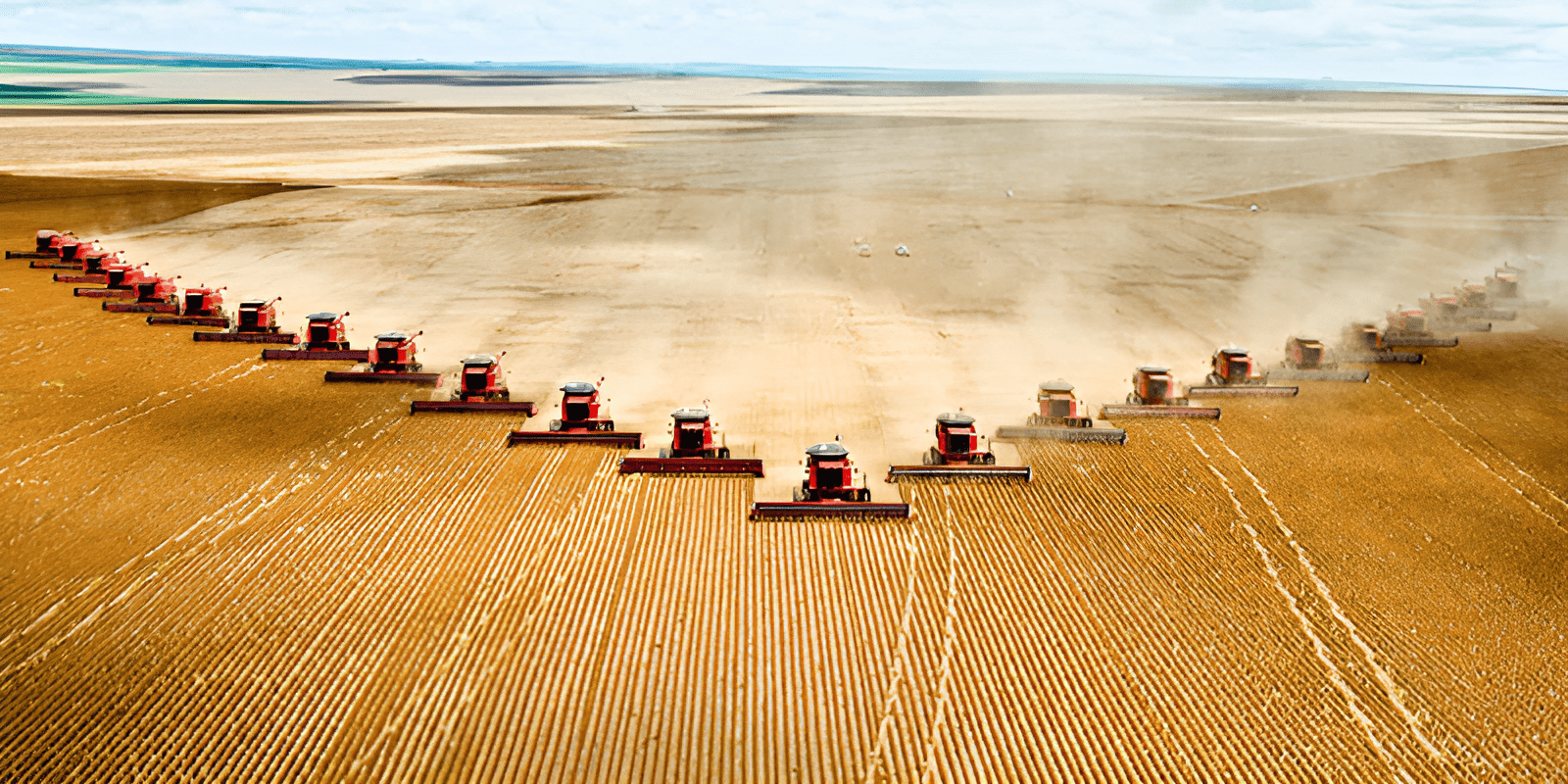
Mechanized agriculture has delivered enormous gains in labor productivity, timeliness, and the amount of land that farmers can manage, but much of today's agricultural machinery still depends on fossil fuels . Diesel remains widely used for tractors, combines, harvesters, loaders, pumps, trucks, and other heavy equipment, while additional energy is required to manufacture machinery, produce agricultural inputs, transport crops, and operate storage and processing facilities.
The environmental effects of mechanization therefore extend beyond fuel burned in a tractor. Repeated machinery passes can compact soil, reduce pore space, restrict root growth, and change the way water infiltrates and moves through a field. Heavy equipment operated when soils are wet can cause particularly persistent compaction, while excessive cultivation may leave soil more vulnerable to erosion and moisture loss.
These concerns do not mean that agricultural machinery is inherently unsustainable. The impact depends heavily on how machinery is selected and operated. GPS guidance, autosteer, controlled-traffic farming, appropriately sized equipment, reduced field passes, conservation tillage, and improved tire-pressure management can all help reduce unnecessary fuel use and soil disturbance.
Precision technology also allows growers to make machinery more targeted. Instead of treating an entire field as though its soil and crop conditions are identical, sensors and mapping systems can help identify variation in moisture, fertility, plant health, and soil conditions. Our guide to Soil Health Monitoring Technology explores how monitoring tools can help farmers make better-informed decisions before irrigation, fertilizer, cultivation, or other field operations are carried out.
The next stage of agricultural mechanization is increasingly focused not simply on using larger machines, but on using machinery more intelligently. This is an important part of sustainable agriculture , where productivity is considered alongside soil health, water efficiency, nutrient management, energy use, biodiversity, farm economics, and the long-term resilience of the land.
Modern sustainable farming can still be highly mechanized. A tractor equipped with accurate guidance may reduce overlapping passes. A variable-rate applicator can adjust fertilizer across management zones. Camera-guided cultivators can remove weeds with less reliance on broadcast herbicides. Automated irrigation can deliver water according to crop demand, while field sensors can help identify where intervention is actually required.
In this context, precision agriculture and conservation agriculture increasingly overlap. Machinery can support reduced tillage, cover-crop establishment, residue management, targeted nutrient placement, and other practices that protect soil while maintaining efficient production. The objective is not necessarily to eliminate machinery, but to reduce unnecessary operations and make every pass through the field more purposeful.
Soil compaction is one of the most important management considerations in mechanized farming. Tractor and implement weight can compress the soil, particularly when fields are wet or when machinery repeatedly travels over the same productive areas. Compacted soil can restrict roots, reduce infiltration, increase runoff, and make subsequent field operations more difficult.
Farmers can reduce these effects by limiting traffic to permanent lanes, avoiding unnecessary field operations, reducing axle loads where practical, using appropriate tires and inflation pressures, and combining operations when possible. Maintaining organic matter and living roots can also improve soil structure and resilience. Reduced- and no-tillage systems may further limit disturbance where they are appropriate for the crop and local conditions.
Mechanization therefore needs to be considered as part of an entire soil-management system rather than as an isolated equipment decision. A machine that completes an operation quickly but damages soil structure can create costs that continue long after the tractor has left the field.
GPS guidance, mapping, sensors, and variable-rate technology allow machinery to respond more precisely to field conditions. Seed populations, fertilizer applications, irrigation, and crop-protection treatments can potentially be adjusted according to management zones rather than applied uniformly across every acre.
This approach can help farmers reduce unnecessary inputs while focusing resources where crops are most likely to use them. It can also improve record keeping, make field operations more repeatable, and provide better information for evaluating crop performance over multiple seasons.
Precision technology does not eliminate the need for good agronomy. Soil testing, crop observation, weather, irrigation management, and practical field experience remain essential. Technology is most useful when it improves the quality of decisions rather than simply adding another layer of equipment.
Mechanized agriculture is also beginning to extend beyond the conventional diesel tractor. Battery-powered tools, electric utility vehicles, autonomous platforms, camera-guided cultivators, robotic weeders, drones, and other technologies are expanding the definition of farm machinery.
Smaller autonomous equipment may eventually allow some operations to be completed with lighter machines making repeated precise passes instead of relying exclusively on very large equipment. Where electricity is generated from lower-emission sources, electrification can also reduce direct fuel use for certain farm operations. The practicality of these systems depends on farm scale, crop type, operating hours, charging infrastructure, equipment cost, and the power required for the task.
Mechanization is not limited to thousands of acres of commodity crops. Compact tractors, two-wheel tractors, transplanting tools, small cultivators, precision irrigation, battery-powered equipment, and appropriately scaled harvesting tools can substantially reduce labor on smaller farms and market gardens.
The important question is whether the equipment is appropriate for the scale of the operation. Purchasing a large machine that is rarely used can increase costs without improving profitability, while a smaller implement that removes a recurring labor bottleneck may deliver considerable value. Our Farm One Acre guide looks at production planning where land, labor, access, and equipment must all be used efficiently within a relatively small footprint.
Crop Circle Farms approaches mechanization from the perspective of matching technology to the production system rather than automatically increasing machine size. Compact equipment, drip irrigation, targeted nutrient delivery, accessible planting areas, and careful farm layout can reduce the number and scale of mechanical operations required for some crops and sites.
This approach is especially relevant to urban farms, community projects, resorts, schools, island communities, and smaller agricultural properties where conventional broad-acre machinery may not be practical. The objective is to combine appropriate mechanization with soil management, water efficiency, crop access, and precision technology to create a production system suited to the property.
Mechanized and sustainable agriculture are therefore not opposing concepts. The challenge is to use machinery where it improves safety, productivity, and labor efficiency while reducing unnecessary fuel consumption, soil compaction, nutrient losses, water use, and repeated disturbance. The future of mechanization is likely to be increasingly precise, data-informed, automated, and tailored to the specific needs of each farm.
Crop Circle Farms can help evaluate farm layout, crop selection, irrigation, soil-management practices, mechanization needs, production goals, and site conditions for a more efficient growing system.
Depending on the crop and site, a design may incorporate compact machinery, precision irrigation, targeted nutrient delivery, soil monitoring, reduced traffic areas, and other practices intended to use land, water, labor, and inputs more efficiently.
Contact Us to discuss a Crop Circle Farm design for your property.
Growing To Give works with partners interested in practical food production, water efficiency, soil health, and agricultural resilience in communities where locally grown food can make a meaningful difference.
Learn More about supporting an initiative or program.
Mechanized agriculture uses machinery, powered equipment, automation, and precision technologies to perform agricultural operations that would otherwise require substantial human or animal labor. It can include tractors, planters, cultivators, harvesters, irrigation equipment, GPS guidance, sensors, variable-rate systems, robotics, and other technologies used to improve the efficiency and timeliness of farm operations.
GPS guidance and autosteer can help machinery follow more consistent field paths, reducing unnecessary overlap and missed areas during planting, cultivation, fertilizer application, and other operations. Greater pass-to-pass accuracy can also support controlled traffic, more precise placement of inputs, and reduced operator fatigue during long working periods.
Variable-rate technology allows equipment to change application rates as it moves through a field. Depending on the system, seed, fertilizer, irrigation, or crop-protection products can be adjusted according to management zones, soil information, crop conditions, prescription maps, or sensor data instead of being applied uniformly across every acre.
Soil compaction can be reduced by avoiding traffic on wet soils, limiting unnecessary field passes, using controlled-traffic lanes, selecting appropriately sized machinery, managing tire inflation pressures, and reducing axle loads where practical. Cover crops, organic matter management, and maintaining living roots can also help improve soil structure and resilience.
Yes. Mechanization does not require large tractors or thousands of acres. Compact tractors, two-wheel tractors, battery-powered equipment, transplanting tools, small cultivators, precision irrigation, and appropriately scaled harvesting equipment can reduce repetitive labor and improve efficiency on market gardens and smaller farms. The equipment should be matched to the farm's scale, crops, workload, and budget.
Sensors and monitoring technologies can provide information about soil moisture, temperature, crop conditions, nutrient status, and other field variables. This information can help farmers decide when and where irrigation, fertilizer, cultivation, or other operations are needed. See our Soil Health Monitoring Technology guide for more information.
Agricultural robotics can assist with tasks such as scouting, mechanical weeding, spraying, harvesting, mapping, and crop monitoring. Camera-guided cultivators and autonomous platforms can potentially perform highly targeted operations using smaller equipment, although cost, reliability, crop type, terrain, infrastructure, and operator oversight remain important considerations.
Yes. Mechanization and sustainable agriculture are not opposing approaches. Machinery can support reduced tillage, cover crops, precision nutrient placement, efficient irrigation, controlled traffic, and other conservation practices. Sustainability depends on how equipment is selected, powered, operated, and integrated with soil, water, crop, and nutrient management.
Equipment decisions should consider purchase or lease cost, financing, fuel or electricity, maintenance, repairs, insurance, storage, operator time, expected annual use, and potential labor savings. Farmers should also compare ownership with custom hiring or shared equipment. The best investment is often equipment that removes a recurring production bottleneck rather than simply adding more machinery.
Crop Circle Farms can combine appropriately scaled machinery with accessible planting layouts, drip irrigation, targeted nutrient delivery, soil monitoring, and reduced traffic areas. Depending on the crop and property, compact equipment and precision systems may provide the labor benefits of mechanization without requiring the large machinery associated with conventional broad-acre production.