Farm One Acre
A Blueprint for Water-Smart Agriculture
Around the world, agriculture is facing unprecedented challenges. Food security has become a critical issue as populations rise, supply chains falter, and the cost of food skyrockets. Water scarcity is intensifying, making traditional farming practices unsustainable in many regions. At the same time, the price of synthetic fertilizers has surged, while industrial farming has left behind degraded soils, reduced biodiversity, and chemical-dependent crops.
Crop Circle Farms are designed as a solution to these global pressures. By combining regenerative agriculture, smart water and nutrient systems, and a compact footprint, it empowers communities to grow high-value, chemical-free food locally using far less water, fertilizer, and labor. This model not only produces healthy soil and nutritional crops but also contributes to climate resilience, food independence, and economic opportunity.
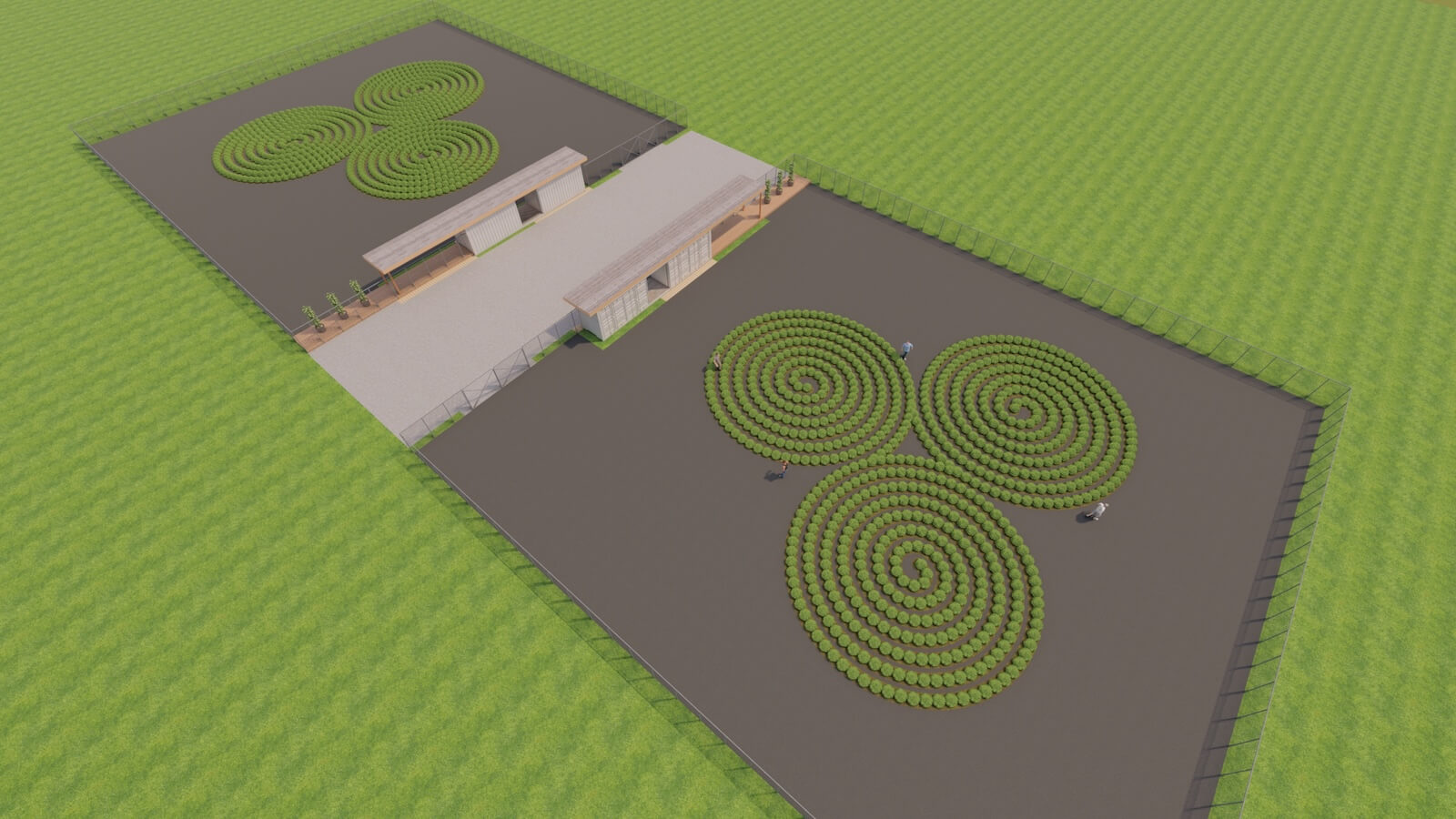
The One Acre Farm is centered around an innovative layout of three interlocking spiral fields, forming a triple tri-spiral growing system. This high-efficiency configuration allows the entire farm - production, infrastructure, and working space - to fit within a single acre.
A fenced perimeter surrounds the site, incorporating windbreak and privacy panels that function as a thermal heat sink to stabilize the microclimate. Beneath all production areas, a weed-suppressing ground cover keeps the farm clean, reduces labor, and maintains soil health.
Surrounding the core tri-spiral system are a series of specialized growing installations including:
These areas serve both as productive growing zones and as demonstration sites for additional regenerative plant propagation technologies.
A centrally located 30-foot by 30-foot work zone provides organized space for equipment, harvesting, washing, and staff operations, with clear pathways for efficient movement and workflow.
Two 20-foot intermodal containers are connected by a covered causeway:
Together, the layout delivers a compact, highly functional, profitable farm design.
The farm is designed for rapid deployment, taking about 6 weeks to install with a trained crew. Once operational, the system requires only 3–4 people per season to manage. This makes it an ideal solution for smallholder farms, community programs, or high-margin specialty crop ventures.
The tri-spiral system is optimized for mono-cropped top crops such as:
Flexibility in design allows for diversified harvests by planting different varieties in each spiral:
This modular approach allows farmers to tailor production to market demand.
Crop Circle Farms leverage proprietary irrigation and self-fertilizing root tubes that deliver nutrients directly at the root zone. This system enables plants to focus energy on growth, flowering, and yield rather than building extensive root networks. As a result, the farm achieves:
All practices follow drill-don’t-till regenerative and biodynamic agriculture, ensuring chemical-free, organic crops with long-term soil health and crop harvest nutritional benefits.
Installed costs typically range from $1M to $1.5M, depending on crop type and shipping logistics. Once operational, farms average about 20% in operating expenses, primarily labor.
Seasonal revenues generally range from $500,000 to $800,000, influenced by crop selection and market conditions.
Return on investment (ROI) is usually achieved within 1 to 3 years (4x faster than typical agricultural endeavors), depending on location. Farms in premium markets - such as the Caribbean, Hawaii, New York, and Boston - often deliver faster payback due to higher retail pricing. In contrast, long-season markets like Florida and California typically experience slower returns, as supply-chain saturation and competitive pricing reduce margins.
Global trade disruptions are creating a powerful opening for local agriculture. Tariffs, logistical delays, and shifting international policies have destabilized supply chains that once relied heavily on low-cost imports from countries such as Mexico and Peru. As a result, distributors who spent decades sourcing cheap produce abroad are now urgently seeking dependable, locally produced alternatives.
In regions like Texas, the shift is especially clear. For years, local farmers struggled to compete with imported produce. Today, the opposite is true - distributors, retailers, restaurants, and institutional buyers are actively searching for reliable, nearby suppliers who can deliver fresh food without international delays, tariffs, or rising freight costs.
The Farm One Acre model is designed to meet this exact demand. Its compact footprint, fast installation timeline, and resource-efficient design allow it to be deployed near cities and regional distribution hubs. By producing chemical-free, high-nutrient crops locally, it enables growers to:
In a world where food security, transportation costs, and consumer expectations are rapidly changing, our One Acre Farms offer timely, scalable solutions.
The Farm One Acre model is not just a farm — it is a blueprint for climate-smart agriculture, economic resilience, and food independence. It allows nations, communities, investors, and families to secure their own food supply, regenerate their soil, reduce inputs, and produce premium crops-anywhere in the world.
Turn a single acre into a compact, highly organized food-production system designed around intensive growing, efficient irrigation, year-round workflow, and local market demand.
Crop Circle Farms designs and develops custom One Acre Farms using interconnected spiral growing areas, Crop Circle Gardens, raised growing systems, Root Tube technology, targeted root-zone irrigation, dedicated work areas, composting, equipment storage, and optional cold-storage infrastructure.
Depending on crop selection, climate, site conditions, irrigation design, and management, Crop Circle technologies can be configured to target substantial reductions in water and fertilizer requirements while increasing productive use of available growing space. Individual results vary by location, crop, soil, weather, market, and operating practices.
Whether the site is a vacant acre, small farm, resort, school, community property, island location, institutional campus, or food-security project, we can develop a system around the land available and the crops and markets it is intended to serve.
Our work can include site planning, spiral farm layout, irrigation and Root Tube design, growing-system installation, crop planning, operational workflow, training, and initial planting.
Contact Crop Circle Farms to discuss a custom One Acre Farm for your property.
The same One Acre Farm model can also be adapted for community food production. Through Growing To Give, municipalities, nonprofits, schools, businesses, foundations, landowners, and other community partners can help establish productive local farms designed to grow fresh food close to the people who need it.
A community site can combine intensive food production with education, volunteer participation, demonstration gardens, food distribution, and long-term local food-security programming.
Explore the Growing To Give Spiral Farm Project to learn how your organization or community can participate.
These frequently asked questions explain the Farm One Acre concept, tri-spiral layout, crop planning, irrigation, infrastructure, labor, economics, market opportunities, and community food-production applications.
A Farm One Acre is a compact Crop Circle farming system designed to organize food production, irrigation, harvesting, storage, composting, access, and other farm infrastructure within approximately one acre. The model uses interconnected spiral growing areas together with specialized Crop Circle growing systems to make productive use of limited land.
The design centers on three interconnected spiral growing areas arranged as a tri-spiral system. Additional growing areas can include Crop Circle Gardens, Vine Gardens, Raised Gardens, Market Gardens, and containerized Root Tubes. The design can also incorporate working areas, pathways, composting, equipment storage, and refrigerated crop storage.
Crop selection can include vegetables such as peppers, beans, spinach, kale, chard, and lettuce, as well as culinary and specialty herbs, flowers, and other high-value crops. Different spiral areas can be planted with different crops or varieties so production can be adjusted to climate, market demand, harvest schedules, and local food needs.
Crop Circle Farms can use targeted root-zone irrigation to deliver water close to individual plants rather than watering the entire growing area. Irrigation can be divided into zones according to crop requirements, planting stage, weather, soil conditions, and seasonal water demand. Actual water savings depend on the system design and the irrigation method used as the comparison baseline.
Root Tubes are designed to concentrate water, nutrients, and root-zone inputs close to individual plants. They can be incorporated into different Crop Circle growing systems as part of a broader irrigation and nutrient-management strategy intended to reduce unnecessary inputs and improve control over plant growing conditions.
A Farm One Acre can include a central work and harvest area, equipment storage, refrigerated crop storage, composting and soil-building areas, irrigation controls, perimeter fencing, wind protection, pathways, and specialized growing installations. The exact infrastructure should be designed around the site, crops, climate, budget, workforce, and intended markets.
Labor requirements depend on crop selection, harvest frequency, automation, planting schedules, market preparation, and the amount of processing performed on site. Crop Circle Farms designs the system to simplify irrigation, movement, harvesting, and maintenance, but actual staffing requirements should be established for each project rather than assumed from acreage alone.
Revenue can vary substantially according to crop selection, yield, harvest frequency, selling price, climate, season length, labor costs, operating expenses, and access to buyers. High-value crops and direct or premium markets may support greater revenue per acre, but financial projections should be based on site-specific production assumptions, verified local prices, and realistic market demand.
The model can be adapted for small farms, vacant land, resorts, schools, institutional campuses, community organizations, municipalities, food-security projects, island communities, and other locations where compact local food production is appropriate. Each site requires its own assessment of land, sunlight, water, climate, soils, infrastructure, crops, and markets.
Yes. The Farm One Acre concept can be adapted for community food production through Growing To Give. Municipalities, nonprofits, schools, businesses, foundations, landowners, and community partners can help establish farms that combine food production with education, volunteer participation, demonstration growing, and local food distribution. Learn more through the Growing To Give Spiral Farm Project .