Harvesting Robots
The Next Evolution of Precision Agriculture
Harvesting has long been one of agriculture’s most labor-intensive and time-sensitive operations. While planting and irrigation have become increasingly automated, the act of harvesting—especially for delicate, high-value crops such as bush beans, has remained dependent on human hands. That is now changing.
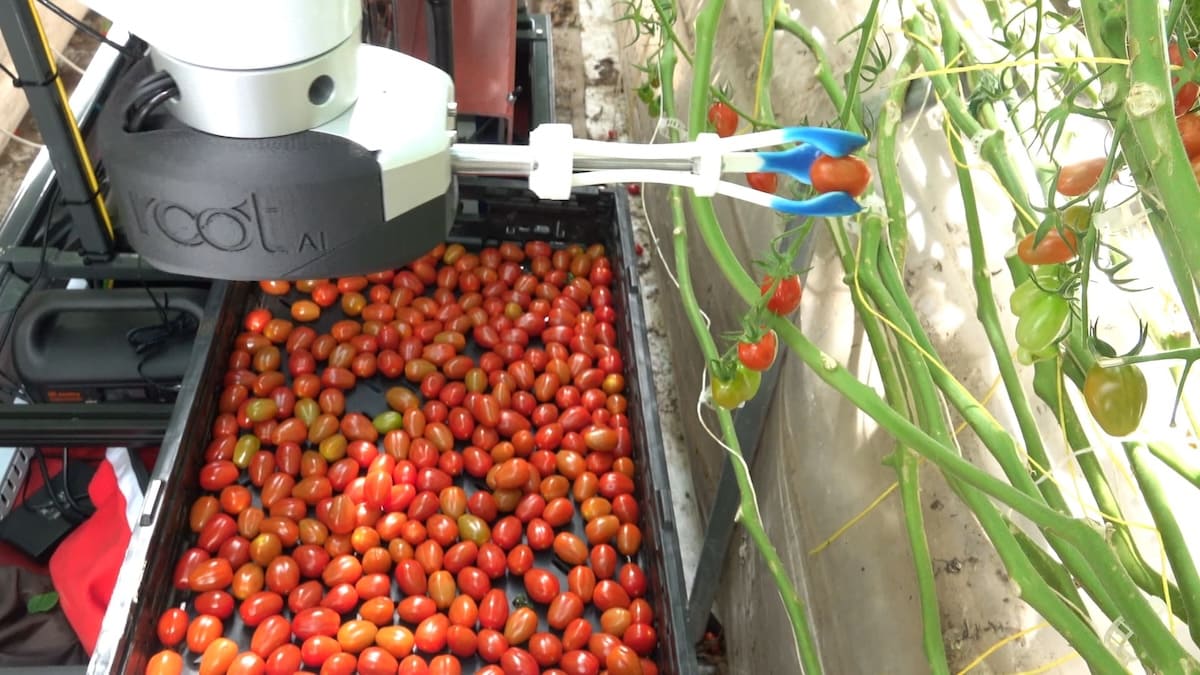
Harvesting robots are emerging as one of the most important innovations in modern agriculture. Designed to reduce labor dependence, improve consistency, and protect soil health, these machines are redefining how crops move from field to market. Unlike traditional mechanized harvesters that prioritize brute throughput, next-generation harvesting robots emphasize selectivity, plant protection, and crop quality.
At their best, harvesting robots combine robotics, computer vision, AI decision-making, and precision movement to replicate the judgment of a careful human picker—at scale.
Harvesting robots are part of our broader agricultural technologies ecosystem focused on robotics, sensing, and automation.
Planting seeds in straight lines is relatively simple. Monitoring crop health with sensors is manageable. But harvesting presents a unique challenge:
Traditional mechanical harvesters often strip entire plants, shake fruit loose, or drive heavy wheels across fields. While efficient in volume, these systems can damage crops, compact soil, and reduce regrowth potential.
Modern harvesting robots are being designed with a different philosophy: harvest only what is ready, leave the rest untouched, and do so without harming the field.
Most harvesting robots share several foundational systems:
High-resolution cameras detect ripe produce based on color, size, and shape. AI models distinguish between mature and immature crops.
Flexible, force-limited end-effectors allow gentle gripping or twisting, mimicking human hands
GPS, LiDAR, or path-planning software guides the robot through fields without constant supervision.
Each harvest event can be recorded, enabling yield mapping and performance analytics.
Some robots are wheeled, others ride on rails in greenhouses, and a new generation uses legged locomotion to avoid soil disturbance altogether.
One of the most compelling examples of crop-specific harvesting design is the Bean Strider™.
Bean Strider™ represents a different approach to harvesting robotics. Rather than adapting existing industrial machinery, it is purpose-built for bush beans planted in spiral rows.
Instead of wheels, conveyors, or strip-picking heads, Bean Strider™ walks like a dog along a spiral path, straddling the planted band so it never drives on soil or roots. This design eliminates soil compaction; one of the silent productivity killers in mechanized agriculture.
Each step represents a harvest station. The robot stabilizes, scans, picks, and then advances. This station-based logic ensures deterministic movement and precise resume capability if the robot pauses to dump harvested beans.
Legs instead of wheels allow Bean Strider™ to:
The defining feature of Bean Strider™ is its dual picking arms.
Each arm services one side of the planted band. Using downward-facing cameras, the robot identifies mature pods based on size, color, and confidence scoring. Immature pods are ignored.
Soft end-effectors perform:
Force limits prevent plants from being yanked or damaged. Each harvest stop allows a “pick burst” - quick, selective harvesting without endless searching.
This mimics how a careful human works: selective, gentle, and efficient.
Traditional row farming requires frequent turning, repositioning, and overlap corrections. Spiral planting systems eliminate row ends and create a single continuous path from center to perimeter.
Bean Strider™ begins at the spiral center and works outward. When its suspended basket reaches capacity—approximately 90–140 pounds - it transitions into fast transit mode, moves to the outer edge where the harvest truck is staged, dumps, and returns precisely to its last completed station.
Because stations are indexed and persisted, the robot never guesses where it left off. It resumes exactly.
Harvesting robots must compete with human labor in both speed and quality.
Bean Strider™’s realistic sustained output ranges between 40–85 pounds per hour depending on plant density. While not a brute-force industrial harvester, it matches careful human picking without fatigue or variability.
Commercial advantages include:
For growers focused on quality rather than sheer tonnage, this model is highly attractive.
Bean Strider™ is not just a machine—it represents a design philosophy: build robots around how plants grow, not how machines prefer to move.
Harvesting robots will likely expand in three directions:
Crop-Specific Platforms – Purpose-built robots for beans, peppers, cucumbers, and specialty crops.
Swarm Coordination – Multiple robots harvesting spirals simultaneously.
Data-Integrated Farming – Robots feeding yield and maturity data into farm management systems.
As labor shortages intensify and soil health becomes a priority, legged, selective, plant-respectful harvesting robots may prove more sustainable than heavy wheeled machinery.
Harvesting robots are no longer science fiction. They are becoming essential infrastructure in precision agriculture—bridging robotics, regenerative planting systems, and premium crop quality.
And in the case of Bean Strider™, they may finally allow farms to scale hand-harvest quality without sacrificing soil, plant integrity, or economic viability.
Harvesting robots are designed to replicate the care of human pickers while increasing consistency, scalability, and operational stability. The comparison below highlights structural differences between traditional manual harvest and selective robotic systems.
| Category | Manual Harvest | Robotic Harvest |
|---|---|---|
| Labor Dependence | Seasonal workforce required | Reduced labor volatility through automation |
| Harvest Consistency | Varies by worker experience and fatigue | Programmed, repeatable picking patterns |
| Selectivity | Visual judgment of ripeness | AI-driven detection and confidence scoring |
| Soil Impact | Foot traffic compaction possible | Low-impact or no-compaction designs (e.g., legged systems) |
| Scalability | Limited by labor availability | Expandable through multi-unit deployment |
| Data Collection | Minimal harvest analytics | Integrated yield tracking and performance logging |
| Operational Hours | Human shift limitations | Extended operation windows depending on system design |
Actual performance varies by crop, maturity variability, field layout, and robot configuration. The metrics below reflect common design targets and operational goals for modern harvesting robots.
| Metric | What It Means | Typical Goal |
|---|---|---|
| Labor Hours per Harvest Cycle | Reduce dependence on seasonal labor and stabilize harvest execution | Decrease labor demand where repetitive picking is required |
| Bruising / Damage Rate | Protect crop quality using soft end-effectors and force-limited picking | Lower damage compared to rough mechanical harvesting methods |
| Selective Pass Frequency | Return more often to pick only what is mature | Enable multiple selective passes during peak maturity windows |
| Picking Accuracy | Identify ripe produce using vision + confidence scoring | Pick mature items while avoiding immature produce when possible |
| Soil Compaction Avoidance | Minimize root-zone disturbance and preserve long-term productivity | Operate with minimal ground pressure or avoid driving on crop bands |
| Yield / Harvest Data Logging | Create harvest maps for forecasting and operational improvement | Capture per-pass performance data to refine strategy |
Note: These are conservative operational targets, not guaranteed outcomes. Results depend on crop type, planting geometry, maturity variability, weather, calibration, and system design.
Harvesting robots are autonomous or semi-autonomous machines that identify ripe produce and pick it using computer vision, robotic arms, and gentle end-effectors. They’re designed to reduce labor dependence, improve consistency, and harvest at the right maturity without damaging plants.
Most systems use cameras (sometimes combined with depth sensors) and AI models to detect produce based on size, color, shape, and confidence scoring. Many robots harvest selectively—picking only mature fruit or pods while leaving immature ones for later passes.
Newer “plant-respectful” designs focus on low-force picking and minimal field impact. Soft end-effectors reduce bruising and tearing, and some systems minimize soil compaction by staying on rails, operating in controlled environments, or using legged movement to avoid driving on growing zones.
Bean Strider™ is a concept for a spiral-row, legged bush bean harvester that straddles the planted band and selectively hand-picks mature pods with two gentle picking arms. It’s designed to avoid soil compaction, follow continuous spiral paths, and deliver hand-harvest quality at field scale.
They can be—especially where labor is scarce or expensive, quality standards are high, or repeated selective harvesting boosts total yield. Cost-effectiveness improves when robots reduce crop damage, stabilize harvest timing, lower labor volatility, and provide consistent output over longer operating hours.