GPS-Guided Farming
High From the Sky Precision Agriculture
Modern agriculture is no longer driven solely by horsepower and instinct. It is increasingly guided by satellites orbiting thousands of miles above the Earth. GPS-guided farming—sometimes called satellite-guided agriculture—uses global positioning systems to enhance precision, efficiency, and environmental stewardship across nearly every stage of crop production.
From planting straight rows to applying variable-rate nutrients, GPS technology has become one of the foundational tools in precision agriculture. It reduces overlap, improves input accuracy, saves fuel, and enables data-driven field management. In today’s climate-constrained and cost-sensitive agricultural environment, GPS-guided farming is not a luxury—it is infrastructure.
GPS-guided farming refers to the use of satellite-based positioning systems to direct farm equipment and field operations with high levels of accuracy—often within inches or even centimeters when paired with RTK (Real-Time Kinematic) correction systems.
Modern tractors, sprayers, planters, and harvesters are equipped with GPS receivers and onboard guidance displays. These systems allow operators—or autonomous platforms—to follow pre-programmed field paths with minimal deviation.
Core components typically include:
The result is machinery that knows exactly where it is, where it has been, and where it needs to go next.
Fields are not uniform rectangles. They contain subtle topographic variations, soil differences, drainage patterns, and yield variability. Traditional farming methods often resulted in:
GPS-guided systems eliminate much of this inefficiency. By maintaining perfectly spaced rows and accurate pass tracking, farmers reduce overlap and ensure consistent coverage.
Even small percentage gains in efficiency can translate into substantial savings over hundreds or thousands of acres.
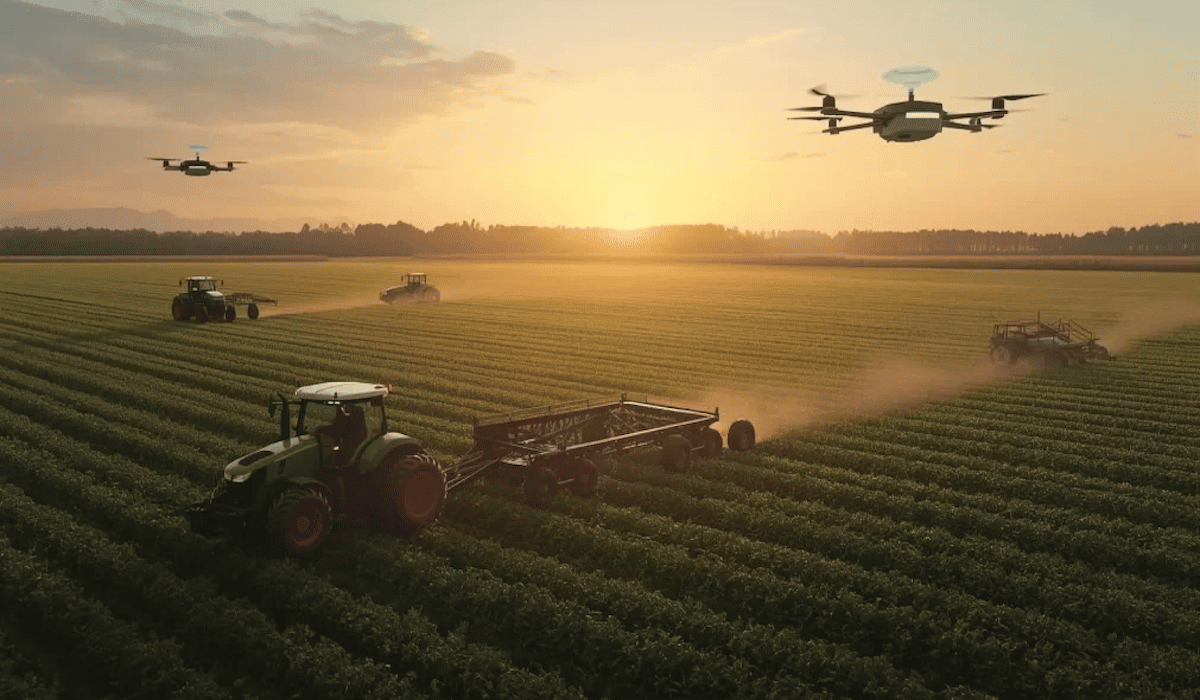
Large-scale corn and soybean producers were early adopters of GPS-guided technology.
In Midwestern row-crop operations, GPS-guided planters maintain exact row spacing across expansive fields. With RTK correction, row placement can be accurate to within one inch. This precision matters for:
Autosteer systems also reduce operator fatigue. Long planting days become more manageable, and night operations remain precise.
The outcome: higher stand uniformity, reduced overlap, lower fuel usage, and improved yield stability.
GPS-guided farming becomes even more powerful when paired with soil mapping and prescription data.
In orchards and vineyards, soil sampling and yield mapping data are integrated into GPS-based field management systems. Equipment can then apply fertilizers or amendments at variable rates based on precise location within the field.
Instead of broadcasting nutrients evenly across an entire block, inputs are adjusted zone-by-zone. Areas with higher organic matter may require less nitrogen. Poorer soils may require targeted support.
This approach improves nutrient-use efficiency and reduces runoff risk. It also lowers total input costs while protecting long-term soil health.
Precision placement transforms fertilization from uniform application into targeted management.
Chemical application is one of the most significant cost centers in crop production. GPS guidance reduces unnecessary overlap and ensures accurate spray coverage.
Sprayers equipped with section control automatically shut off nozzles when overlapping previously treated areas. This reduces:
In combination with field mapping and emerging robotic systems, GPS-guided sprayers can apply treatments only where needed.
This reduces chemical use and strengthens integrated pest and weed management strategies.
One of the most immediate benefits of GPS-guided farming is fuel efficiency.
Straight-line passes and minimized overlap reduce unnecessary travel distance. Over hundreds of acres, this translates into measurable fuel savings.
In addition, maintaining consistent traffic lanes reduces soil compaction in unintended areas. Controlled traffic farming—enabled by GPS—keeps heavy equipment on fixed tracks, preserving soil structure in crop zones.
Better soil structure improves water infiltration and root development over time.
GPS does more than guide machinery—it builds data layers.
Each pass across a field can generate georeferenced data:
Over multiple seasons, these data layers create a historical record of field performance. Farmers can identify patterns, adjust management strategies, and plan long-term improvements.
GPS becomes the spatial backbone of smart agriculture systems.
Precision placement of inputs reduces environmental risk.
By minimizing fertilizer overlap and chemical excess, GPS-guided farming helps:
When combined with soil monitoring, irrigation management, and regenerative practices, GPS-guided systems support both productivity and ecological stewardship.
Beyond efficiency theory, GPS-guided farming delivers measurable performance improvements across modern operations:
Precision guidance transforms incremental efficiency gains into significant economic and environmental impact over time.
GPS-guided farming is evolving rapidly.
Emerging developments include:
As artificial intelligence layers onto geospatial data, farms will operate with increasing automation and predictive capability.
The combination of GPS, sensors, robotics, and data analytics is transforming agriculture from reactive to anticipatory management.
GPS-guided farming represents one of the most transformative shifts in modern agriculture. By aligning machinery with satellite precision, farmers reduce waste, lower costs, and protect natural resources.
From row crops in the Midwest to orchards and vineyards worldwide, GPS technology improves efficiency while strengthening environmental performance.
In a world demanding higher yields with fewer inputs, precision from the sky down is not optional—it is foundational.