Agricultural Robotics
The Future of Precision Farming and Smart Agriculture
Agricultural robotics is no longer a futuristic concept confined to research labs and trade shows; it is rapidly becoming one of the defining forces shaping the next era of food production. As global agriculture faces mounting pressures—labor shortages, rising input costs, climate volatility, soil degradation, and the need to produce more food on less land—robotic systems are stepping in to deliver precision, consistency, and data-driven intelligence at scale. Unlike traditional mechanization, which primarily amplified human muscle, agricultural robotics amplifies human decision-making. These systems combine sensors, artificial intelligence, machine vision, GPS guidance, and autonomous mobility to execute tasks with a level of accuracy that was previously impossible in open-field environments. As part of broader smart agriculture technologies, robotics is helping farms transition from broad, uniform management toward hyper-targeted, plant-by-plant care.
Agricultural robotics refers to the use of autonomous or semi-autonomous machines equipped with AI, sensors, and advanced control systems to perform tasks such as planting, weeding, harvesting, monitoring, and livestock management. These systems integrate hardware and software to interpret environmental conditions and act with precision. From robotic arms in greenhouses to autonomous tractors in row crops, agricultural robotics represents a critical evolution within circular agricultural systems, where efficiency, waste reduction, and precision resource use are central objectives. Robotics enables farms to close nutrient loops, optimize input usage, and reduce environmental impact while maintaining productivity.
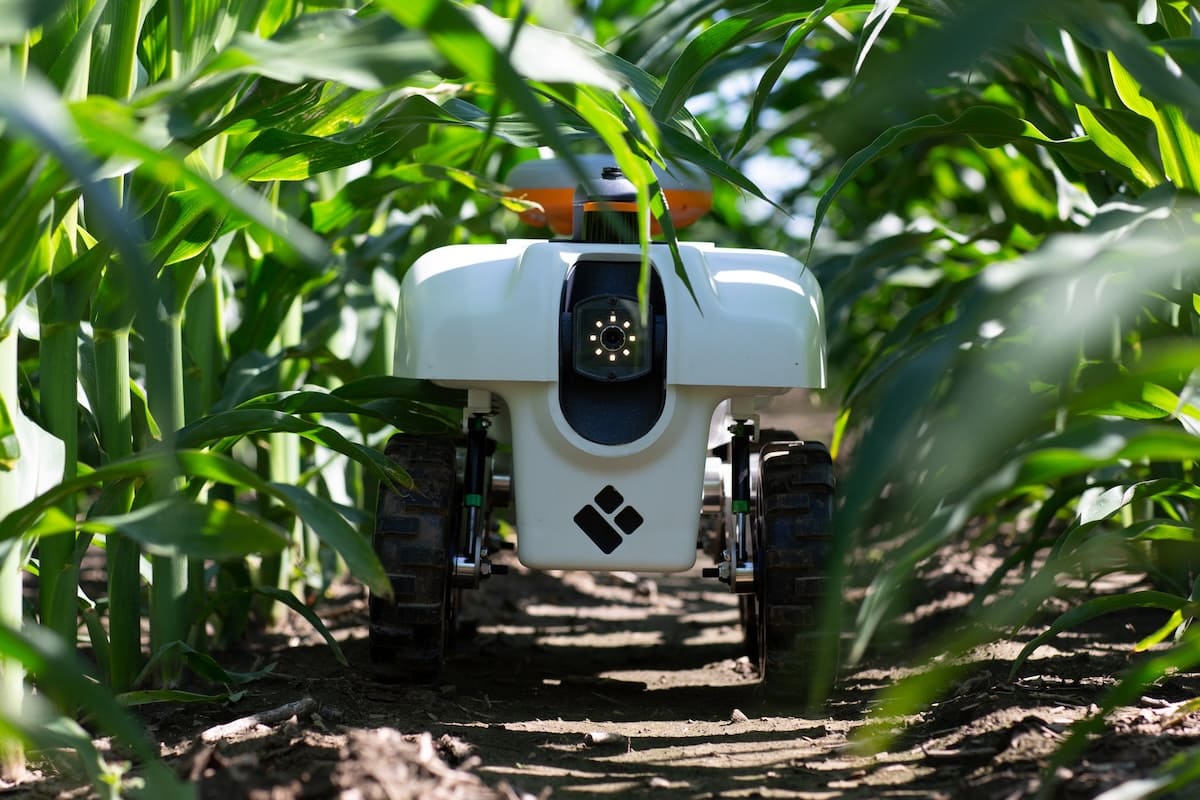
One of the most visible applications of agricultural robotics is autonomous field machinery. Self-driving tractors and robotic implements now navigate fields using RTK GPS with sub-inch accuracy, enabling precise seeding, cultivation, and harvesting. Companies such as John Deere and CNH Industrial have integrated autonomous capabilities into large-scale systems, allowing farmers to manage equipment remotely. These machines dynamically adjust seeding rates and fertilizer application based on field variability, supporting strategies aligned with carbon-smart farming and reduced input intensity. Precision execution lowers fuel use, minimizes over-application, and supports climate-resilient crop production.
Smaller robotic platforms are redefining specialty crop production. In fruit and vegetable systems, robotic harvesters use computer vision to identify ripe produce and gently remove crops without damage. This technology is especially important in high-value crops where labor shortages threaten profitability. Robotics companies such as Blue River Technology have pioneered systems that identify individual plants in real time, enabling targeted action at the leaf level. When integrated with data models similar to digital twin farming, robotic harvesters can optimize timing, yield forecasting, and quality control, reducing waste and improving margins.
Weeding robots represent a major breakthrough in sustainable agriculture. Rather than applying herbicides uniformly, robotic systems analyze plant structure and apply micro-doses only where needed. Some platforms use mechanical removal, while others employ laser-based elimination methods. This precision aligns with regenerative goals outlined in smart regenerative agriculture, where reducing chemical dependency is critical. By treating individual weeds instead of entire fields, robotic weeders significantly lower herbicide use, slow resistance development, and protect soil biology.
Robotics is transforming livestock production through automated feeding systems, robotic milking stations, and wearable health monitors. These technologies improve efficiency while enhancing animal welfare. Sensors track rumination, movement, and temperature, enabling early detection of health issues. This predictive approach complements integrated systems like closed-loop farming, where livestock, crops, and nutrient cycles function as interconnected components. Robotic data collection strengthens traceability, performance analytics, and overall system resilience.
In controlled environment agriculture, robotics plays a central role in hydroponic and vertical farming operations. Robotic arms transplant seedlings, monitor nutrient delivery, and harvest crops in climate-controlled facilities. Companies such as Iron Ox have developed autonomous greenhouse systems that optimize plant positioning and growth conditions. These systems integrate seamlessly with water-efficient models similar to those discussed in water-smart farming, maximizing yield per square foot while minimizing resource consumption.
Every robotic pass across a field generates data points related to soil moisture, plant vigor, pest pressure, and yield performance. Over time, this information feeds predictive analytics platforms that guide farm management decisions. Robotics becomes the execution layer for insights generated through tools like climate risk forecasting, enabling proactive adjustments before stress becomes visible. This shift from reactive to predictive agriculture improves resilience and reduces financial risk.
Agricultural robotics supports sustainability by reducing fertilizer runoff, lowering greenhouse gas emissions, and minimizing soil compaction. Smaller autonomous units can replace heavy machinery in certain contexts, preserving soil structure and biodiversity. Robotics also enhances practices such as compost application and cover crop management, which are foundational to soil-building strategies discussed in building soil. By enabling precision at scale, robotics strengthens the environmental and economic pillars of climate-smart farming.
While upfront costs remain a barrier for some operations, robotics-as-a-service models and leasing programs are expanding access. As labor shortages intensify and compliance standards tighten, robotic systems increasingly deliver measurable return on investment. Farms that integrate robotics alongside analytics platforms within the Smart Agriculture Technologies Hub framework position themselves for long-term efficiency and scalability.
The future of agricultural robotics lies in coordinated, AI-driven ecosystems. Swarms of small robots may collaborate across fields, guided by centralized platforms that integrate satellite imagery, predictive analytics, and on-the-ground sensors. These distributed systems align with the broader evolution toward circular agricultural systems, where productivity, environmental stewardship, and profitability operate in balance. Farmers will transition from machine operators to strategic system managers, overseeing integrated digital-physical ecosystems that define the next generation of resilient food production.
Agricultural robotics is the use of autonomous or semi-autonomous machines—powered by sensors, AI, machine vision, and GPS—to perform farm tasks such as planting, weeding, spraying, harvesting, scouting, and livestock monitoring with plant-level precision.
Farm robots combine perception (cameras, LiDAR, and sensors), decision-making (AI models and onboard computing), and action (robotic arms, tools, or sprayers). They map fields, identify crops vs. weeds, detect ripeness or stress, and then perform targeted operations—often guided by high-accuracy GPS or row-following vision.
Harvesting robots can be profitable when labor is scarce or expensive, crops are high-value, and harvest timing strongly affects quality and yield. Many farms see ROI through reduced labor volatility, improved pack-out quality, lower damage rates, and the ability to harvest more consistently at peak ripeness.
The Bean Strider is a lightweight, row-adaptive agricultural robotics platform designed to move efficiently through crop rows with minimal soil compaction and plant disturbance. It supports targeted harvesting and in-field monitoring—showing how smaller, intelligent systems can outperform heavier machinery in sensitive production environments.
Robotics reduces labor costs by automating repetitive field tasks (weeding, spraying, scouting, harvesting) and making labor more efficient when people are needed. Instead of large crews, farms can shift to smaller teams that supervise autonomous systems, respond to alerts, and focus on skilled work like crop management and quality control.