Rethinking Agriculture
Build a Million Dollar per Acre Farm
Conventional agriculture is no longer sustainable. Tractor-dependent, open-field farming locks producers into an extractive system that depletes natural resources while generating diminishing returns. The evidence is clear:
Conclusion: Today’s dominant model is labor-intensive, dependent on increasingly exepensive fertilizers, environmentally damaging, and economically fragile.
The Concept: Change the Shape of Agriculture
A secure, circular, closed-loop cultivation system that reimagines how high-value crops can be grown. By reorganizing the physical, biological, and logistical layout of farm infrastructure, the system is designed to increase production per square foot, improve water and fertilizer efficiency, reduce operating inputs, and strengthen resilience to climate and market variability. Actual results depend on crop selection, climate, site conditions, system design, and management.
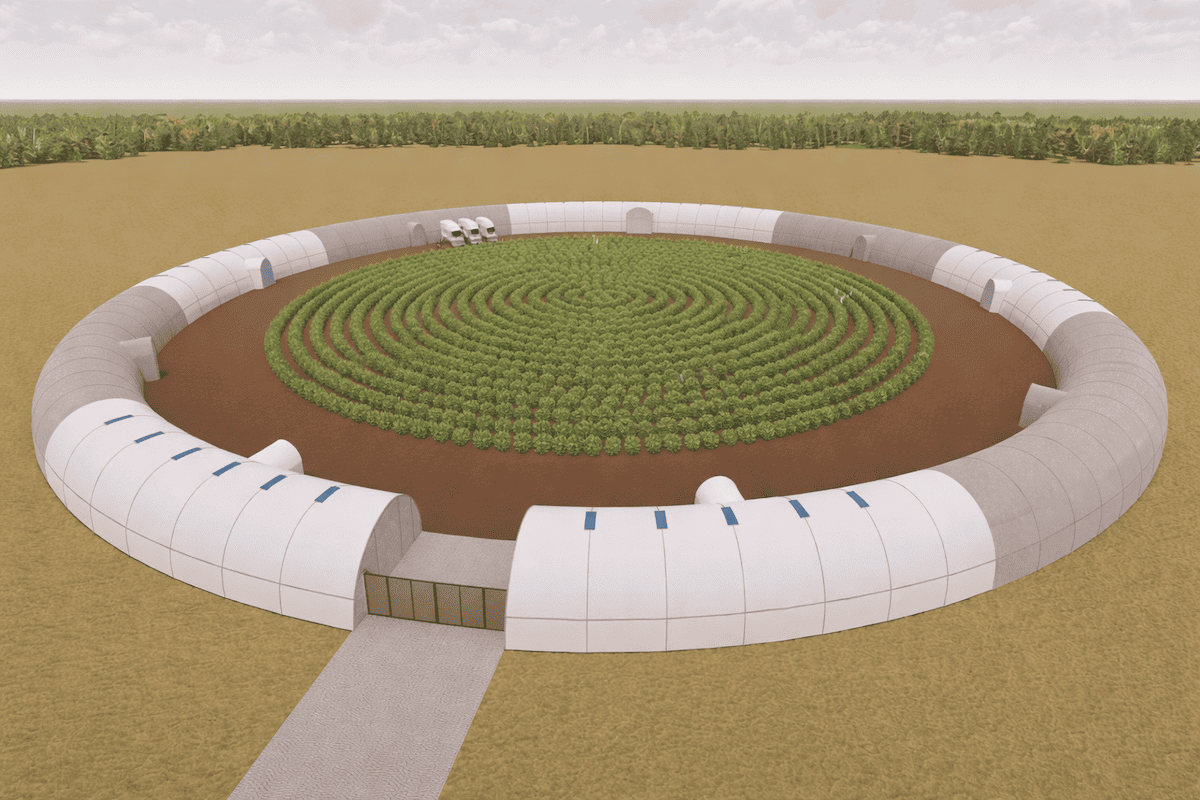
At the heart of the complex lies an Archimedean spiral - an efficient planting geometry enclosed within a multi-functional arched structure that provides:
Although the system is illustrated using bell peppers, it is engineered to support diverse crops—from leafy greens to root vegetables, herbs, and even ornamental flowers.
This is not just a layout—it's a full system redesign for scalable, regenerative agriculture.
Features That Compound Advantage
The Crop Circle Grow Complex is a high-output, resource-optimized platform where multiple performance benefits reinforce one another. Each feature has been designed to amplify the system’s yield, resilience, and return on investment—without compromising ecological integrity
The multi-functional arched infrastructure includes:
Result: A modular, scalable system that brings together resource-smart design, closed-loop fertility, and on-site energy generation—engineered for long-term resilience and immediate profitability.
The Crop Circle Grow Complex is not just a high-yield system—it is engineered to deliver measurable environmental improvements across multiple sustainability dimensions, from water use and soil health to energy efficiency and biodiversity.
The complex promotes long-term soil integrity and dramatically reduces water usage:
By shifting to electrified operations powered by renewable energy, the system minimizes its carbon footprint:
The circular design and minimized chemical input create conditions that support beneficial organisms and local biodiversity:
The Crop Circle Grow Complex represents a complete paradigm shift in agricultural design. It is not merely a novel layout—it is a high-efficiency, closed-loop production platform that combines precision engineering, renewable systems, and regenerative practices to deliver consistent profits and measurable environmental benefits.
At its core, this is a 5 million dollar farm model that:
By re-engineering layout, inputs, and logistics around a protected circular geometry, the Crop Circle Pepper Complex delivers higher yield per square foot, radically lower resource intensity, improved quality control, and bankable economics—a significant step from land-degrading open-field practices to resilient, profit-forward regenerative production.
Turn your 1 acre into a high-yield, profitable farm.
Crop Circle Farms specializes in designing and building fully engineered, low-impact profitable farm systems that use 90% less water, 85% less fertilizer, and deliver two to three times the yield of traditional farming.
Whether you have a vacant lot, an empty field, a resort, school, island community, or small family farm, we’ll build it from the ground up for you. Our team handles everything from farm layout and installation to irrigation, root systems, training, and first planting.
Contact Us to explore a custom Crop Circle Farm design for your property.
Help us expand our mission to revolutionize agriculture globally. We are seeking partners to implement Crop Circle Farms to feed people in need. Together, we can build scalable food production systems that save water, reduce costs, and feed thousands of people. Contact Growing To Give
These frequently asked questions explain the economics, crops, infrastructure, production intensity, sales channels, risks, and Crop Circle design principles behind high-revenue-per-acre farming.
It is rare and only plausible under highly intensive, protected systems that stack high-value crops, value-added products, premium pricing, and near-100% market absorption. Most farms should target progressive, evidence-based revenue steps rather than a headline number.
Examples include premium leafy mixes and herbs with fast turns, greenhouse tomatoes and berries, nursery starts, specialty mushrooms, microgreens, and value-added items such as washed and packed salads, sauces, and pestos paired with direct or subscription channels.
Turns per year, square-foot yield, sell-through rate, price per unit, shrink, labor per dollar of sales, and the margin uplift from processing, branding, and guaranteed channels such as CSA programs, subscriptions, and contracts all influence revenue potential.
Intensive models require significant capital for protected cultivation such as greenhouses or tunnels, climate controls, fertigation, wash and pack facilities, cold-chain infrastructure, and vehicles. They also require skilled labor for seeding, harvesting, quality control, food safety, and sales. Underestimating labor and compliance can significantly affect financial performance.
Weekly subscriptions and CSA programs, restaurants, specialty retail, premium product lines, on-site farmstands where permitted, and institutional contracts can support higher selling prices. Wholesale-only models generally make extreme revenue-per-square-foot targets more difficult to achieve.
Value-added processing can substantially affect farm economics. Washing and packing, specialty mixes, branded products, prepared foods, or shelf-stable products can increase selling value and create additional markets, provided the operation meets applicable licensing, food-safety, processing, storage, and labeling requirements.
Important risks include market saturation, price compression, crop failure, food-safety incidents, equipment downtime, labor shortages, regulatory requirements, unexpected operating costs, and cash-flow gaps between infrastructure investment and mature sales.
A farm can begin with high-turn crops and relatively simple protected growing systems, add targeted irrigation and fertigation, develop reliable weekly buyers, and then expand into value-added products, wash and pack infrastructure, cold storage, and additional protected production. Expansion should follow demonstrated production and market demand.
Crop Circle layouts use circular and spiral planting geometry to organize crops, irrigation, harvesting, access, and infrastructure within a compact footprint. Radial zoning can shorten movement between growing areas and central infrastructure while allowing different crop groups and production stages to be organized within the same system.
Useful metrics include crop turns, yield per square foot, marketable yield, shrink and waste, labor per unit produced, average selling price by crop and sales channel, sell-through rate, water and fertilizer use, operating costs, and cash conversion. Tracking these measurements helps determine which crops and production strategies should be expanded, modified, or discontinued.