Land-Based Recirculating Aquaculture Systems (RAS)
The Future of Water-Smart, Controlled Environment Seafood Production
A Land-Based Recirculating Aquaculture System (RAS) is a controlled, indoor fish or shrimp production system that continuously filters and reuses water rather than discharging it after a single pass. Unlike open-net pens in oceans or traditional pond aquaculture, RAS facilities operate in closed-loop environments where 90–99% of the water is recycled, dramatically reducing water use, environmental discharge, and disease exposure.
In a world facing overfished oceans, water scarcity, climate volatility, and increasing protein demand, RAS represents a structural shift in how seafood is produced.
Instead of relying on tides, rivers, or lakes, land-based RAS facilities function like biological life-support systems for fish — carefully balancing:
When properly engineered, RAS systems provide year-round production, precise feed conversion, and biosecure environments that can be located close to major urban markets.
Global seafood demand is projected to rise dramatically by 2050. Meanwhile:
RAS addresses these constraints by:
For regenerative agriculture innovators, RAS also opens doors to circular nutrient systems, compost integration, aquaponics, and climate-resilient protein production.
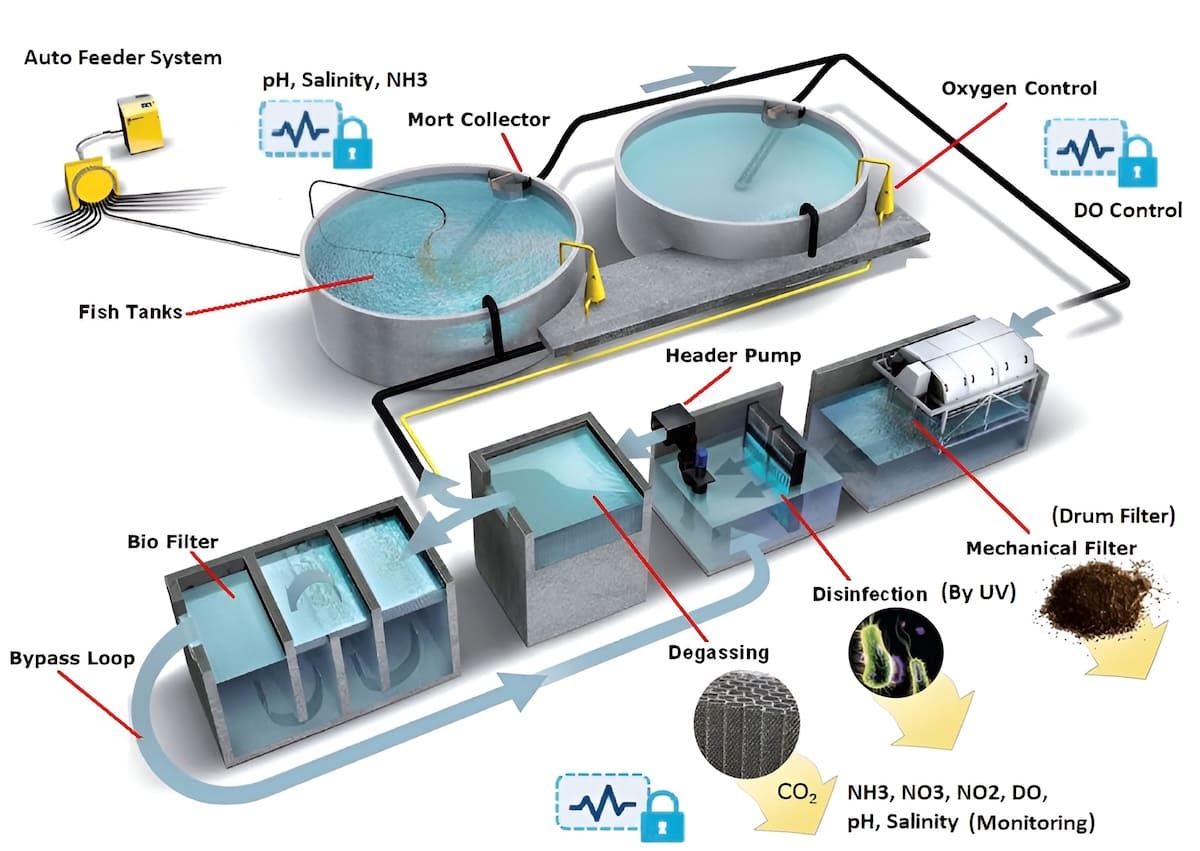
Fish are raised in circular or rectangular tanks. Circular tanks are preferred because they create a rotational flow that naturally moves solids toward a central drain.
Benefits:
Before water can be reused, solid waste must be removed.
Common systems:
Solids removal is critical because organic waste consumes oxygen and releases ammonia.
Fish excrete ammonia (NH₃), which is toxic. Biofilters convert ammonia through a biological process called nitrification:
Ammonia → Nitrite → Nitrate
Specialized bacteria colonize media surfaces in systems such as moving bed biofilm reactors (MBBR).
Without efficient biofiltration, fish mortality can occur rapidly.
Fish consume oxygen and produce carbon dioxide. Systems must:
Advanced systems use:
To prevent disease spread, RAS systems commonly incorporate:
These reduce pathogen load without antibiotics.
RAS facilities rely on:
Automation is critical. Even brief system failures can cause catastrophic loss.
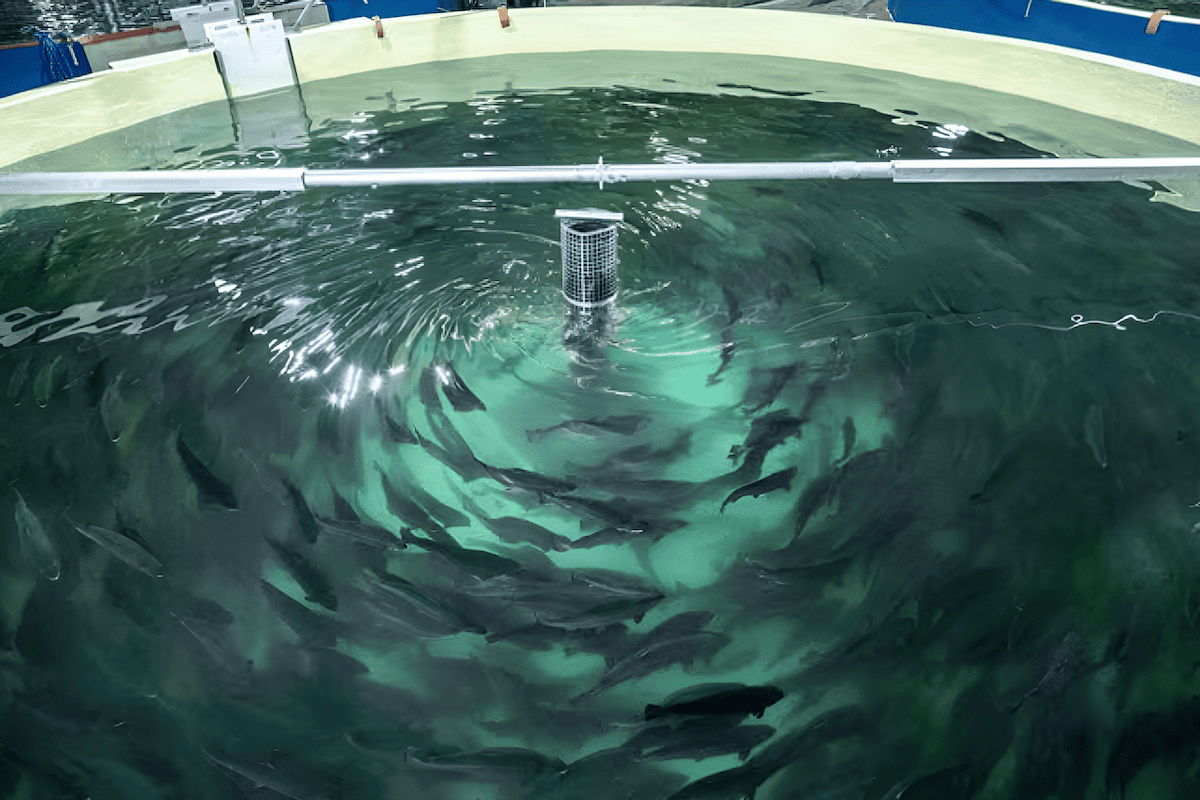
RAS is essentially aquatic life-support engineering.
Key parameters:
Poor management of even one parameter can destabilize the entire system.
RAS systems reuse up to 99% of water. This makes them viable even in arid regions.
Closed systems reduce exposure to:
Facilities can be built:
RAS is not simple.
Construction can range from $8–$20+ per annual kilogram of capacity.
Pumping and oxygenation require continuous power.
Operators must understand:
Power outages, pump failure, or oxygen system breakdown can result in total stock loss.
Redundancy systems are essential.
Major operating costs:
Feed conversion ratios (FCR) are critical:
High-end RAS salmon can command premium pricing due to:
| System | Water Use | Escapes | Waste Discharge | Disease Risk |
|---|---|---|---|---|
| Ocean Net Pens | Low intake | Yes | Direct to ocean | Higher |
| Ponds | Moderate | Possible | Local discharge | Moderate |
| Land-Based RAS | Very Low | None | Controlled | Lower |
RAS allows capture of phosphorus and nitrogen, preventing watershed contamination.
One of the most promising integrations is pairing RAS with plant systems.
Fish waste nutrients can:
Instead of discharging nutrients, circular systems transform waste into productivity.
This aligns strongly with regenerative agriculture principles.
Energy use is the main environmental tradeoff.
Solutions include:
As renewable energy costs fall, RAS economics improve.
A large-scale land-based salmon producer demonstrating commercial viability in the U.S.
Developing major RAS facilities in North America.
Focused on land-based salmon production with genetic optimization.
Lessons learned:
Land-based facilities must comply with:
Compared to ocean net pens, RAS permitting can be more straightforward because impacts are contained.
Professional RAS facilities implement:
Redundancy is not optional — it is foundational.
| Category | Conventional Land-Based RAS | Artificial River Systems |
|---|---|---|
| Water Movement | Mechanical recirculation with pumps and filtration loops | Continuous directional current using gravity-assisted or low-energy flow |
| Energy Demand | High (pumps, oxygen injection, mechanical filtration) | Moderate to Low (flow-driven oxygenation and natural turbulence) |
| Fish Health | Controlled environment but limited swim stimulation | Constant current strengthens muscle development and mimics natural habitat |
| Water Quality Management | Biofilters, solids removal, UV/ozone treatment | Flow-based nutrient distribution with integrated filtration and settlement zones |
| Nutrient Handling | Captured waste requires separate disposal or treatment | Can integrate directly into regenerative irrigation or ecological water systems |
| Regulatory Profile | Contained discharge, often streamlined permitting | Contained system with potential watershed restoration alignment |
| Infrastructure Complexity | High mechanical complexity and capital intensity | Simplified hydraulic design with scalable modular expansion |
| Best Fit | Urban, high-density indoor fish production | Regenerative land-based aquaculture integrated with water restoration |
As climate volatility increases and coastal aquaculture faces regulatory pressure, land-based systems will likely expand.
Drivers include:
RAS may not replace ocean aquaculture entirely, but it will likely become a major component of global seafood production.
Yes, but profitability depends heavily on:
Typically 90–99% less than flow-through systems.
System failure leading to oxygen depletion.
Yes. Small commercial systems and research-scale units exist, though economics improve at scale.
It eliminates sea lice and escapes but may carry higher energy footprints unless renewable energy is used.