Grow Lights
Types • Spectrum • Timing
Grow lights allow growers to precisely control light intensity, spectrum, and timing when natural sunlight is limited, inconsistent, or unavailable. From seed-starting racks and grow tents to greenhouses and indoor farms, artificial lighting makes it possible to maintain healthy plant growth year‑round.
Different plants require different light intensities and daily light durations. The table below shows typical PPFD targets and recommended light hours for common indoor crops grown under grow lights.
| Plant Type | General PPFD Starting Range | Typical Light Hours |
|---|---|---|
| Seedlings | 100–300 µmol/m²/s | 14–18 hours |
| Leafy greens (lettuce, kale, spinach) | 200–400 µmol/m²/s | 14–18 hours |
| Herbs (basil, cilantro, parsley) | 200–500 µmol/m²/s | 14–18 hours |
| Tomatoes | 400–900 µmol/m²/s | 12–16 hours |
| Peppers | 400–800 µmol/m²/s | 12–16 hours |
Note: Exact lighting needs vary depending on plant variety, temperature, CO₂ levels, and growing method. Start with moderate intensity and increase gradually while monitoring plant response.
The key to success is matching light output to the plant’s growth stage. Seedlings require gentle but close light to prevent stretching, leafy crops thrive under steady vegetative intensity, and flowering or fruiting plants demand higher total daily light to support bloom formation and yield.
This guide explains the major grow light types, how spectrum and photoperiod affect plants, and how to choose fixtures that balance plant performance, energy efficiency, heat management, and usable growing space.
| Stage | Typical PPFD target* | Photoperiod (hours/day) | Notes |
|---|---|---|---|
| Seedlings / propagation | 100–300 | 14–18 | Keep lights close enough to prevent stretching. Gentle airflow helps strengthen stems. |
| Vegetative growth (leafy) | 200–500 | 14–18 | Great for herbs, greens, and transplants. Blue-rich or full-spectrum works well. |
| Flowering / fruiting vegetables | 400–900+ | 12–16 typical | Light requirements vary by crop, cultivar, growth stage, temperature, CO₂, and target DLI. Increase intensity gradually and monitor plant response. |
*Targets vary by crop, CO₂ level, temperature, and cultivar. Start lower and increase if plants respond well (thicker stems, tighter internodes, deeper green without burn).
Light intensity and spacing directly affect growth rate and harvest size. Use these tools to estimate output and dial in plant density under lights.
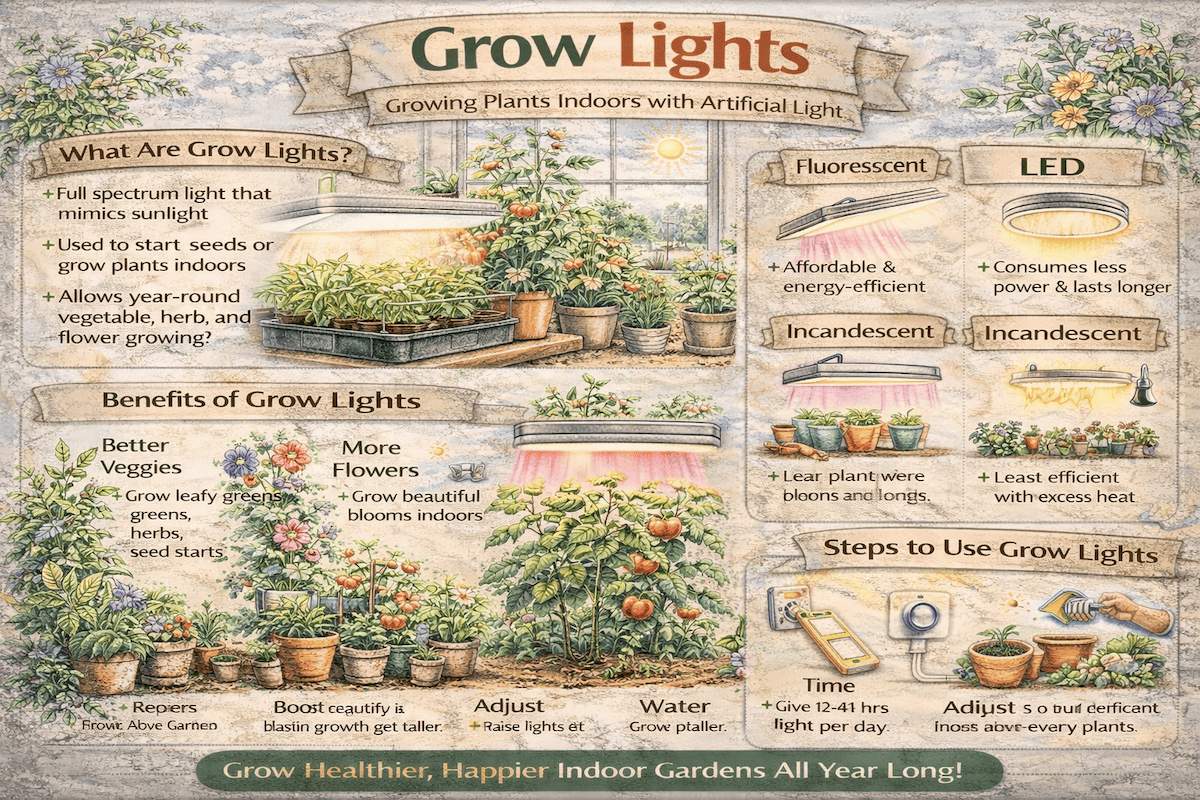
Feel free to share this grow lights infographic on your website or blog. Please include a link back to this page as the source.
Modern horticulture LEDs are efficient, run cooler than HID, and can be built as bars (even canopy coverage) or boards (compact fixtures). Look for full-spectrum (white + some deep red) and good thermal management. Dimmable drivers are a big plus.
Fluorescents are a proven, low-cost choice for seed starting and light vegetative growth. They don’t penetrate deeply into thick canopies, so they’re less ideal for heavy flowering/fruiting.
HID systems were the commercial standard for decades. Metal Halide (MH) is blue-leaning (veg), and HPS is red/orange-leaning (flower). They produce more radiant heat, which can help in cold spaces but becomes a challenge in warm rooms.
CMH (also called LEC) is a type of HID with a broader spectrum than HPS, often praised for plant quality and color rendering. It still runs hot compared to LED, but many growers like the canopy penetration and spectrum balance.
| Plant type | What they want most | Good light approach | Tips |
|---|---|---|---|
| Leafy greens (lettuce, kale, spinach) | Steady veg light, moderate intensity | Full-spectrum LED or T5 for racks | Cooler temps + strong airflow = tighter heads and better texture. |
| Herbs (basil, cilantro, mint) | Moderate-high veg light | Full-spectrum LED | Basil handles higher PPFD than many herbs—watch tip burn from heat or EC. |
| Seedlings / transplants | Compact growth, strong stems | T5/LED close to canopy | If seedlings stretch, increase intensity or move lights closer. |
| Fruiting crops (tomato, pepper, cucumber) | High intensity + longer DLI | High-output LED bars / quality HID | Fruit set improves with stable temps, airflow, and consistent watering. |
| Flowering ornamentals | Photoperiod control + intensity | LED with timer control | Many ornamentals are day-length sensitive—timers are your friend. |
| Technology | Advantages | Disadvantages |
|---|---|---|
| LED | High efficiency; lower radiant heat; long service life; full-cycle capable; dimmable | Higher upfront cost; fixture quality varies; poor layouts can create uneven canopy intensity |
| Fluorescent | Great for seedlings; inexpensive; easy to hang close | Lower intensity; weaker penetration; bulbs age and need replacing |
| HID (HPS/MH) | High intensity; strong penetration; proven results | High radiant heat; lower efficiency than modern LEDs; ventilation often required; lamp replacement |
| CMH/LEC | Broad spectrum; good plant quality; strong penetration | Heat; power use; bulb cost/replacement |
Optimize inputs under controlled conditions—measurement, timing, and ROI decisions.
High-yield leafy crops under lights—spacing, airflow, and harvest cadence.
Designing productive indoor systems—light planning, climate control, and layout.
Maximize canopy efficiency and airflow while preventing disease pressure.
Crop Circle Farms designs resource-efficient growing systems tailored to site conditions, crops, water availability, production goals, and market needs. Services can include farm layout, irrigation planning, crop selection, production modeling, and integration of Crop Circle growing systems.
Explore our water-efficient farming resources or Contact Us to discuss a farm design for your property.
Through our nonprofit partners, Crop Circle farming concepts can also support community food-production projects in food-insecure, island, and water-stressed regions.
Learn more about the Growing To Give Spiral Farm Project or contact Growing To Give.
A quality full-spectrum LED grow light is one of the most versatile choices for home growing because modern LEDs are energy-efficient, produce less radiant heat than traditional HID systems, and can support plants from seedlings through flowering and fruiting when the fixture provides sufficient intensity and canopy coverage.
For seed-starting shelves, microgreens, herbs, and other relatively low-intensity applications, smaller LED bars or fluorescent T5-style fixtures can also work well.
Tall, weak, or stretched seedlings are often a sign that light intensity at the canopy is too low. This can happen when the fixture is too far from the plants, is dimmed too much, or does not provide adequate output for the growing area.
Follow the fixture manufacturer's recommended hanging distance, then adjust gradually based on plant response. Consistent light schedules and gentle airflow can also help seedlings develop compact growth and stronger stems.
Many seedlings and leafy crops are grown with approximately 14–18 hours of light per day. Fruiting crops such as tomatoes and peppers are often grown with approximately 12–16 hours, depending on crop type, light intensity, growth stage, cultivar, and target daily light integral.
Plants also require a regular dark period. A timer is an easy way to maintain consistent light and dark cycles.
Light intensity, duration, and spectrum can all influence plant growth and development. Blue wavelengths are often associated with more compact vegetative growth, while red wavelengths are important for photosynthesis and can influence flowering and plant form.
Most modern full-spectrum LED fixtures provide wavelengths suitable for both vegetative and reproductive growth. In many indoor-growing situations, providing adequate PPFD and DLI is more important than attempting to use a narrowly defined color spectrum for each growth stage. Plant responses vary by species and cultivar.
PPFD, or photosynthetic photon flux density, measures the density of photosynthetically active photons reaching a plant canopy at a given moment. It is measured in µmol/m²/s.
DLI, or daily light integral, measures the total amount of photosynthetically active light received over an entire day and is expressed in mol/m²/day.
When PPFD remains constant, DLI can be calculated as: PPFD × 3,600 × light hours ÷ 1,000,000. DLI is useful because it accounts for both light intensity and the number of hours the lights operate.
The correct hanging distance depends on the fixture's output, beam pattern, plant species, growth stage, and whether the fixture is dimmed. There is no single correct distance for every grow light.
Start with the manufacturer's recommended hanging height and, where possible, use a PPFD map or light meter to evaluate canopy intensity. Stretching can indicate insufficient light, while bleaching, leaf curling, excessive canopy temperature, or other stress can indicate that intensity is too high.
Yes. Tomatoes, peppers, cucumbers, and other fruiting crops can be grown indoors when they receive sufficient light intensity and daily light, appropriate temperatures, airflow, water, nutrients, and root-zone space.
Fruiting crops generally require considerably more light than seedlings or leafy greens. Indoor growers may also need to assist pollination through airflow, flower vibration, hand pollination, or another crop-appropriate method.
Yes. Fluorescent fixtures, including T5 systems, can still be useful for seedlings, propagation, microgreens, and relatively low-growing leafy crops. They can be positioned close to the canopy and may be inexpensive where existing fixtures are already available.
Modern LEDs generally offer higher efficiency and greater output flexibility, so fluorescent lighting is less commonly selected for new high-intensity flowering or fruiting installations.
Start with the size of the growing area and the type of crop. Seedlings, microgreens, herbs, and leafy greens generally need less intensity than flowering and fruiting vegetables.
Compare fixtures using actual power consumption, recommended coverage, published PPFD maps, efficiency, dimming capability, thermal management, electrical safety information, and warranty support. Size the fixture for the growing footprint rather than relying on marketing names or advertised equivalent wattage.
Grow-light products are available from many horticultural lighting manufacturers and retailers. Examples commonly encountered in the U.S. market include Horticulture Lighting Group (HLG), Fluence, Gavita, Spider Farmer, Mars Hydro, AC Infinity, California LightWorks, and ViparSpectra, along with retailers such as GrowGeneration, Hydrobuilder, HTG Supply, and independent hydroponic stores.
Brand recognition alone does not determine fixture quality. Compare electrical certifications, actual power consumption, fixture efficiency, coverage area, PPFD maps, dimming capability, warranty terms, and suitability for your particular crop and growing area before purchasing.