Farm Sensor Networks
The Digital Nervous System of Modern Agriculture
Agriculture is becoming data-driven at a level that would have seemed impossible just a decade ago. While tractors, irrigation systems, and autonomous platforms receive much of the attention, the true foundation of precision farming lies beneath the surface—both literally and figuratively. Farm sensor networks function as the digital nervous system of modern agriculture, collecting real-time environmental data that allows farmers to make smarter, faster, and more sustainable decisions.
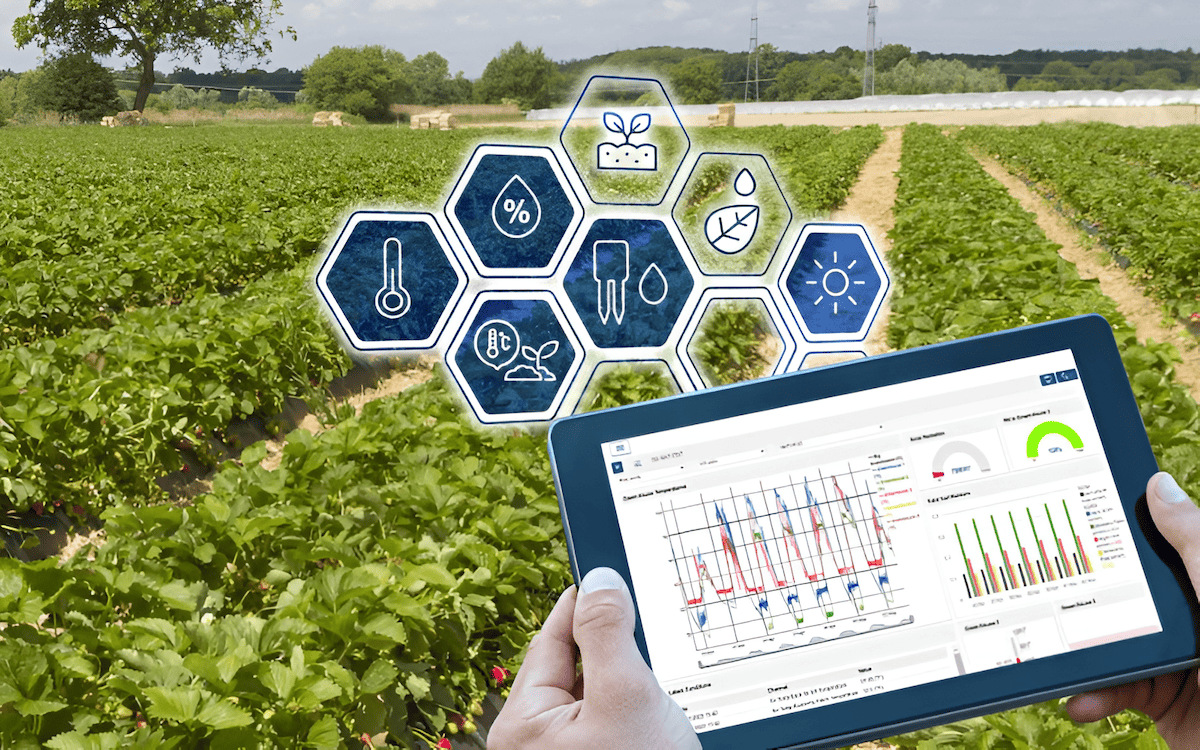
At their core, farm sensor networks are distributed systems of connected devices placed across fields, orchards, greenhouses, and livestock operations. These sensors continuously monitor soil, crop, water, and climate conditions, transmitting data to centralized dashboards or AI platforms for analysis. Instead of reacting to problems after they appear, farmers can anticipate stress, optimize inputs, and reduce waste before damage occurs.
A farm sensor network typically includes multiple types of sensors communicating through wireless technologies such as LoRaWAN, cellular LTE, satellite, or mesh networks. These sensors may monitor:
Data is transmitted in real time or at programmed intervals, allowing farmers to visualize trends and receive alerts when thresholds are crossed. Integrated with AI analytics, these networks transform raw measurements into actionable insights.
The result is precision agriculture based on evidence, not guesswork.
Traditional farming often relies on averages—average rainfall, average soil type, average nutrient recommendations. But fields are not uniform. Microclimates, soil variations, drainage differences, and crop density create invisible variability across even small parcels of land.
Farm sensor networks reveal that variability.
When moisture sensors detect dry zones in one section of a field, irrigation can be targeted precisely. When leaf wetness sensors indicate disease risk, preventative action can be timed correctly. When nutrient sensors show depletion patterns, fertilization can be micro-dosed rather than broadcast.
This precision reduces input costs, protects soil biology, and improves long-term field resilience.
High-value specialty crops often lead adoption of sensor networks because margins justify investment. In California vineyards, distributed microclimate sensors monitor:
By analyzing microclimate data, vineyard managers can activate frost protection systems only when needed, reducing energy use. Irrigation is adjusted block-by-block based on soil moisture readings rather than calendar schedules.
The outcome: reduced water usage, improved grape quality, and lower disease pressure.
In regions facing water scarcity, sensor networks help transform irrigation from routine scheduling into precision hydration.
Large-scale grain operations are increasingly deploying sensor arrays across broad acreage. In Midwestern corn and soybean systems, soil moisture probes placed at multiple depths provide continuous readings throughout the growing season.
These networks allow farmers to:
Rather than applying uniform inputs across thousands of acres, farmers can tailor management strategies to field-specific data.
In drought years, this data becomes critical. Sensor networks allow growers to conserve water while protecting yield potential.
In controlled-environment agriculture, farm sensor networks are even more tightly integrated. European greenhouse systems deploy dense arrays of climate and substrate sensors to monitor:
AI-driven platforms use this sensor data to automatically adjust ventilation, shading, irrigation, and nutrient delivery in real time.
The result is hyper-efficient resource use. Water recycling rates increase. Fertilizer runoff is minimized. Crop growth becomes predictable and consistent.
Greenhouse sensor networks demonstrate what fully integrated precision agriculture looks like at scale.
A functional sensor network typically includes:
Physical devices placed at strategic points throughout the farm. Placement strategy is critical—too few sensors reduces accuracy; too many increases cost without added value.
Wireless transmission systems that connect sensors to gateways. Low-power wide-area networks (LPWAN) are increasingly popular due to range and efficiency.
Cloud-based dashboards collect and store incoming data. Visualization tools allow farmers to monitor trends over time.
Advanced systems use machine learning to detect patterns, forecast risks, and generate predictive alerts.
When integrated with autonomous equipment, sensor networks become even more powerful. For example, soil moisture data can automatically trigger variable-rate irrigation or robotic nutrient application.
Farm sensor networks support regenerative agriculture by:
Economically, they improve efficiency by lowering input costs and reducing crop loss risk.
Rather than responding to visible stress symptoms, farmers intervene earlier—often preventing yield damage before it becomes measurable.
Despite their benefits, farm sensor networks require thoughtful implementation.
However, sensor costs continue to decline as adoption increases. Battery life is improving. Solar-powered sensor nodes reduce maintenance burdens. Satellite connectivity is expanding into remote agricultural zones.
The trajectory is clear: sensor networks are becoming foundational infrastructure rather than experimental tools.
As artificial intelligence, autonomous robotics, and climate variability converge, farm sensor networks will serve as the backbone of intelligent agriculture.
Future developments may include:
Farm sensor networks transform agriculture from reactive management into predictive stewardship.
In a world facing water scarcity, soil degradation, and climate uncertainty, data is not a luxury—it is resilience.
The farms that build digital awareness into their fields today are building long-term ecological and economic stability for tomorrow.
Improvement range with sensor-guided scheduling
Reduced losses via data-driven application timing
Typical payback window (crop + system dependent)
Annual growth trend in connected farm tech
Note: Replace ranges with your preferred benchmarks if you have project-specific data.