Raspberries are one of the most adaptable berry crops for home gardens, market farms, and diversified planting systems. From classic red raspberries to black, purple, and golden types, each group offers distinct harvest timing, flavor profiles, growth habits, and climate preferences. Understanding the difference between summer‑bearing (floricane) and fall‑bearing or everbearing (primocane) raspberries is essential for planning labor, pruning, and seasonal yield.
This guide breaks down raspberry varieties by color, fruiting habit, and climate performance so you can match the right plants to your goals—whether that’s a single concentrated harvest for preserving, extended fall production, container growing, or integration into a Crop Circle or spiral garden layout.
Use this checklist to choose the right raspberry type fast—then confirm with climate fit and pruning strategy.
| Type | Fruits on | Best for | Pruning approach |
|---|---|---|---|
| Summer-bearing (Floricane) | Second-year canes | One big harvest window; preserving; peak-season sales | Remove spent canes after harvest; tie new canes to trellis |
| Fall-bearing (Primocane) | First-year canes (late summer–fall) | Extended season; simpler management; shoulder-season pricing | Single crop: mow to ground in winter; two crops: keep canes for spring fruiting |
Black raspberries, also known as blackcaps, are less common but cherished for their unique, robust flavor and high antioxidant content. Varieties like Bristol, Jewel, and Cumberland are celebrated for their glossy black berries that bring a distinctive twist to any fruit salad or dessert much like black strawberries do.
Venturing into the realm of the unique and unusual, purple raspberries are hybrid varieties, the result of crossing red and black raspberries. These berries are large, firm, and have a unique flavor profile. Cultivars such as Brandywine and Royalty are just a few examples, delivering large, deep purple berries with a subtly sweet yet tart flavor.
Yet another entrant in the colorful ensemble of raspberries is the yellow or golden raspberry. Varieties such as Fall Gold and Anne offer beautiful, sweet, gold-colored berries that are milder in flavor compared to their red counterparts. These berries add a pop of color and a unique taste to the palette.
Within these color categories, raspberries are further classified into summer-bearing and everbearing types, depending on their fruiting habits.
Summer-bearing raspberries, or "floricane" raspberries, like the Canby or Tulameen, produce one large crop typically in the summer.
Everbearing or fall-bearing raspberries, also known as "primocane" raspberries, such as Heritage or Autumn Bliss, produce two crops - one in summer and another in the fall, extending the harvest period.
Regardless of the type or variety, raspberries offer delightful flavors, stunning colors, and a bounty of health benefits that make them a prized addition to any garden.
Use these tools to estimate yield per plant, plan berry rows/beds, and model harvest totals over time.
Estimate yield per crop or planting unit.
Plan rows, spacing and total harvest.
Tip: Airflow and cane spacing improve berry size and reduce mildew pressure.
Red raspberry canes are biennial, meaning they have a two-year life cycle, growing vegetatively in the first year and fruiting in the second. Characterized by a distinctive reddish-brown color, they feature compound leaves with serrated edges, thorns along the length of the cane, and white to light pink flowers that mature into the well-known red raspberry fruit. Here are a few varieties:
Heritage: An everbearing variety that produces crops in both the summer and fall. It's a popular variety known for its flavor and good disease resistance.
Autumn Bliss: A late-season, everbearing variety that is resistant to many common raspberry diseases and provides a high yield of firm, flavorful berries.
Amity: Known for producing large, firm berries, this fall-bearing variety offers a high yield.
Canby: This summer-bearing variety produces sweet, large fruits and is appreciated for its nearly thornless canes.
Cascade Delight: A summer-bearing variety that yields large, firm berries and exhibits good resistance to root rot.
Tulameen: A late-season variety that produces large, flavorful berries. It's highly regarded for its disease resistance and heat tolerance.
Latham: Known for its hardiness and reliability, Latham produces medium to large berries with a sweet flavor. It's an excellent choice for colder climates.
Killarney: This variety is a cold-hardy summer bearer that produces bright red, firm, and flavorful berries.
Glen Ample: Known for its large, firm, and highly flavorful fruits, this summer-bearing variety offers high yields.
Malling Admiral: A UK variety, Malling Admiral is resistant to several raspberry diseases and produces medium-sized fruits.
Black raspberries, also known as blackcaps, are less common than red raspberries but are known for their unique flavor and high antioxidant content. Here are some varieties of black raspberries:
Bristol: Known for its high yield and good disease resistance, Bristol produces medium to large, glossy black berries with a sweet flavor.
Blackhawk: A variety that produces firm, sweet berries. The Blackhawk is known for its productivity and cold hardiness.
Cumberland: Known for its large, sweet, and firm berries, this variety is a good choice for both fresh eating and processing.
Jewel: This variety produces large, sweet berries that are excellent for fresh eating, freezing, or making into jams and jellies. Jewel is known for its disease resistance and cold hardiness.
Mac Black: A late-season variety that produces firm, glossy berries with a sweet flavor. Mac Black is prized for extending the black raspberry season.
Munger: Munger is an old variety known for its large, firm, sweet berries. It's a reliable producer, but it's more susceptible to disease than some other varieties.
Allen: This variety is appreciated for its yield and firmness of the berries. Allen is also known for its resistance to diseases like anthracnose.
Glencoe Purple: Technically a purple raspberry, Glencoe Purple is a hybrid of red and black raspberries and produces sweet, flavorful berries.
Purple raspberries are hybrids between red and black raspberries. They are known for their large, firm fruits and unique flavor. Here are some varieties of purple raspberries:
Brandywine: A late-season variety that produces tart, large, deep purple berries. The berries are excellent for jams, jellies, and pies.
Royalty: The most widely grown purple raspberry variety, Royalty produces large, sweet berries that can be harvested in the summer and are excellent for fresh eating when fully ripe or making into jams and jellies.
Glencoe (Purple Thornless): This variety is known for its compact growth habit and thornless canes, making it an excellent choice for small gardens or container growing. It produces medium-sized, sweet, purple berries.
Success: An older variety, Success offers a small harvest in early summer and a larger one in late summer to fall. It's known for its sweet-tart flavor.
Yellow or golden raspberries are known for their unique color and typically sweeter, milder flavor compared to red raspberries. Here are some varieties:
Fall Gold: This is an everbearing variety known for its sweet, gold-colored berries that can be harvested in the summer and fall.
Anne: Often considered one of the best-tasting yellow raspberries, Anne produces large, sweet berries and is an everbearing variety.
Golden Harvest: A summer-bearing variety that produces a large yield of bright, gold-colored berries.
Honey Queen: This variety is known for its honey-sweet flavor. It's a yellow raspberry variety that is hardy and resistant to common diseases.
Goldie: A very early-bearing variety that produces large, yellow, sweet berries. Goldie is an everbearing variety and continues to produce until the first frost.
Kiwi Gold: This variety is a hybrid of red and yellow raspberries. Kiwi Gold produces large, flavorful, yellow-gold berries.
Double Gold: A recent variety from Cornell University, Double Gold has a deep blush, champagne, or peach color and a very sweet flavor.
Summer-bearing raspberries, also known as "floricane" raspberries, produce one large crop of fruit typically in the summer. Here are some varieties of summer-bearing raspberries:
Canby: A thornless variety known for its large, sweet, and firm red berries. It's a very hardy and disease-resistant variety.
Cascade Delight: This variety is highly resistant to root rot and produces large, firm red berries.
Latham: Known for its hardiness and reliable fruit production, Latham produces medium to large red berries with a sweet flavor.
Killarney: This variety is a cold-hardy summer bearer that produces bright red, firm, and flavorful berries.
Tulameen: A late-season variety known for its large, firm, and sweet berries. It does well in hotter climates and has good disease resistance.
Meeker: A popular variety that produces sweet, dark red fruit. It's particularly noted for its resistance to fruit rot diseases.
Boyne: This variety is known for its excellent cold hardiness and disease resistance. It produces medium-sized, dark red, flavorful berries.
Nova: An adaptable variety, Nova produces bright red, firm, and flavorful berries. It's noted for its heat and cold tolerance, and resistance to several common raspberry diseases.
Everbearing or fall-bearing raspberries, also known as "primocane" raspberries, can produce two crops per year: one in the summer on the previous year's growth and one in the fall on the current year's growth. Here are some everbearing raspberry varieties:
Heritage: This variety is very popular due to its reliable productivity and disease resistance. It produces medium-sized, firm, flavorful red berries.
Autumn Bliss: Known for its early fall harvest, Autumn Bliss provides a high yield of firm, flavorful berries and is resistant to many common raspberry diseases.
Amity: A variety that produces large, firm red berries in late summer to fall. Amity is known for its winter hardiness.
Fall Gold: A yellow raspberry variety that is appreciated for its sweet, gold-colored berries and its two harvest seasons.
Caroline: Producing sweeter, larger berries than many other varieties, Caroline is highly productive and resistant to several diseases.
Joan J: An everbearing variety that offers large, firm, and flavorful fruit. It is also thornless, making harvesting easier and more enjoyable.
Anne: A yellow raspberry variety that is often considered one of the best-tasting raspberries. Anne produces large, sweet berries and is an everbearing variety.
Jaclyn: Known for its high yield and large, firm berries, this variety produces a summer and fall crop.
Polana: This variety is appreciated for its early harvest in the season, producing large, firm, and flavorful red berries.
Turn your 1 acre into a high-yield, profitable farm.
Crop Circle Farms specializes in designing and building fully engineered, low-impact farm systems that use 90% less water, 85% less fertilizer, and deliver two to three times the yield of traditional farming.
Whether you have a vacant lot, an empty field, a resort, school, island community, or small family farm, we’ll build it from the ground up for you. Our team handles everything from farm layout and installation to irrigation, root systems, training, and first planting.
Contact Us to explore a custom Crop Circle Farm design for your property.
Help us expand our mission to revolutionize agriculture globally. We are seeking partners to implement Crop Circle Farms to feed people in need. Together, we can build scalable food production systems that save water, reduce costs, and feed thousands of people. Contact Growing To Give
Compare berry varieties, plan spacing, and estimate harvest totals using the guides and calculators below. These links help you move from “which variety?” to “how many plants?” and “how much harvest?” Start here: Berry Varieties Hub.
June-bearing vs everbearing vs day-neutral + selection tips.
American vs European vs hybrids + climate fit.
Highbush vs rabbiteye + soil pH and pollination.
Thornless, trailing, primocane types + trellis notes.
Red/white/black/pink currants + selection guide.
Estimate yield per plant and scale up.
Plan rows/beds and forecast total harvest.
Tip: Harvest estimates improve when you track spacing, plant age, and variety type (early/mid/late).
Raspberries come in four main color groups: red, black, purple, and yellow (or golden). Red raspberries are the classic garden berry and include popular varieties like Heritage, Autumn Bliss, Canby, Cascade Delight, Tulameen, and Latham. Black raspberries (blackcaps) such as Bristol, Jewel, Cumberland, and Mac Black offer rich flavor and high antioxidant levels. Purple raspberries like Brandywine and Royalty are hybrids of red and black raspberries, while yellow or golden raspberries—Fall Gold, Anne, Golden Harvest, Honey Queen, Goldie, Kiwi Gold, and Double Gold—provide very sweet, mild-flavored fruit.
Summer-bearing (floricane) raspberries fruit once per year on second-year canes, usually in early to mid-summer. Examples include Canby, Cascade Delight, Latham, Killarney, Tulameen, Meeker, Boyne, and Nova. Everbearing or fall-bearing (primocane) raspberries can give two crops—one lighter crop in summer on last year’s canes and a heavier crop in late summer to fall on current-year canes. Heritage, Autumn Bliss, Amity, Fall Gold, Caroline, Joan J, Anne, Jaclyn, and Polana are common primocane types.
For colder regions, choose varieties noted for winter hardiness and disease resistance. Red raspberries such as Latham, Killarney, Boyne, and Nova are well-known for tolerating cold winters while still producing reliable crops. Many black raspberries—like Bristol, Jewel, and Blackhawk—also offer good cold hardiness when planted in well-drained soil and protected from extreme wind exposure.
In warmer climates or sites with hot summers, varieties like Tulameen and Nova handle heat better than many older cultivars. Fall-bearing raspberries such as Heritage, Autumn Bliss, Caroline, and Polana can perform especially well when given mulch, consistent moisture, and light afternoon shade, producing high-quality berries from late summer into fall even where summers are hot.
Yes. Some red raspberries like Canby are nearly thornless, which makes pruning and harvest more comfortable. Among purple raspberries, Glencoe (often sold as Purple Thornless) provides compact growth and thornless canes, making it a great option for smaller gardens and high-traffic picking areas.
Large, firm, sweet berries from red cultivars such as Tulameen, Glen Ample, Heritage, Amity, and Nova are excellent for fresh eating, baking, or freezing. Tart, intensely flavored varieties like Brandywine and many black raspberries (Bristol, Jewel, Cumberland) shine in jams, jellies, sauces, and desserts. Yellow raspberries like Anne, Fall Gold, and Double Gold are exceptionally sweet and mild, ideal for fresh snacking or mixed-berry desserts, especially when paired with other berries like strawberries or blueberries.
Black raspberries (blackcaps) such as Bristol, Jewel, Cumberland, and Mac Black have a deep, winey, almost wild flavor and very high antioxidant content. Purple raspberries like Brandywine and Royalty combine traits of red and black raspberries, yielding large berries with a complex, sweet-tart flavor that works well for preserves. Yellow raspberries—Fall Gold, Anne, Golden Harvest, Honey Queen, Goldie, Kiwi Gold, and Double Gold—are typically milder and very sweet, with less acidity than most reds.
If you prefer a single concentrated harvest window, plant summer-bearing (floricane) types. Canby, Cascade Delight, Tulameen, Meeker, Boyne, Killarney, Latham, and Nova are all strong choices, offering one large early- to mid-summer crop that’s easy to plan around for freezing, canning, or farm-stand sales.
For extended picking through late summer and fall, focus on everbearing/primocane raspberries. Heritage, Autumn Bliss, Amity, Caroline, Joan J, Jaclyn, Polana, Fall Gold, and Anne can provide fruit over many weeks. In many climates, you can prune primocanes to the ground each winter and enjoy a large, simplified fall crop with minimal pruning complexity.
Yes. Compact or thornless varieties like Glencoe Purple and Canby work particularly well in tight spaces and large containers. Choose a sunny site with well-drained soil or a high-quality potting mix, add sturdy stakes or a short trellis for support, and maintain regular watering. For mixed berry plantings, pair raspberries with other cane fruit, or plant them near strawberry varieties for a long season of fresh berries from early summer through fall.
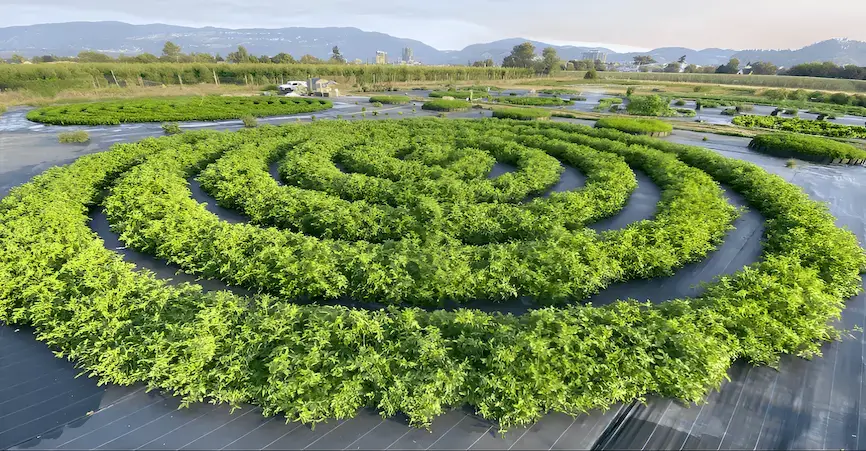
In a Crop Circle or spiral layout, raspberries are often placed on outer or leeward arcs so they don’t shade lower crops. Running raspberries along curved trellis lines creates efficient harvesting lanes and keeps canes supported and well-aerated. Drip irrigation and deep mulch around the root zone help stabilize moisture, limit weeds, and improve overall berry size and quality while integrating raspberries into a diverse, high-yield garden system.