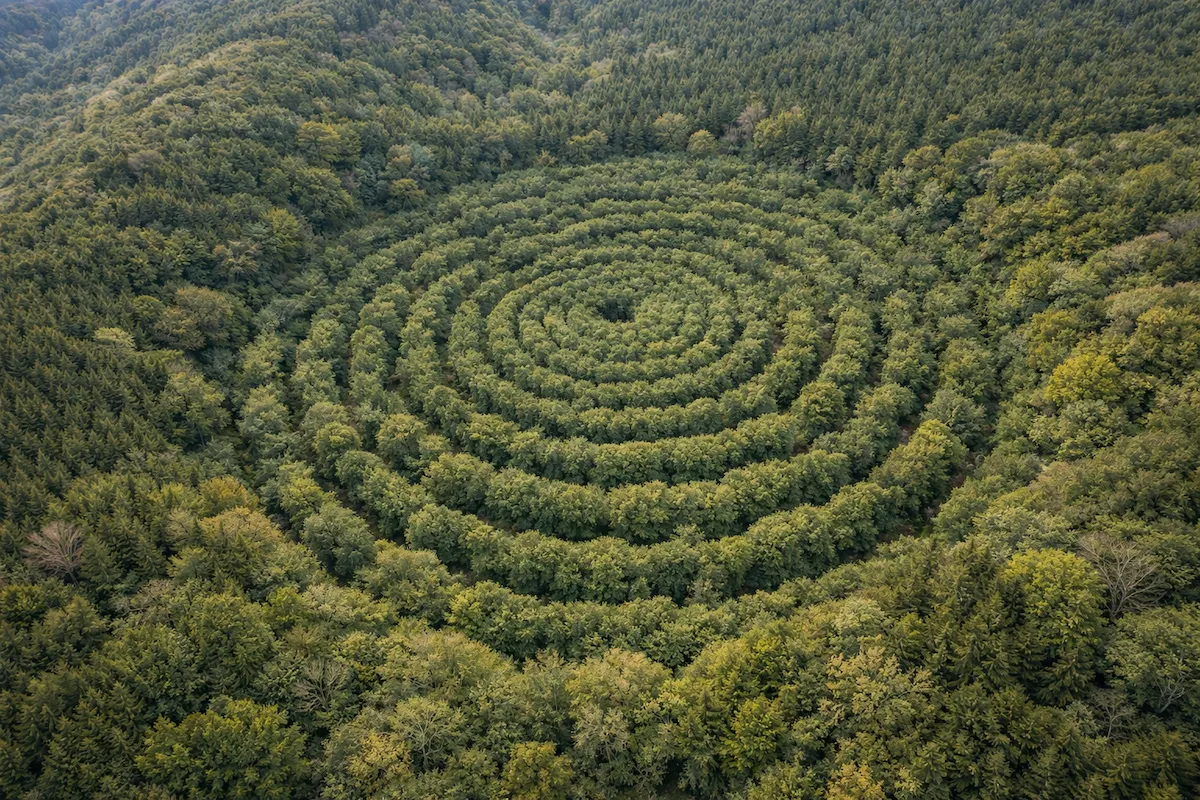
Crop Circle Tree Farms
Regenerative Tree Plantations That Build Ecosystems
Climate change, degraded soils, and biodiversity loss are reshaping the future of forestry. Conventional monoculture plantations are increasingly vulnerable to pests, drought, and market volatility. At Crop Circle Farms, we design regenerative tree plantations that grow trees 10–20% faster through spiral layouts, mixed-species forestry, and water-smart, root-first establishment—creating resilient timber, carbon, and restoration outcomes.
Explore the connected systems that support whole-landscape performance: Circular Agriculture · Agroforestry · Sustainable Agriculture · Reforestation · Afforestation · Silvopasture · Carbon Farming
Many commercial plantations use straight, parallel rows and a limited number of species because these layouts simplify planting, management, and harvesting. Crop Circle Tree Plantations® explore spiral geometry and mixed-species forestry as alternative design tools intended to improve spatial distribution, diversify the stand, and make better use of available light, water, and growing space.
Most commercial tree plantations are planted in straight, parallel rows with one primary species. While mechanically simple, these designs often increase pest exposure, create uneven light competition, and deliver fewer ecosystem services. Crop Circle Tree Plantations replace straight lines with spiral geometry and mixed-species forestry to improve sun distribution, airflow, and root development.
| Feature | Traditional Row Plantation | Crop Circle Tree Plantation® |
|---|---|---|
| Layout | Straight monoculture rows | Spiral, flowing patterns |
| Species Diversity | Single species | 2–3 compatible species |
| Pest & Disease Risk | Higher (uniform host) | Reduced (diversified stand) |
| Light Distribution | Uneven, self-shading | Optimized sun exposure |
| Airflow | Restricted | Improved circulation |
| Water Strategy | Often broadcast watering | Targeted deep-root irrigation |
| Biodiversity | Low | High (layered canopy) |
| Growth Rate | Baseline | 10–20% faster on comparable sites |
Spiral layouts reduce crown competition and self-shading, improve early-season sunlight capture, and increase airflow to reduce fungal pressure. The result is better crown development and diameter growth, especially during spring and early summer.
Crop Circle Tree Plantations® commonly use two or three companion species selected for compatible growth, shade tolerance, and soil-building traits. Examples include:
Water-smart irrigation focuses on deep, targeted watering at the drip line—encouraging strong root systems while reducing waste. Combined with mulching and climate-aware scheduling, this approach is especially effective in dryland, coastal, and island climates.
Regenerative plantations deliver more than timber. They improve soil structure, support pollinators and wildlife, protect waterways, moderate microclimates, and strengthen land resilience—while storing carbon in wood and soil organic matter.
Ready to explore a productive, climate-responsive tree plantation? We design low-impact, water-conscious plantation systems tailored to climate, soils, species, land-use objectives, and market goals.
Contact Crop Circle Farms to explore a custom plantation design.
Support scalable regenerative forestry projects designed for measurable climate and community outcomes—timber, carbon, restoration, and long-term stewardship. Explore investment-aligned projects .
We collaborate with landowners, foundations, ESG teams, and mission-aligned partners to implement regenerative forestry solutions in regions facing deforestation, food insecurity, and climate stress. Sponsor a pilot, fund trees and infrastructure, or partner on a landscape-scale implementation.
These frequently asked questions cover regenerative tree plantations, spiral planting layouts, mixed-species forestry, tree growth, irrigation, carbon storage, timber production, biodiversity, and plantation planning.
A regenerative tree plantation is designed to produce trees while also supporting soil health, biodiversity, water management, carbon storage, and long-term land resilience. Regenerative designs may combine multiple tree species, soil-building practices, targeted irrigation, habitat features, and planting layouts adapted to the site.
A Crop Circle Tree Plantation® uses spiral or flowing planting geometry rather than relying exclusively on conventional parallel rows. The design can also incorporate mixed-species forestry, water-smart establishment, agroforestry, restoration, and other regenerative land-management strategies.
Layouts are adapted to tree species, land area, topography, climate, soil, equipment access, and the intended purpose of the plantation.
Tree growth is influenced by species, genetics, soil, available water, climate, spacing, competition, sunlight, fertility, and management. Spiral layouts are intended to distribute trees differently across the available growing area and may improve spatial use, crown spacing, light interception, and airflow under suitable conditions.
Any growth advantage is site-specific and should not be treated as a guaranteed percentage for every plantation.
Mixed-species plantations can provide greater structural and biological diversity than a single-species planting. Compatible species may occupy different canopy positions, rooting zones, or ecological niches while creating a more diverse habitat.
Species combinations should be selected carefully because differences in growth rate, shade tolerance, water demand, mature size, and harvest objectives can affect long-term performance.
Species selection should consider climate, winter and summer temperatures, rainfall, soil type, drainage, elevation, available irrigation, pest and disease risks, expected mature size, growth rate, and the purpose of the planting.
Timber production, wildlife habitat, restoration, wind protection, carbon storage, agroforestry, and landscape resilience may each require different species combinations.
Tree spacing depends on species, mature crown size, management objectives, equipment access, expected thinning, water availability, and whether other crops or livestock will share the site.
Dense spacing can increase early competition and may require thinning, while wider spacing provides individual trees with more growing space. Plantation design should be based on the intended long-term management system rather than one universal spacing.
Water-smart establishment focuses irrigation where young trees can use it effectively while encouraging development of a healthy root system. Strategies can include targeted drip irrigation, deep watering, mulching, soil-moisture monitoring, appropriate planting times, and irrigation schedules adjusted for weather and soil conditions.
Water requirements vary significantly by tree species, climate, soil, tree age, and rainfall.
Yes. Growing trees store carbon in trunks, branches, roots, and other biomass, while well-managed soils can also contain substantial organic carbon.
The amount stored depends on species, growth rate, stand density, climate, soil, mortality, harvesting practices, and what happens to the wood after harvest. Carbon-storage estimates therefore need to be calculated for the specific project.
Yes. Regenerative forestry and commercial timber production are not mutually exclusive. A plantation can be designed around timber species while also incorporating species diversity, soil protection, water management, habitat, selective thinning, and long-term stewardship.
Financial performance depends on land cost, establishment costs, species, growth rates, rotation length, management, harvesting, timber markets, and transportation.
Yes. Tree systems can be integrated with crops through agroforestry or with managed livestock through silvopasture .
Successful integration requires planning for sunlight, tree protection, livestock pressure, root competition, water, equipment access, and the needs of each agricultural enterprise.
They can, but the design must be adapted to local conditions. Species selection, planting season, irrigation, wind exposure, salt exposure, rainfall patterns, soil depth, drainage, and drought risk are especially important in challenging climates.
Water availability should be evaluated before plantation size and planting density are finalized.
Start with climate, soils, water availability, topography, existing vegetation, land-use restrictions, wildfire risk, species suitability, access roads, equipment requirements, labor, establishment costs, maintenance, expected markets, and the intended purpose of the plantation.
A practical plan should also consider tree survival, replacement planting, thinning, harvesting, long-term management, and whether the project is primarily intended for timber, restoration, carbon, agroforestry, habitat, or a combination of objectives.