Crop Circle Farms
Changing the Shape of Agriculture
Patented and trademarked in more than 40 countries, Crop Circles ® is a resource-efficient, high-yield agricultural technology developed through years of field testing. Crop Circle Farms systems have demonstrated substantial reductions in water and land requirements together with significant increases in crop production across multiple crops and growing conditions.
Crop Circle Farms are intentionally designed food-production systems that use circular, concentric, and spiral planting patterns to make efficient use of available growing space. By integrating reduced soil disturbance, targeted root-zone management, and water-efficient irrigation, the system is designed to support productive agriculture in a range of site and climate conditions.
These approaches can contribute to broader efforts addressing the global food crisis by improving resource efficiency, local food production, and adaptability where land or water is limited.
Model farm production, compare growing layouts, estimate food-security impact, or explore the complete Crop Circle Farms resource library.
Estimate how farm and garden production can translate into people fed and community food-security impact.
Calculate Food Impact →Model crop production, planting density, revenue potential, input assumptions, and yield per acre.
Calculate Farm Yield →Compare conventional row planting with spiral layouts using side-by-side acreage and yield assumptions.
Compare Farm Layouts →Explore calculators, planning tools, growing guides, climate resources, food-security information, and farm-design content.
Explore All Resources →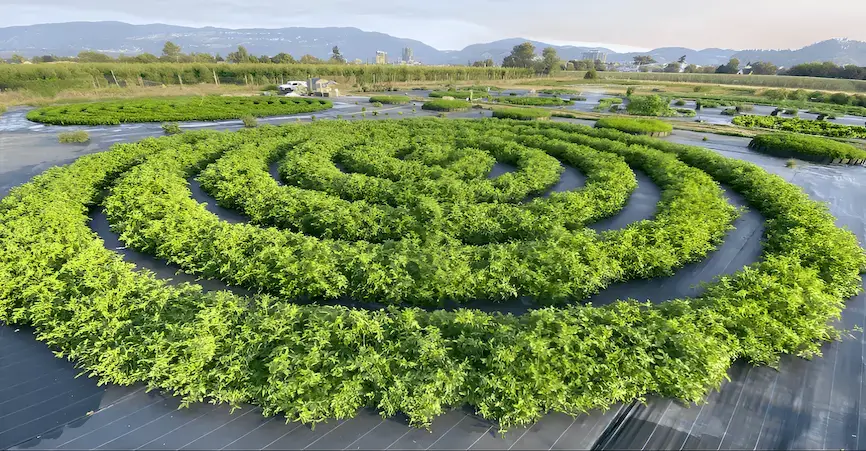
Farming Small City Spaces: City land is a premium resource that is identified by the square foot rather than acres. Small city spaces are not suitable for open field farming due to production limitations - tractor pull agriculture is virtually impossible – and the high capital costs of hydroponic operations are prohibitive, so one way to grow produce profitably is to utilize Crop Circle Farming systems.
Island Agriculture: There are thousands of islands dotted around the world’s oceans most of which are uninhabited. Those that are not struggle with food security. Dependence on imported food has prompted many governments to explore ways to develop island agriculture; ways that are sustainable, environmentally friendly, provide employment and create food security for the islands and their people. Crop Circle Farms provides agricultural technologies suitable for small land holder farming that adapt to the natural environment in a sustainable, productive, and cost-effective way.
Arid and Semi-Arid Regions: Growing food in desert environments is challenging due to water scarcity, extreme temperatures, nutrient-poor soils, salinity, and limited biodiversity. However, targeted agricultural features of the Crop Circle Farm system mitigates most these challenges by utilizing grow-in-place, water-smart cavitated spaces. Perfect for food deserts.
Land Reclamation: Growing food on contaminated land can be achieved by placing a Crop Circle Farm on top of large-span, shallow-depth raised platforms that create a sealed barrier between the contaminated soil below and food-grade soil above. This design ensures the crops are grown in a safe, uncontaminated environment. A ground cover is placed over the food-grade soil to prevent weed growth, retain moisture, and act as a heat sink, which accelerates plant growth by maintaining consistent warmth. This innovative system not only rehabilitates unusable land but also supports efficient, sustainable food production in areas with otherwise unsuitable growing conditions.
Refugee Camps and Displaced Communities: Small-scale food-production systems can supplement food access while providing opportunities for agricultural training and community participation where local conditions permit. Crop Circle Farms works with Growing To Give on food-security and community-growing initiatives.
Market Gardens: Nearly 50% of rural farmers worldwide grow food on less than an acre. Without economies of scale, smallholding farmers face significant challenges, struggling to survive or make a profit. Urban community gardens and farms face similar obstacles with restricted agricultural space. Many farms have disappeared due to urban development, leaving only small plots, often the size of a building lot, scattered throughout cities. Crop Circle Farms address these challenges by tripling production per foot in small agricultural settings, making previously unprofitable spaces very profitable for a market garden.
Food Safe: Sealed growing areas isolate crops from contaminants, while food-grade soils, clean water sources, and organic inputs provide a toxin-free environment. Ground covers prevent weed growth and cavitated fertilization vessels eliminate the need for chemical herbicides. Closed-loop irrigation systems ensure efficient water use and protect against contamination further guaranteeing a controlled and safe growing environment, making crop circle farms a reliable solution for producing high-quality, safe food.
Rooftop Agriculture: There’s a huge food growing opportunity high above everyone’s heads. With all but a few farm acres lost to development, the only space left to grow is high above the ground; on top of the roofs of cityscape high-rises. Crop Circle Farms proposes a transformative change to rooftop agriculture by colonizing city roofscapes with high-in-the-sky farms and gardens to create a building-by-building supply chain of nutritious, fresh produce for the cities of the world.
Crop Circle Farms designs resource-efficient growing systems tailored to site conditions, crops, water availability, production goals, and market needs. Services can include farm layout, irrigation planning, crop selection, production modeling, and integration of Crop Circle growing systems.
Contact Us to discuss a farm design for your property.
Through nonprofit and community partnerships, Crop Circle farming concepts can support food-production projects in food-insecure, island, urban, and water-stressed regions. Project scale, water use, production, and economic outcomes depend on location, crops, infrastructure, management, and local conditions.
Contact Growing To Give to explore an initiative or partnership.
A Crop Circle Farm is an intentionally designed food-production system that uses circular, concentric, or spiral planting patterns rather than relying exclusively on conventional straight-row layouts.
The design can integrate targeted irrigation, reduced soil disturbance, root-zone management, companion planting, raised growing areas, and other techniques selected for the crops, climate, soil, water availability, and production goals of a particular site.
The term crop circle can refer to several different types of geometric formations. Some well-known crop circles are human-made patterns created by flattening crops, while large agricultural circles can also be produced by center-pivot irrigation systems.
Crop Circle Farms use intentionally planned geometric layouts for agriculture, including circles and spiral patterns designed to organize crops, irrigation, access routes, and growing space.
The effect depends on what type of crop circle is being discussed. Flattening crops to create decorative field formations can bend or damage plants and reduce harvestable production.
In a Crop Circle Farm, plants are intentionally positioned within a designed growing system. Crop performance depends on factors such as plant spacing, sunlight, irrigation, soil conditions, fertility, crop variety, climate, pest pressure, and farm management.
Many crop-circle formations found in agricultural fields have been created by people. Large circular fields can also result from agricultural equipment such as center-pivot irrigation systems.
Crop Circle Farms are intentionally designed by growers. Their circular, concentric, and spiral layouts are planned as part of the farm's planting, irrigation, access, and crop-management system.
A geometric planting pattern does not by itself biologically transform a plant. In an agricultural system, however, layout can influence practical growing conditions such as plant spacing, access to sunlight, airflow, irrigation distribution, and ease of crop management.
Actual plant growth, flowering, fruit production, and yield depend on the crop, genetics, climate, soil or growing medium, water, nutrients, pest and disease pressure, spacing, and management practices.