
Growing Vegetables in Alaska
Long Summer Days, Cool Temperatures, Big Harvests
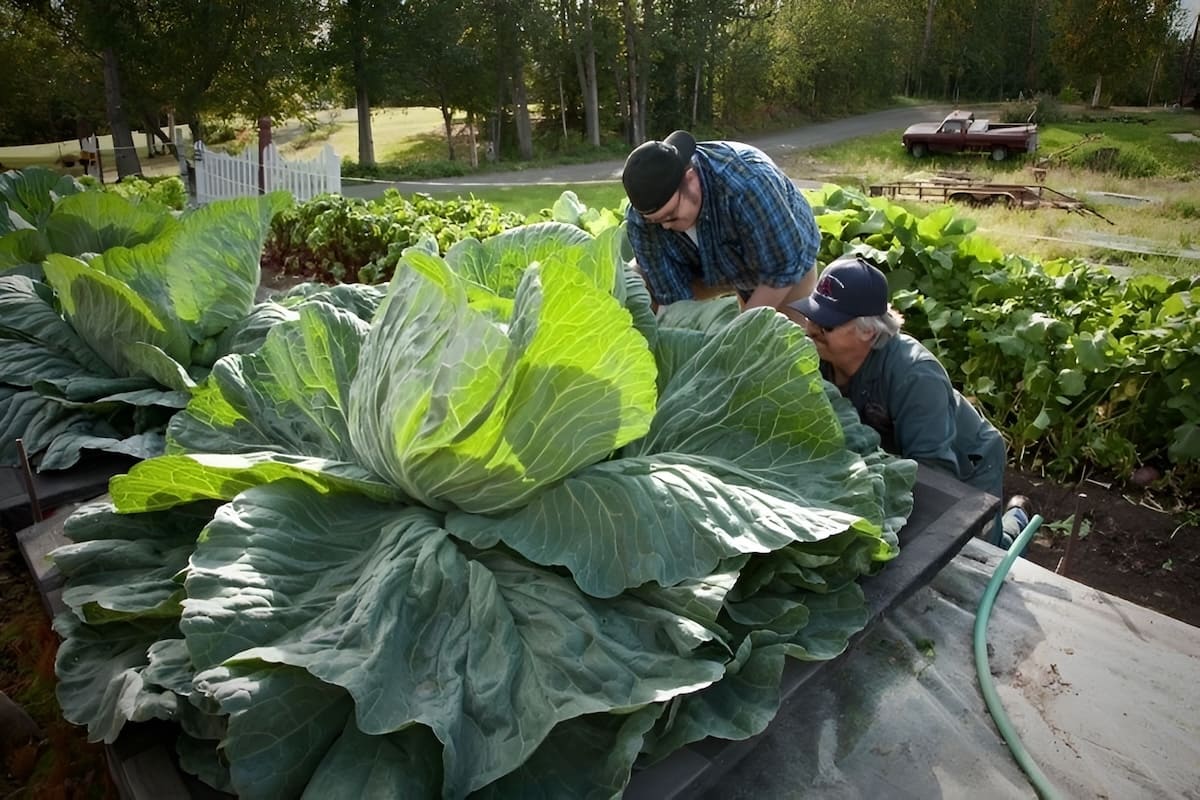
Alaska may have one of the shortest growing seasons in the United States — but it also produces some of the largest vegetables in the world. From 100-pound cabbages to record-breaking pumpkins, Alaska has become famous for giant produce competitions and backyard harvests that seem almost unreal.
The secret lies in light. During peak summer months, parts of Alaska receive up to 20–24 hours of daylight. While temperatures remain cool, the extended sunlight allows plants to photosynthesize nearly around the clock.
Instead of experiencing the stress of intense midday heat like southern states, Alaskan vegetables grow steadily and consistently under mild temperatures and constant light. The result? Massive biomass production.
Cool soils also slow plant respiration at night, meaning plants conserve energy rather than burning it off in heat stress. Long daylight + cool temperatures = steady, uninterrupted growth.
Although the frost-free growing season can be relatively short in many parts of Alaska, long summer days allow adapted crops to make rapid use of the available season. Growth response varies by species, variety, temperature, soil conditions, and daylength sensitivity.
Root crops and cool-season vegetables can perform exceptionally well under these conditions when growers select suitable varieties and provide adequate fertility, moisture, and soil preparation.
Now imagine combining Alaska’s 20-hour sunlight with Root Tube growing systems.
Root Tubes create vertical, aerated root zones that:
In Alaska’s extended light environment, enhanced root oxygenation could dramatically increase nutrient uptake efficiency. Carrots could grow denser and longer. Cabbages could layer more tightly. Potatoes could multiply more uniformly in vertical root channels.
It would be a fascinating agricultural experiment — pairing long sun cycles with engineered root performance.
Now take that one step further.
Imagine Alaska vegetables grown in a fully engineered Crop Circle system:
Under 20-hour daylight, a Crop Circle layout could create a controlled, high-efficiency growth pattern — maximizing photosynthesis while reducing wind stress.
It would be out of this world to witness the scale of biomass possible in that configuration.
Alaska’s long, cold winters also offer a major benefit: natural refrigeration. Root vegetables can be stored in cellars or cold ground for months without mechanical cooling.
This makes Alaska uniquely positioned for self-reliant, high-density seasonal production.
Alaska’s “giant vegetable” advantage is largely a sunlight advantage. Near the June solstice, daylight stretches far beyond what most of the Lower 48 experiences, giving plants many more hours to photosynthesize.
| Location | Longest-day daylight length | What it means for plants |
|---|---|---|
| Anchorage (Southcentral) | ~19 hours 21 minutes | Long daylight without extreme heat = steady growth and thick leaf mass. |
| Fairbanks (Interior) | Just under ~22 hours | Near-round-the-clock photosynthesis supports rapid biomass and huge roots. |
| Utqiagvik (Arctic Coast) | 24-hour daylight (midnight sun season) | Continuous light can push vegetative growth, especially in protected systems. |
Tip: Use NOAA’s sunrise/sunset calculator to generate a daylight table for your exact town and dates.
Growing vegetables in Alaska isn’t just possible — it can be extraordinary. Long summer sunlight, cool nights, and resilient growers combine to produce some of the largest vegetables on earth.
And when paired with modern Root Tube systems or Crop Circle design principles, the potential becomes even greater.
Alaska proves that agriculture isn’t just about season length — it’s about light, efficiency, and intelligent design.






Alaska's long summer days can give adapted crops many hours of usable light during the growing season. Cool summer temperatures can also favor crops such as cabbage, kale, carrots, potatoes and other cool-season vegetables. Exceptional size still depends on variety, soil, fertility, moisture, temperature, pest management and the skill of the grower.
Summer daylight varies greatly by latitude. Around the June solstice, Anchorage receives roughly 19 hours of daylight, Fairbanks approaches 22 hours, and communities north of the Arctic Circle can experience continuous daylight for part of the summer. Local sunrise and sunset times should be used when planning for a specific Alaska location.
Not necessarily. Plants respond to light intensity, temperature, genetics, water, nutrients and their own biological rhythms as well as day length. Long daylight can support rapid growth in suitable crops, but continuous daylight does not automatically produce larger plants or higher yields.
Many cool-season vegetables are well suited to Alaska, including cabbage, kale, lettuce, spinach, peas, radishes, turnips, beets, carrots and potatoes. Warm-season crops such as tomatoes, peppers, cucumbers and squash may also be grown successfully when growers choose suitable varieties and use protected growing or season-extension techniques where needed.
A short frost-free season does not necessarily mean slow summer growth. During the height of the season, long daylight can give adapted crops substantial time for photosynthesis. Fast-maturing varieties, healthy soil, adequate fertility, consistent moisture and good crop management help growers make effective use of that concentrated growing period.
Growers can extend the season with raised beds, cold frames, row covers, low tunnels, hoop houses and greenhouses. Starting transplants indoors can also give slower-growing crops a head start before outdoor conditions are suitable. The best approach depends on the crop, local frost dates, wind exposure and temperature.
No. Alaska covers an enormous geographic area with major differences in latitude, coastal influence, temperature, wind, precipitation, frost dates and summer daylight. Growing conditions in Anchorage, Fairbanks, Southeast Alaska and Arctic communities can be very different, so crop selection and planting schedules should be based on local conditions.
Many cool-season crops can be stored after harvest when they are handled correctly. Potatoes, carrots, beets and cabbage are commonly suited to cool storage, while other crops may be frozen, canned, dried or otherwise preserved. Storage temperature, humidity and preparation requirements differ by crop.
Root Tube systems could provide an interesting platform for testing vegetable production under Alaska's long summer daylight. Potential research could compare root-zone aeration, drainage, irrigation, temperature and crop performance with conventional growing methods. Results would need to be measured under Alaska conditions rather than assumed from performance in other climates.
Crop Circle Farm layouts could be adapted around local sunlight, wind, irrigation, season extension and crop requirements. Different rings or growing zones could be used for cool-season vegetables, protected crops, windbreaks or temporary covers. Actual performance would depend on the Alaska location, soil, crop selection, weather and farm-management system.